Fire exits are built for people who can walk. But in every building, some people cannot use the stairs on their own. When the lifts stop in a fire, they need a safe and tested way down.
An evacuation chair gives them that way. But a chair alone does not make a building safe. It must meet a proven standard, sit in the right place, and be used by trained staff.
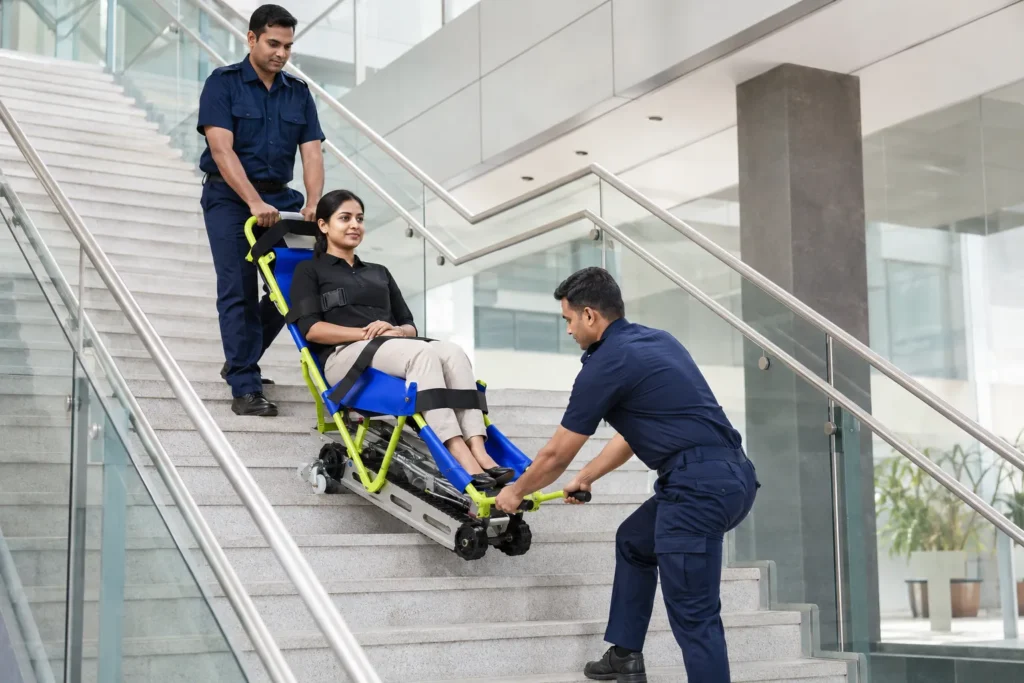
This guide explains, in simple words, the evacuation chair safety rules and standards that apply in India in 2026, and how your building can stay compliant.
What Are the Evacuation Chair Safety Standards in India?
Quick Answer: India has no single BIS standard just for evacuation chairs. Safety comes from three layers: (1) laws and codes such as the RPwD Act 2016, the National Building Construction Standards 2026 (which replaced NBC 2016) and state fire rules, which require safe escape for everyone; (2) product standards such as ISO 7176-28 and RESNA ED-1, which prove the chair has been tested; and (3) good practice, which means a written evacuation plan, trained operators, regular drills and a yearly service.
Key Takeaways
- Indian law expects buildings to protect people with disabilities in emergencies (RPwD Act 2016, Section 8).
- NBC 2016 was replaced by the National Building Construction Standards 2026 (SP 7:2026) on 30 April 2026. Fire safety is now in Part F.
- Ask for proof of testing to ISO 7176-28, RESNA ED-1 or CE marking before you buy.
- A chair is only safe with a plan: trained staff, drills and a yearly service.
Why Evacuation Chair Safety Standards Matter
In a fire, lifts are switched off or should not be used. Smoke fills corridors fast. Anyone who cannot walk down stairs is at serious risk unless someone has a tested way to move them.
Fire is still a big risk in India. NCRB data for 2024 shows 5,888 deaths from fire accidents, and about 60% of fire accidents happened in homes and residential buildings. In October 2025, a fire in the trauma ICU of SMS Hospital, Jaipur, killed patients who could not move on their own (All India Radio report).
Standards matter because an untested chair can tip, slip or run too fast on a stair. The person in the chair, and the operator, can both get hurt. A tested chair, used by a trained person, turns a dangerous carry into a controlled descent.
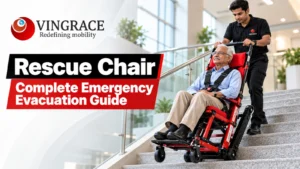
If you are new to these devices, start with our guide on what an evacuation chair is and why every building needs one.
Indian Laws and Codes That Apply to Evacuation
1. Rights of Persons with Disabilities Act, 2016
The RPwD Act 2016 is the main disability law in India. Two parts matter most:
- Section 8 (Protection and safety): persons with disabilities must get equal protection and safety in situations of risk, disasters and emergencies.
- Sections 40 to 46 (Accessibility): public buildings and services must be accessible.
In November 2024, the Supreme Court (Rajive Raturi vs Union of India) told the Centre to make firm, mandatory accessibility rules. In July 2026, the Court asked the government to take expert inputs so the final rules are strong and workable (Verdictum report). In short, accessibility rules are getting stricter, not looser.
2. National Building Construction Standards 2026 (earlier NBC 2016)
For years, Part 4 of the National Building Code 2016 set fire and life safety rules, including refuge areas in tall buildings. On 30 April 2026, the Bureau of Indian Standards replaced it with the National Building Construction Standards 2026 (SP 7:2026). Fire and life safety now sits in Part F.
What this means for you:
- NBCS 2026 becomes binding once your state or city adopts it into its bye-laws.
- Many local rules still refer to NBC 2016 during the changeover.
- Your fire NOC is still issued by the state fire service, based on local rules.
So the safe approach is simple: plan for assisted evacuation anyway, and check with your local fire authority which version they apply.
3. Harmonised Guidelines for Universal Accessibility (2021)
The Ministry of Housing and Urban Affairs published the Harmonised Guidelines and Standards for Universal Accessibility in India in 2021. They cover accessible routes, refuge spaces and emergency evacuation for people with disabilities. Architects and public bodies use them as the main design reference.
4. State fire service rules and sector rules
Each state has its own Fire Service Act and rules. Some sectors also have their own safety checks:
- Hospitals: the NABH 6th edition standards (January 2025) cover fire and non-fire emergency plans under Facility Management and Safety.
- Offices and factories: fire safety and emergency plans are checked under state factory and fire rules.
- Schools: school boards and state education departments ask for fire safety audits.
Read more about evacuation chair use in India and workplace accessibility rules in India.
Product Safety Standards for Evacuation Chairs
India does not yet have a dedicated BIS standard for evacuation chairs. So buyers rely on well-known international standards. Ask your supplier for test reports, not just brochures.
| Standard | What it covers | Why it matters to you |
|---|---|---|
| ISO 7176-28 | Test methods for stair-climbing devices | Shows the device was tested for stability, brakes and strength on stairs |
| RESNA ED-1 | Emergency stair travel devices used by people with disabilities | Written for evacuation devices, including load, speed and braking |
| CE marking (EU MDR) | Medical device safety in Europe | Many evacuation chairs are sold as Class I medical devices in Europe |
| ISO 9001 / ISO 13485 | Quality systems of the maker | Shows the factory follows a controlled process |
Safety features every compliant chair should have
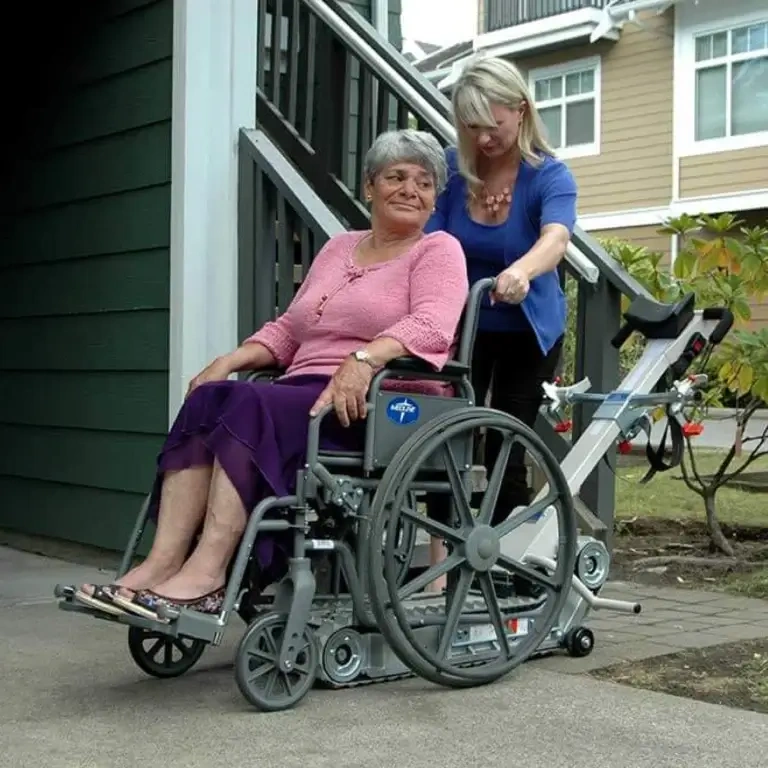
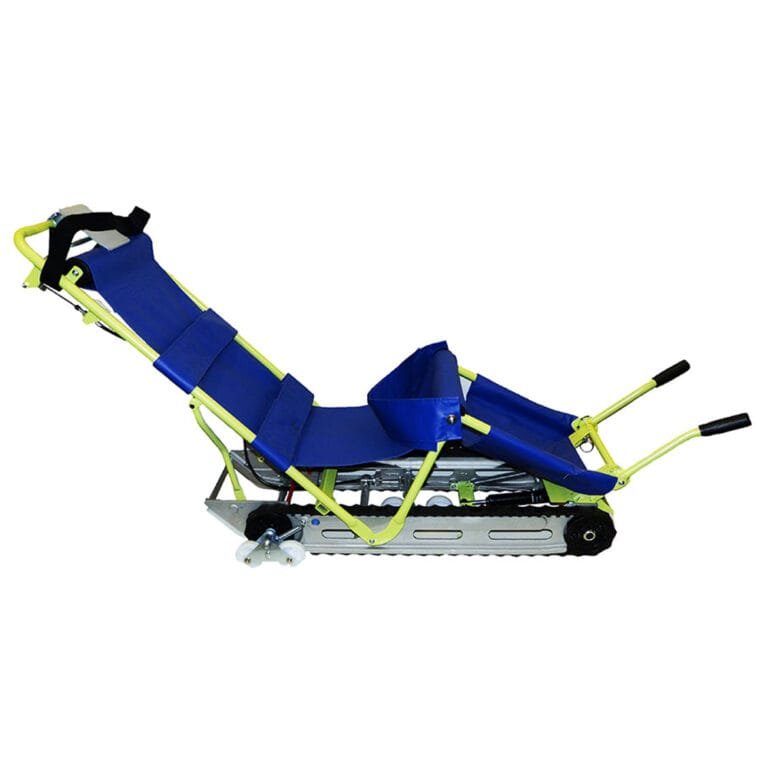
- Tested load rating: commonly 150 kg to 180 kg or more. Match it to the heaviest person you may need to move.
- Speed control and brakes: friction tracks or a brake that stops the chair the moment the operator lets go.
- Safety belts: at least a lap belt, and ideally chest straps and a head rest.
- Anti-tip design: a stable base on landings and a tested stair angle range.
- Clear instructions: printed on the chair and in a local language if possible.
Our guide on stair climbing wheelchair safety features explains these features in more detail.
How to Make Your Building Compliant: Step-by-Step
Step 1: Do a fire risk and evacuation assessment
Walk every stairwell. Note stair width, landing size, turns and where refuge areas are. Count people who may need help: staff, visitors, patients, residents and elderly people.
Step 2: Write a PEEP for each person who needs help
A Personal Emergency Evacuation Plan (PEEP) names the helpers, the route, the equipment and the waiting place. For visitors, write a general plan (GEEP). The UK government guide on means of escape for disabled people is a clear model to follow.
Step 3: Choose the right number and type of chairs
A good starting point is one chair per evacuation stairwell, near the top floor or refuge area. Add more for hospitals and busy buildings. If you also need to go up (for basements), choose a powered chair. Our guide on how to choose the right evacuation chair walks you through it.
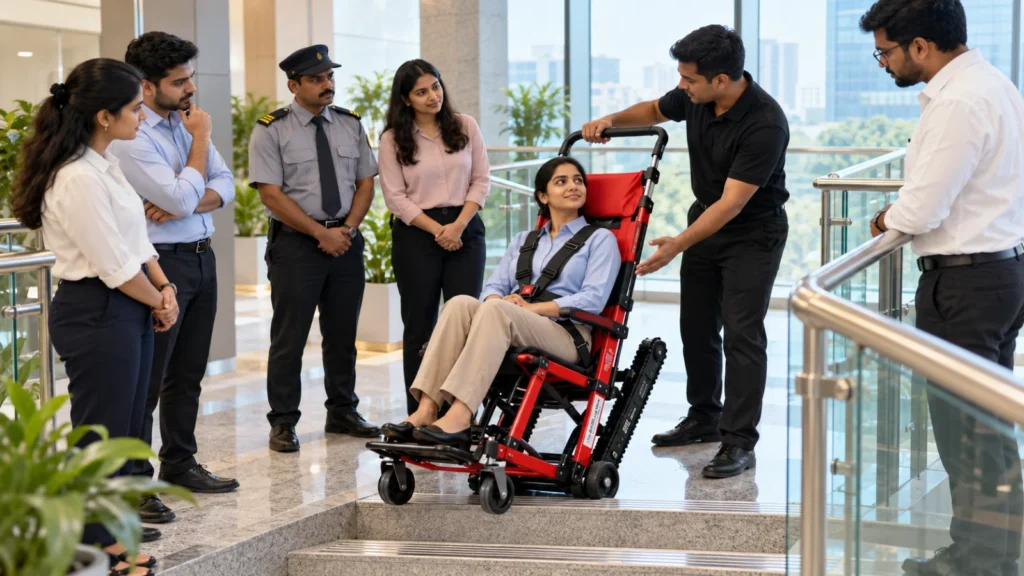
Step 4: Train operators and run drills
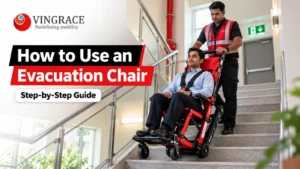
Train at least two or three people per shift, per chair. Use the chair with a volunteer in at least one drill each year. See our step-by-step guide on how to use an evacuation chair during emergencies.
Step 5: Inspect, service and keep records
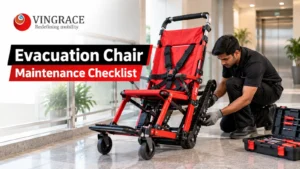
Check each chair every month and get a full service every year. Keep a log of checks, repairs and training. Use our evacuation chair maintenance checklist to stay on track.
Evacuation Chair Compliance Checklist
- Fire risk assessment done and updated this year
- PEEPs written for every person who needs help
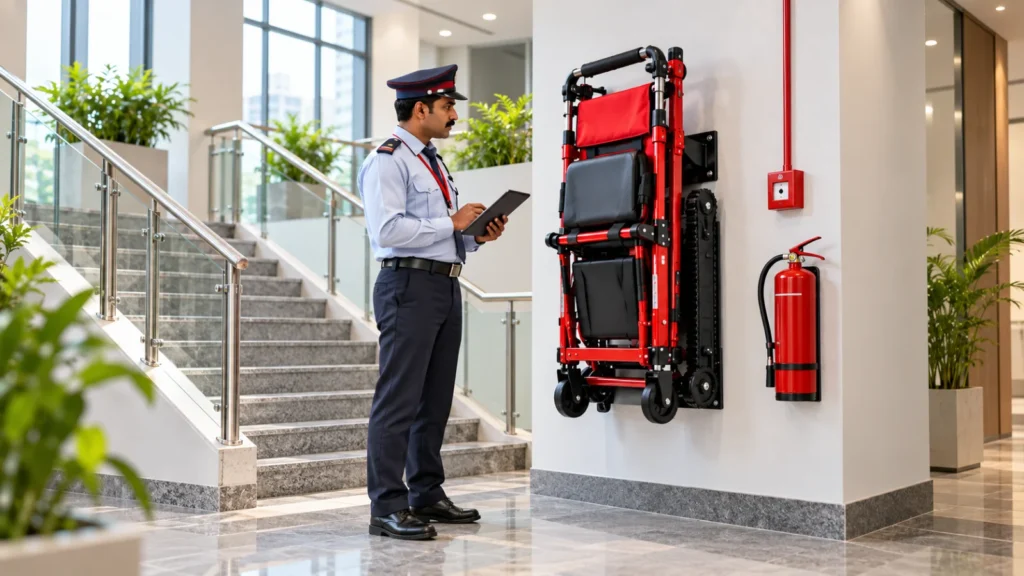
- Chairs placed at the top of each evacuation stair or near refuge areas
- Clear signs pointing to each chair
- Test certificates (ISO 7176-28, RESNA ED-1 or CE) on file
- Trained operators on every shift, with training records
- At least one live drill using the chair each year
- Monthly checks and yearly service logged
Common Compliance Mistakes to Avoid
- Buying a chair and locking it away. Staff must know where it is and be able to reach it in seconds.
- Training only one person. That person may be on leave on the day of the fire.
- Using lifts in a fire. Unless a lift is a certified fire or evacuation lift, do not use it.
- Ignoring the weight limit. Always check the load rating against your users.
- No service record. If it is not written down, auditors treat it as not done.
Final Thoughts | Compliance Is a System, Not a Single Product
Evacuation chair safety in India is moving fast. The building code changed in 2026, and accessibility rules under the RPwD Act are being made stronger. The buildings that stay ahead are the ones that treat evacuation as a full system: a tested chair, a written plan, trained people and regular checks.
For the full picture, read our complete evacuation chair buying and safety guide.
Need help making your building compliant? Explore Vin Grace evacuation chairs for stairs or contact our team to book a free site survey.
Frequently Asked Questions
Q. Is an evacuation chair mandatory in India?
There is no single national law that says every building must buy an evacuation chair. But the RPwD Act 2016, fire safety rules and building bye-laws expect safe escape for everyone, including people who cannot use stairs. For many hospitals, high-rise offices, schools and public buildings, an evacuation chair is the most practical way to meet that duty.
Q. Which standard should an evacuation chair meet?
India does not yet have a dedicated BIS standard for evacuation chairs. Buyers usually ask for proof of testing to international standards such as ISO 7176-28 for stair-climbing devices, RESNA ED-1 for emergency stair travel devices, or CE marking under European medical device rules, along with the maker’s load and stair-angle test data.
Q. Did NBC 2016 change in 2026?
Yes. On 30 April 2026, BIS notified the National Building Construction Standards 2026 (SP 7:2026), which replaced NBC 2016. Fire and life safety is now covered in Part F. It applies to a building once your state or local body adopts it, so always check the bye-laws that apply in your city.
Q. How often should staff be trained on an evacuation chair?
Train every operator before they are put on the evacuation team. Give a short hands-on refresher at least every 6 to 12 months, and use the chair in at least one fire drill each year. Keep a training record for each person.
Q. How often should an evacuation chair be serviced?
Do a quick visual check every month and a full service by a trained technician at least once a year, or as the maker advises. Record every check, service and repair in a log book.
Q. What is a PEEP?
A PEEP, or Personal Emergency Evacuation Plan, is a short written plan for one person who may need help to escape. It says who will help them, what equipment will be used, which route they will take and where they will wait. It is a good practice used widely in the UK and is now common in Indian corporate and hospital safety plans.