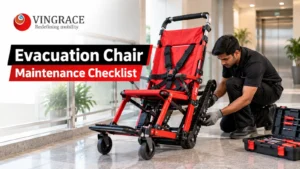

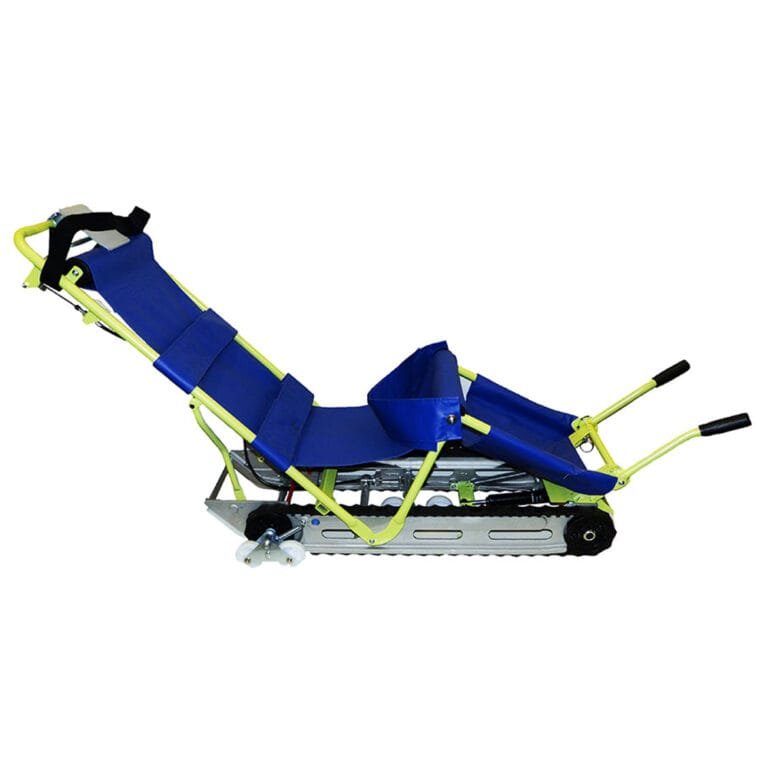
An evacuation chair may sit in its cabinet for years. Then, one day, it has to work perfectly the first time. A frayed strap, a worn track or a flat battery can turn a safe escape into a dangerous one.
That is why evacuation chair maintenance matters as much as buying the right chair. This guide gives you a simple maintenance checklist you can print and use, with monthly, quarterly and yearly checks.
Whether you are a facility manager, a hospital safety officer or a housing society secretary, this checklist will help you keep every chair ready for the day it is needed.
Quick Answer: How Do You Maintain an Evacuation Chair?
To maintain an evacuation chair, do a visual check every month (frame, tracks, belts, straps, wheels, handle and storage cover), a deeper user check every three months (open, lock, brake test and clean), and a full service by a trained technician at least once a year. For powered chairs, check and charge the battery as the maker advises. Record every check in a log book and take any faulty chair out of use at once.
Key Takeaways
- Monthly visual check, quarterly user check, yearly professional service.
- Check the chair after every drill or real use.
- Tag and remove any faulty chair, and have a backup ready.
- Keep written records. If it is not recorded, it is treated as not done.
Why Evacuation Chair Maintenance Matters
Evacuation chairs have moving parts: tracks, belts, brakes, wheels, hinges and, in powered models, motors and batteries. Rubber and fabric age, even if the chair is never used. Dust, heat and humidity in Indian buildings can speed this up.
Safety guidance from the UK, where evacuation chairs are very common, says the chair should be serviced regularly by a competent person and records kept (City of Bradford fire safety guidance). The UK also treats it as work equipment under PUWER rules from the Health and Safety Executive. These are good models for Indian buildings to follow. For Indian rules, see our guide on evacuation chair safety standards and compliance in India.
Evacuation Chair Maintenance Checklist
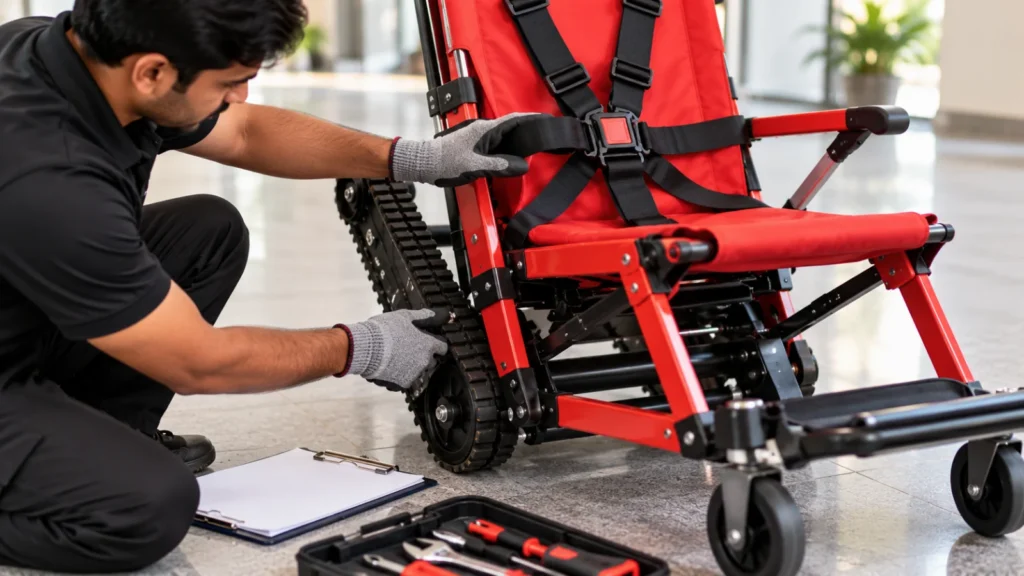
Monthly visual check (5 minutes, by trained staff)
- Chair is in its marked place, with clear access and a visible sign
- Storage cover or cabinet is clean and undamaged
- Frame has no cracks, bends or rust
- Tracks or belts have no cuts, cracks or missing parts
- Seat fabric is not torn
- Safety straps and buckles are complete and not frayed
- Wheels turn freely and are not flat or cracked
- Handle extends and locks
- Instruction label is readable
- Powered chairs: battery charge level is correct and charger is working
Quarterly user check (15 to 20 minutes)
- Fully open the chair and check it locks firmly
- Test straps: buckle, adjust and release
- Check head rest and footrest work
- Test brakes or friction control on a few steps, without a passenger
- Tighten any loose nuts or bolts you are trained to adjust
- Clean the seat, straps and frame with a mild cleaner (follow infection-control rules in hospitals)
- Fold it back and store it correctly
Yearly professional service (by a competent technician)
- Full inspection of the frame, joints and welds
- Track and belt tension and wear test; replace if needed
- Brake and speed control test under load
- Wheel bearings and axles checked and lubricated as advised
- Strap and buckle strength check
- Powered chairs: motor, controls, battery health and safety cut-off tested
- Service label updated with date and next due date
- Service report given for your records
After every use or drill
- Look for new damage, wear or loose parts
- Clean the chair
- Recharge powered chairs
- Record the use in the log book
Maintenance Schedule at a Glance
| Task | How often | Who |
|---|---|---|
| Visual check | Monthly | Trained in-house staff |
| User function check and cleaning | Every 3 months | Trained in-house staff |
| Battery check (powered chairs) | Monthly, or as per maker | Trained in-house staff |
| Full service | At least once a year | Maker or authorised technician |
| Operator refresher training | Every 6 to 12 months | Trainer or supplier |
| Check after use or drill | Every time | Operator |
Common Problems and What to Do
| Problem | Likely cause | Action |
|---|---|---|
| Chair slides too fast on stairs | Worn tracks or brake issue | Remove from use; call service |
| Frame does not lock open | Bent part or blocked catch | Do not use; get it repaired |
| Straps frayed or buckle stiff | Age, dirt or wear | Replace straps with maker’s parts |
| Wheels do not roll | Dust or dry bearings | Clean; service if not fixed |
| Powered chair will not start | Flat or old battery | Charge; replace battery if it will not hold charge |
Golden rule: if you are not sure a chair is safe, tag it “Out of Service”, remove it and put a backup chair in its place.
Storage Tips That Extend Chair Life

- Store the chair in its cover or a wall cabinet, away from direct sun and rain
- Keep it in a dry place to prevent rust and mould
- Do not hang heavy items on it or use it as a trolley
- Keep the path to the chair free of boxes and furniture
- Keep powered chairs plugged into their charger if the maker advises
Keep Simple Records
Your log book should show the chair ID and location, date of each check, who checked it, what was found, any repairs, and next service date. Keep service reports and training records in the same file. This helps during fire audits, NABH inspections and insurance claims.
Final Thoughts | A Checked Chair Is a Ready Chair
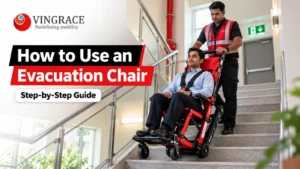
Maintenance is quick, cheap and easy compared to the cost of a chair that fails in a real emergency. A short monthly check, a quarterly test and a yearly service keep your chair ready. Pair this with good training, explained in our guide on how to use an evacuation chair.
Need a service or AMC for your evacuation chairs? Contact Vin Grace for servicing, spare parts and annual maintenance contracts, or explore our evacuation chairs.
Frequently Asked Questions
Q. How often should an evacuation chair be checked?
Do a quick visual check every month, a deeper user check every three months and a full service by a trained technician at least once a year. Also check the chair after every use, drill or move.
Q. Who should service an evacuation chair?
A competent person should do the yearly service. This is usually the maker, the authorised dealer or a technician trained on that model. In-house staff can do monthly visual checks.
Q. What are the signs an evacuation chair needs repair?
Worn or cracked tracks or belts, frayed straps, a frame that does not lock, brakes that slip, wheels that do not turn freely, loose bolts, rust, or a powered chair whose battery does not hold charge. Take the chair out of service and tag it until it is repaired.
Q. How long does an evacuation chair last?
With proper care, many chairs last 10 years or more. Belts, tracks, straps and batteries are wear parts and may need replacing sooner. Follow the maker’s service life advice.
Q. Do I need to keep maintenance records?
Yes. Keep a log of every check, service, repair, use and training session. Auditors, fire officers and insurers often ask for these records.