Quick answer: An evacuation chair is a light, foldable chair with rubber tracks. It lets one trained person safely bring a wheelchair user, an elderly person, or an injured employee down the stairs during a fire or emergency when lifts cannot be used.
In India, certified models cost between ₹50,000 and ₹1,50,000. Buildings covered by NBC 2016 Part 4 and the RPwD Act are increasingly expected to keep them near refuge areas and stair landings.
Key takeaways
- What it is: A stair descent device that moves a person with limited mobility down the stairs without anyone having to lift them.
- Price in India: ₹50,000 to ₹1,50,000 for manual track chairs, and ₹2,00,000+ for powered models.
- Who needs one: Any building with more than one floor where a person with reduced mobility lives, works, studies, or visits.
- How many: One per protected staircase, on every floor where someone may need help to get out.
- The law: No single rule names evacuation chairs, but NBC 2016 Part 4 and the RPwD Act make assisted evacuation a practical must.
- Training matters: A chair nobody has practised with won’t save anyone. Train at least four people per floor zone.
Why every multi-storey building needs a stair evacuation plan
In 2024, fire accidents killed 5,888 people in India. That’s about 16 people every single day. Residential buildings were the most common location.
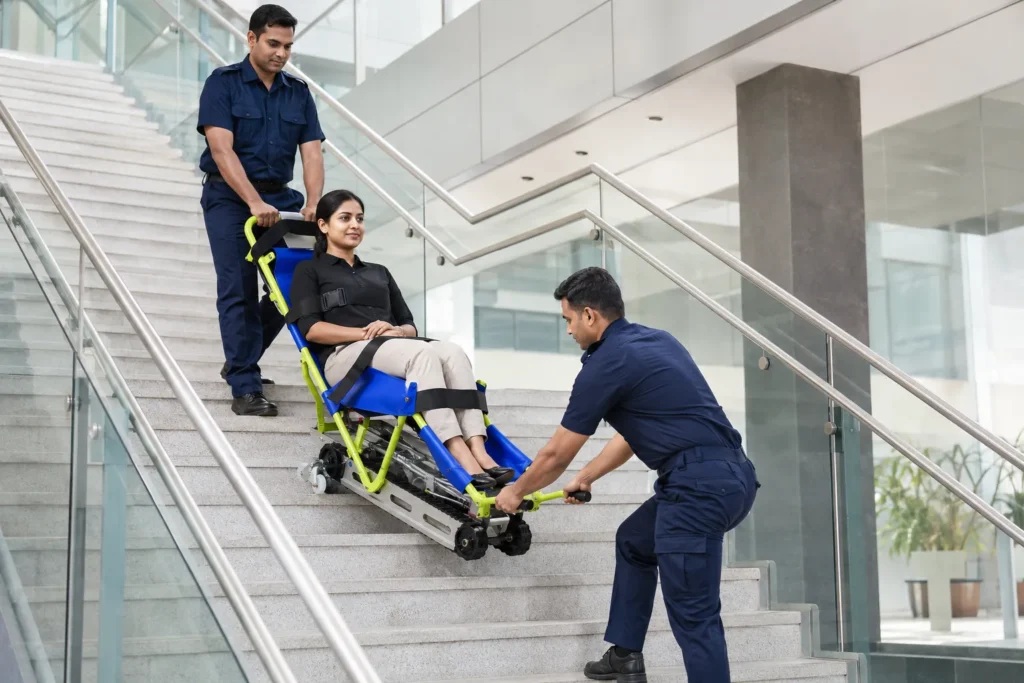
Now picture this. The fire alarm goes off. The lifts shut down automatically, exactly as they should. Everyone heads for the stairs.
But what about the wheelchair user on the sixth floor? The resident still recovering from knee surgery? The colleague with a fractured ankle? They wait for help that may not arrive in time.
An evacuation chair closes that gap. It turns a trapped person into an evacuated person, usually in under two minutes.
What is an evacuation chair and how does it work?
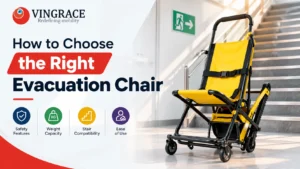
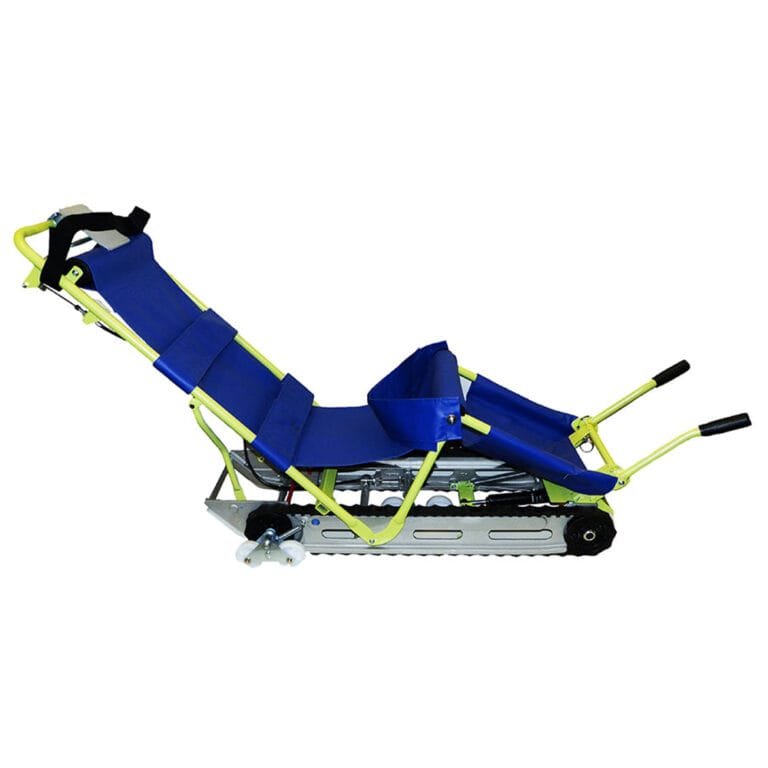
An evacuation chair, also called an emergency stair chair or escape chair, is a stair-descent device built for one job: moving a person with limited mobility down stairs without lifting them.
The escape chair was invented in the United States in 1982. Modern versions run on caterpillar-style rubber tracks.
How it moves
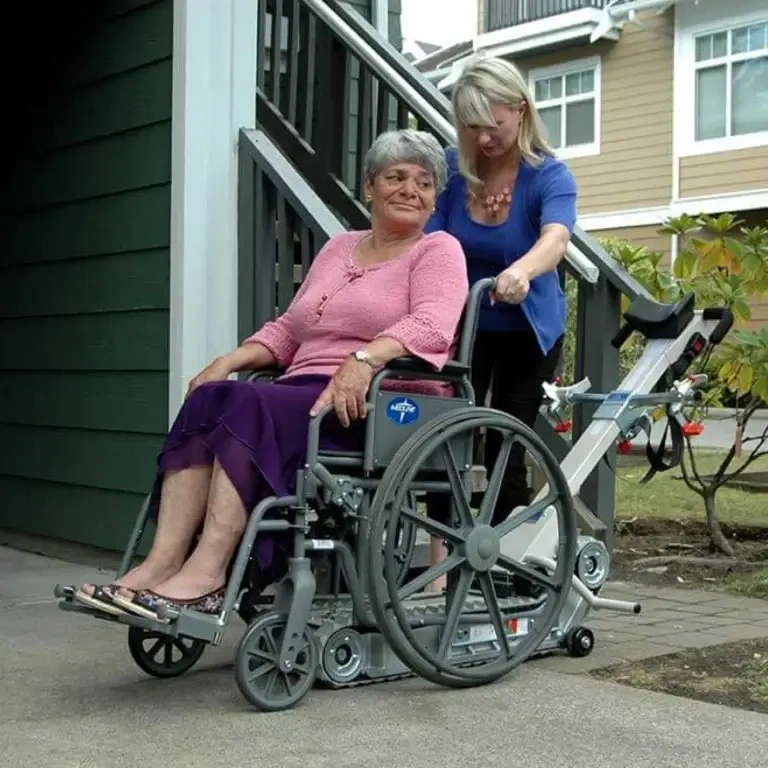
On flat ground, it works just like a wheelchair. You simply push it from behind. At the top of the stairs, the operator tilts it back so the tracks rest on the stair treads.
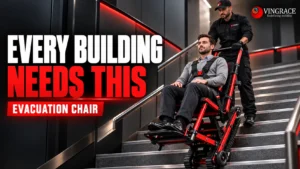
Here’s the clever part: the operator doesn’t need to be strong. On track-type models such as the Evacu-Trac, the passenger’s own weight moves the chair down the stairs. A speed governor keeps the descent slow and steady, and a failsafe brake brings the chair to a complete stop automatically.
That means a 50 kg staff member can safely bring down a 120 kg passenger. No lifting. No back injuries. No two-person carry.
How it’s stored
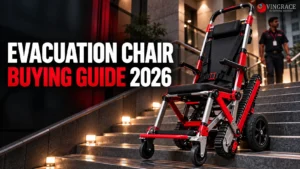
Good-quality chairs fold flat and sit in a wall cabinet near the upper stair landing, ready for instant use. Opening one usually takes a single pull of a handle.
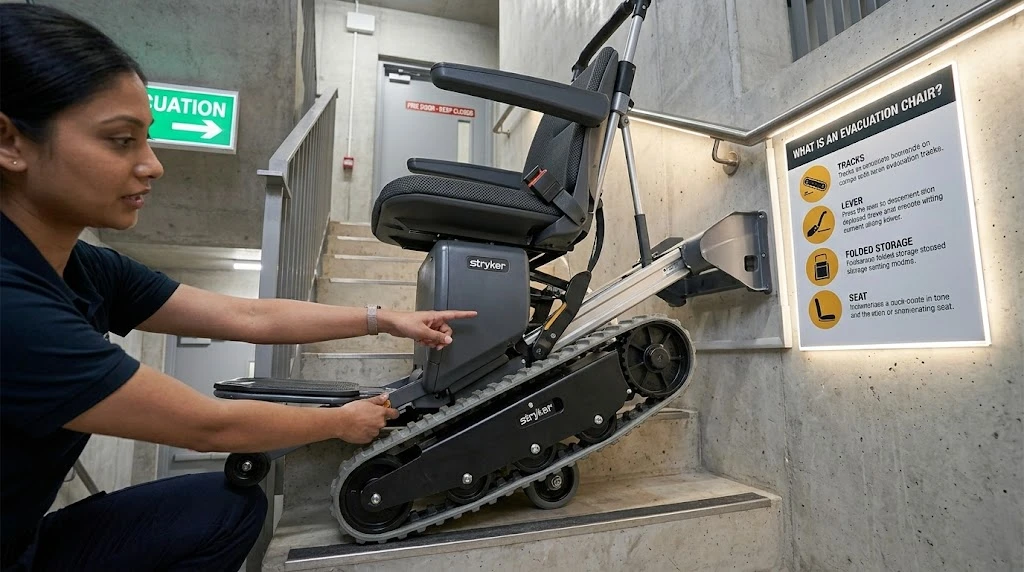
You can check specifications for available models on our evacuation chair for stairs page.
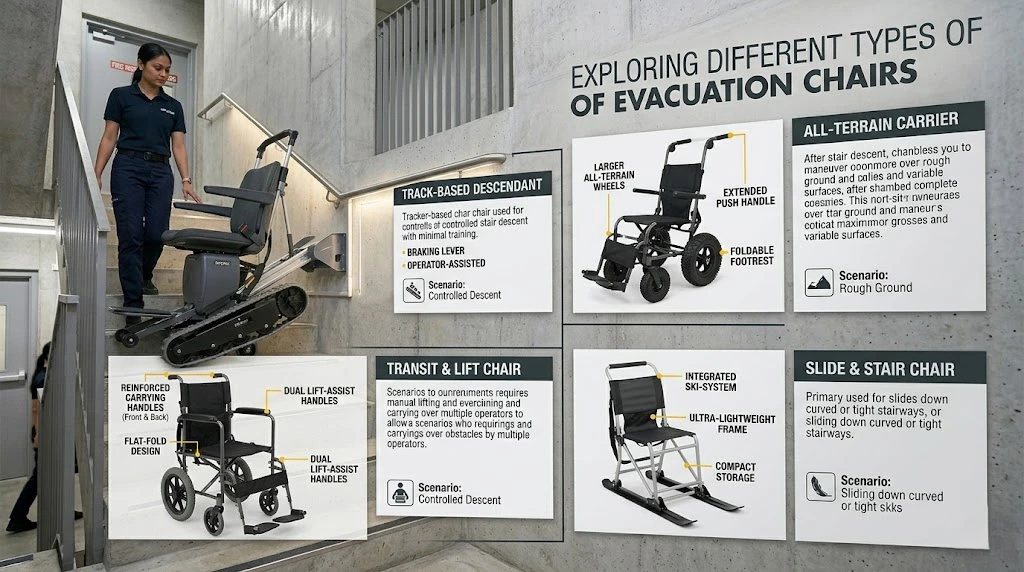
Types of evacuation chairs available in India
| Type | How it works | Best for | Indicative price |
|---|---|---|---|
| Track-type, manual descent | Rubber tracks, gravity-powered, speed governor | Offices, schools, malls, hotels, apartments | ₹50,000 to ₹1,50,000 |
| Powered stair-climbing | Motor and battery; goes up and down | Hospitals, metro stations, buildings with basements | ₹2,00,000+ |
| Sled or evacuation mat | Fabric sheet pulled down the stairs | Care homes, bedridden patients | ₹15,000 to ₹40,000 |
| Carry chair, two-person | Two operators lift and carry | Ambulance and paramedic use | ₹20,000 to ₹60,000 |
Manual or powered | which one do you need?
Here’s the key difference: manual track chairs only go down. That works for most fire evacuations, because the way out is usually downwards.
But if your building has basement floors, a parking level, or someone who has to come up to reach the exit, you need a powered chair.
Powered models such as the Power Evacu-Trac use a motor and battery. Even a small attendant can move a heavy passenger up or down the stairs at the push of a button. An electromagnetic brake stops and holds the chair mid-stair, and extra wheels help it roll across landings.
- For basement or split-level exits: see the Garaventa Powertrac evacuation chair.
- For standard downward evacuation: the Evacu-Trac emergency evacuation chair is the most widely used reference model in India.
Which buildings need an evacuation chair?
Short answer: any building with more than one floor where a person with reduced mobility may live, work, study or visit. In practice, that includes:
- Corporate offices and IT parks above the ground floor
- Schools and colleges with students or staff who have disabilities or injuries
- Hospitals and nursing homes, where post-operative patients can’t use the stairs
- Hotels and banquet halls that welcome elderly guests
- Shopping malls and cinemas with heavy public footfall
- Residential high-rises and housing societies with ageing residents
- Metro stations, airports and government buildings
- Factories and warehouses with mezzanine levels
Try this simple test: does your fire drill plan have a written answer for the person in a wheelchair on the fifth floor? If not, you need one.
Is an evacuation chair required by law in India?
There’s no single national rule that says “every building must buy an evacuation chair”. But two sets of rules together make assisted evacuation a practical obligation for most buildings.
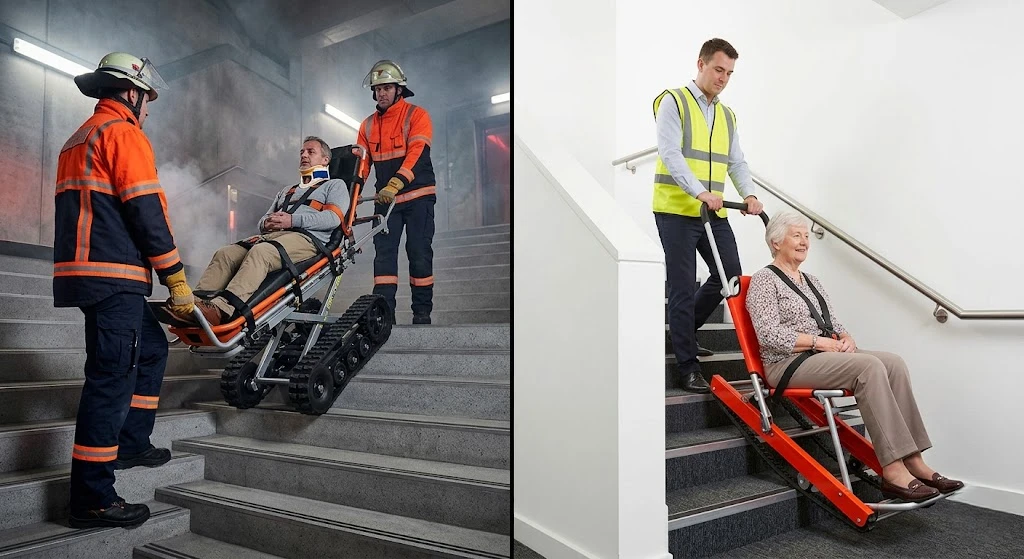
National Building Code of India 2016, Part 4
The NBC is published by the Bureau of Indian Standards. On its own, it is only a recommendation. However, on 18 April 2017, the Ministry of Home Affairs issued an advisory asking all state governments to add NBC 2016 Part 4 (Fire and Life Safety) to their building bye-laws. Once a state does this, the rules become mandatory. Most major states have already done so.
Two NBC ideas matter directly here.
1. Refuge areas. A refuge area is a safe holding space, separate from the escape route. It is designed to stay safe, with breathable air and no smoke getting in, for at least two hours while firefighters deal with the fire below. It exists for people with limited mobility who can’t use the stairs on their own.
Here’s what many building owners miss: a refuge area is a waiting point, not the final destination. People are expected to leave as soon as the staircases are clear. That is exactly when an evacuation chair is used.
2. Progressive evacuation. NBC 2016 added detailed rules for progressive evacuation in hospital buildings. Patients first move sideways to a safe section on the same floor, and then downwards. Moving patients who can’t walk down the stairs needs proper equipment.
You can read the official documents on the MHA Directorate General of Fire Services website.
The RPwD Act and the 2026 change
On 8 November 2024, the Supreme Court ruled in Rajive Raturi vs Union of India that Rule 15 of the RPwD Rules 2017 was ultra vires (beyond the powers of) the parent Act.
The reason: it only created persuasive guidelines, not compulsory standards. The Court directed the Union Government to frame mandatory accessibility rules under Section 40 of the RPwD Act 2016.
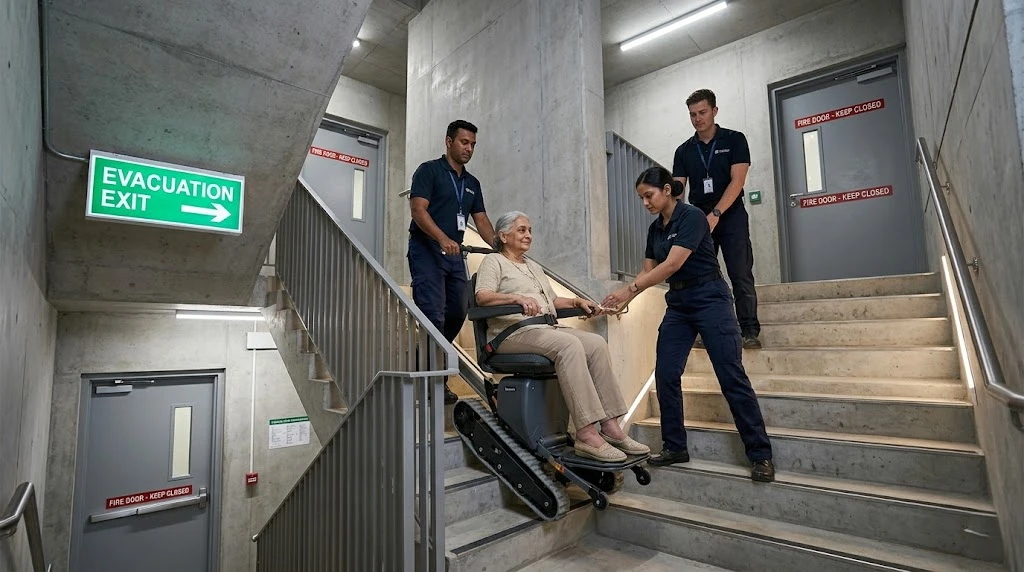
Since then, the Ministry of Social Justice and Empowerment has issued draft notification S.O. 3962(E), dated 16 July 2026 and published in the Extraordinary Gazette on 20 July 2026. It separates binding accessibility rules from the older, recommendation-only guidelines.
What this means for you: accessibility in Indian buildings is moving from “good practice” to a legal minimum that you must be able to show. A safe emergency exit for persons with disabilities is part of that minimum. For the wider compliance picture, read our guide to workplace accessibility in India.
Note: Fire NOC requirements vary by state and building height. Check current expectations with your local fire department before you buy. This is general information, not legal advice.
How to choose an evacuation chair | the 12-point buying checklist
- Weight capacity. Check the rated capacity, not the tested capacity. Many models used in India support up to 150 kg. Buy for your heaviest realistic occupant, plus a safety margin.
- Single-operator design. Make sure one average-sized person can operate it alone. At 9 PM, you may have just one security guard on duty.
- Descent speed control. A speed governor or motorised brake is non-negotiable. Without it, the chair becomes a sledge.
- Failsafe braking. The brake should engage automatically the moment the operator lets go of the handle.
- Fire-retardant fabric. Quality chairs use a sling seat made of fire-retardant fabric that is easy to clean. Ask for the certificate, not just a verbal promise.
- Restraint straps. Upper-body straps keep an injured person, or someone with no upper-body control, steady. Lower-body straps secure smaller passengers.
- Easy transfer. The seat should allow a sideways transfer from a wheelchair, without lifting.
- Landing wheels. Extra wheels let the operator cross flat landings at walking speed.
- Folded size. Measure your landing first. A stored chair that blocks the escape route is a code violation.
- Stair compatibility. Indian staircases vary a lot: tight turns, uneven risers, marble treads, mid-landings. Insist on a site survey, and ask whether the tracks will mark your flooring.
- Cabinet and signage. The chair needs a clearly marked, unlocked cabinet near the upper landing, with photoluminescent (glow-in-the-dark) signs that stay visible during a power cut.
- Training, warranty, and service. Confirm the warranty, plus after-sales maintenance and repairs. Ask how many trained technicians the supplier has in your city, not across India.
Compare models across the Vin Grace product range.
Evacuation chair price in India
- Certified track-type chairs: ₹50,000 to ₹1,50,000
- Powered stair-climbing models: ₹2,00,000 upwards
- Evacuation mats or sleds: ₹15,000 to ₹40,000
What decides the price? The weight rating, powered vs. gravity descent, track material, warranty length, and whether training and annual servicing are included.
A word of caution about the cheapest options. A ₹15,000 chair from an unbranded seller often has no speed governor, no certified fabric, and no service network. The difference between a controlled and an uncontrolled descent is measured in broken bones. Treat this as life-safety equipment, not a bargain buy.
Where should you install an evacuation chair?
Buying the chair is only part of the job. Where you place it decides whether it actually works when it matters.
What to do
- Mount it at the top landing of each protected staircase, on every floor where a person with limited mobility may be present.
- Place it inside, or right next to, the refuge area.
- Keep the cabinet unlocked, or behind a frangible (break-glass) cover.
- Add signage at eye level, and at 1200 mm for wheelchair users.
- Mark its location on the floor evacuation plan.
What not to do
- Don’t lock it in the facility manager’s cupboard.
- Don’t keep it in a storeroom.
- Don’t place it where it narrows the escape route.
- Don’t install just one chair for an entire multi-storey building.
Rule of thumb: one chair per staircase, per floor zone where assisted evacuation may be needed. A single chair on the ground floor only creates false confidence.
Training and PEEPs: who needs to know what?
Here’s an uncomfortable truth: most evacuation chairs in Indian buildings have never been used by the people expected to operate them.
Write a PEEP for everyone who needs one
A Personal Emergency Evacuation Plan (PEEP) is a custom escape plan for someone who can’t reach total safety without support. The test is simple: can this person get out on their own, reasonably quickly, in an emergency?
A complete PEEP records:
- The person’s details and location
- The evacuation route and method
- The assistance needed
- The equipment required
- The named, trained helpers
- A review date
PEEPs apply to more people than you might expect, including staff with temporary injuries, heart conditions or late-stage pregnancy.
Train at least four people per floor zone
Cover every shift. Include security guards, floor wardens, housekeeping supervisors and HR.
Understand the transfer limit
Standard assisted evacuation plans usually expect the person to move themselves into the chair with minimal help.
Not every wheelchair user can safely use an evacuation chair. If someone can’t transfer on their own, their PEEP must say who lifts them and how, or plan for an evacuation lift instead.
Drill with real weight
Use an actual adult in the chair, not an empty unit. Include the chair in fire drills at least twice a year, with refresher training every year.
How to use an evacuation chair, step by step
- Take the chair out and place it on a flat surface at the top landing.
- Open it, usually with one firm pull on the handle.
- Transfer the passenger sideways from their wheelchair, without lifting.
- Fasten the upper and lower body straps.
- Tell the passenger what will happen next.
- Position the chair at the top of the stairs and tilt it back until the tracks touch the treads.
- Go down with both hands on the handle, and let the speed governor control the pace.
- Cross landings on the auxiliary wheels.
- Park and brake once you’re clear. On most designs, the brake is on by default and engages when you release the bar.
- Report the evacuated person to the assembly point marshal by name.
How to maintain an evacuation chair
| How often | What to check |
|---|---|
| Monthly | Cabinet is reachable and unlocked, signage is undamaged, chair is present and folded correctly, no fabric tears or frayed straps |
| Quarterly | Check track rubber for cracks, test that the brake engages, make sure strap buckles latch firmly, cycle the battery on powered units |
| Annually | Full service by the manufacturer or authorised dealer, load test as per the manufacturer’s schedule, refresher training for all named operators, review of every PEEP |
Keep the service log in your fire safety file. Fire inspectors are increasingly asking to see it.
Evacuation chair vs stairlift vs platform lift: which do you need?
An evacuation chair is emergency equipment, not an everyday accessibility solution. Most buildings need both.
| Need | Solution |
|---|---|
| Emergency stair descent during a fire | Evacuation chair |
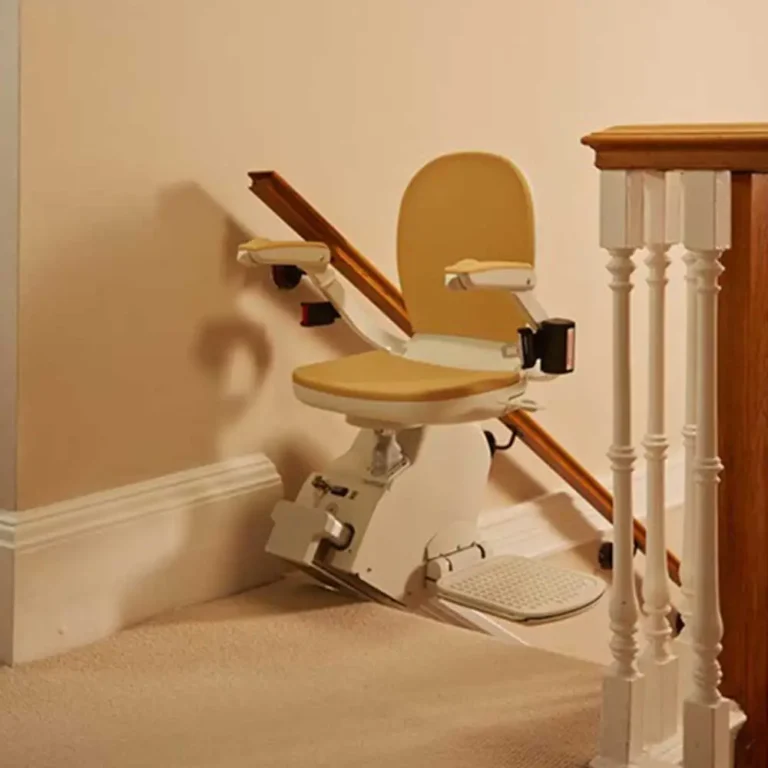
| Daily movement between floors at home | Stairlift |
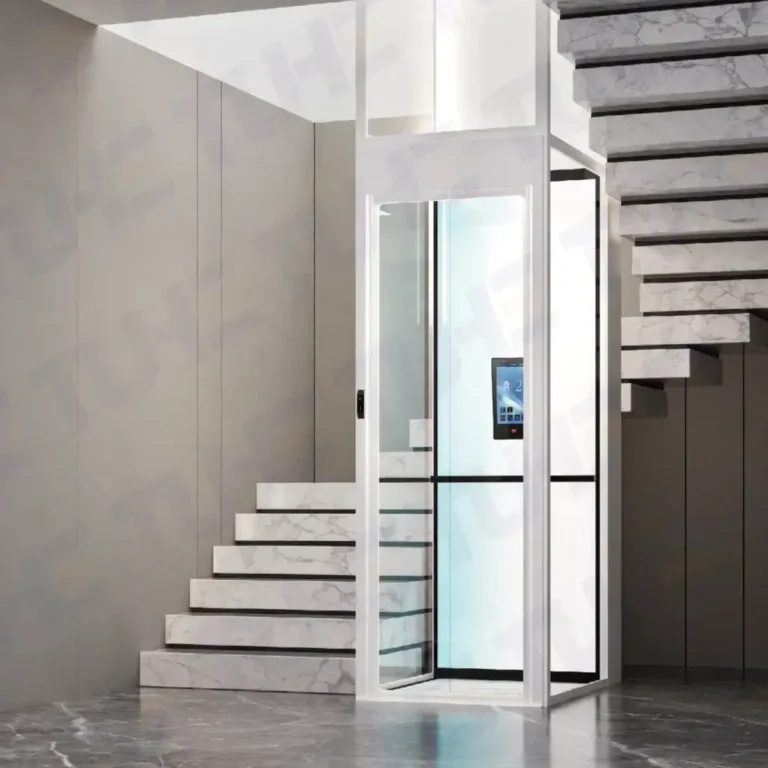
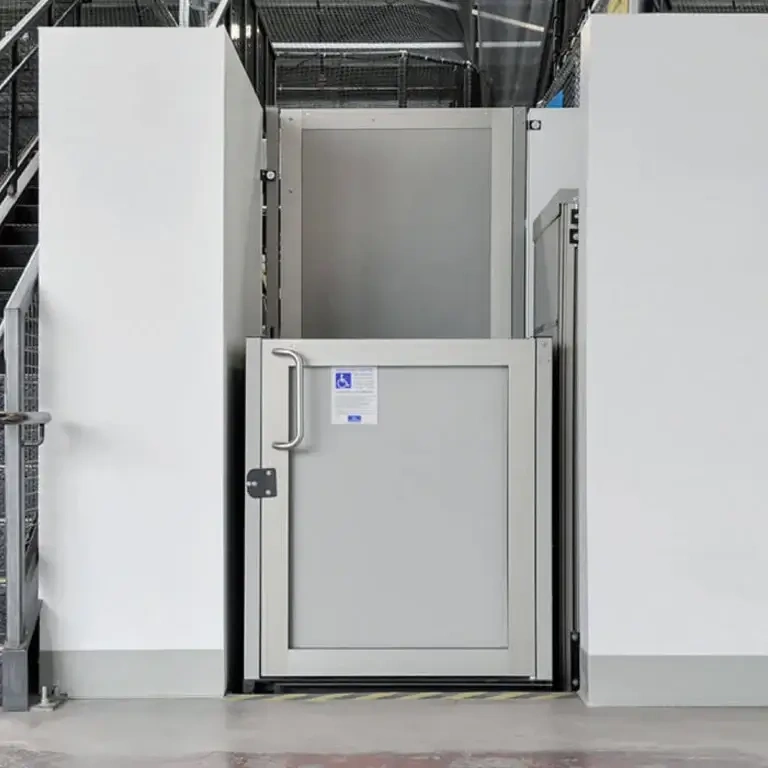
| Full floor access for a wheelchair user | Platform lift |
| Portable stair climbing, indoors and outdoors | Stair-climbing wheelchair |
| Climber attached to an existing wheelchair | Garaventa Stair-Trac |
A practical approach for commercial buildings: install platform lifts or ramps for daily access, and keep evacuation chairs ready for emergencies when those lifts shut down. See the full range of Vin Grace accessibility products.
The bottom line
An evacuation chair is a small investment that answers one of the hardest questions in any fire plan: how do we get everyone out? Pick a certified chair that suits your stairs, place one on every floor that needs it, write a PEEP for each person who needs help, and practise with real people. When the alarm goes off, that preparation is what counts.
Frequently asked questions
Q. Is an evacuation chair mandatory in India?
No single national rule names evacuation chairs as compulsory. However, NBC 2016 Part 4 rules on refuge areas and means of escape, together with the RPwD Act and the draft rules notified in July 2026 that aim to make accessibility standards mandatory, make assisted evacuation arrangements a practical obligation for most public and commercial buildings. Confirm the details with your state fire authority.
Q. How much does an evacuation chair cost in India?
Certified track-type evacuation chairs cost ₹50,000 to ₹1,50,000. Powered stair-climbing models start at around ₹2,00,000, and evacuation mats or sleds cost ₹15,000 to ₹40,000.
Q. How many evacuation chairs do I need?
One per protected staircase on each floor where a person with limited mobility may be present. A building with refuge areas on several floors needs several chairs.
Q. Where should an evacuation chair be kept?
In a clearly marked, unlocked wall cabinet at the top landing of each protected staircase, inside or right next to the refuge area. It should never block the escape route or be locked away in a storeroom.
Q. Does an evacuation chair need electricity or batteries?
Manual track-type chairs need neither, because the passenger’s weight provides the movement. Only powered stair-climbing models need batteries.
Q. Can an evacuation chair go up the stairs?
Manual chairs only go down. Powered models such as the Powertrac can also climb, which matters for basements and below-ground exits.
Q. How much weight can an evacuation chair carry?
Common ratings go up to 136 kg (300 lbs), and some models support up to 150 kg.
Q. Who should be trained to use an evacuation chair?
Floor wardens, security staff across all shifts, and HR and housekeeping supervisors. Aim for at least four trained people per floor zone.
Q. What is a PEEP?
A PEEP (Personal Emergency Evacuation Plan) is a custom escape plan for someone who can’t evacuate safely without help. It lists the person’s location, route, method, equipment, named helpers, and a review date.
Q. How long does it take to evacuate one person?
With a trained operator, opening the chair and going down several floors usually takes one to three minutes.