Every NABH-accredited hospital in India must now meet RPwD Act accessibility standards. Non-compliance risks both accreditation loss and penalties up to 5 lakh per violation.
Hospital administrators and NABH compliance officers face growing pressure. Patients with disabilities expect barrier-free care. The law demands it.
Your hospital’s reputation, NABH score, and revenue depend on it. This guide explains exactly what you need to do in simple, practical steps.
Content Overview
ToggleKey Takeaways
- RPwD Act Section 25 and Sections 40–46 make barrier-free access mandatory in all hospitals – government and private.
- NABH Patient Rights & Education chapter now links directly to physical and digital accessibility for full compliance.
- Key physical fixes: dedicated PwD parking within 30 metres, 800 mm counter height, 1,800 mm corridors, 5% accessible rooms, accessible toilets on every floor.
- Digital access (website, patient portal, telemedicine) must follow WCAG 2.1 AA and IS 17802.
- Retrofitting costs range from ₹10 lakh to ₹50 lakh depending on hospital size – but ROI is fast through higher NABH scores, more patients, and insurance tie-ups.
- 15% of patients have disabilities (or need accessible features due to age or temporary conditions). Meeting standards opens this large market and avoids heavy fines.
- Start with a free audit checklist (download below) to spot gaps in one day.
Legal & Accreditation Framework
India’s accessibility rules for hospitals rest on four pillars. Understanding them helps you stay compliant and avoid surprises during NABH inspections.
1. RPwD Act, 2016 Section 25 clearly states that every hospital – public or private – must provide barrier-free access in all parts of the building, plus priority in attendance and treatment. Sections 40 to 46 cover physical environment, transport, information & communication technology (ICT), and consumer goods. The Central Government sets standards that every hospital owner must follow. Non-compliance attracts fines and legal action.
2. NABH Standards (6th Edition) The Patient Rights & Education (PRE) chapter requires hospitals to protect dignity, privacy, and equal access. NABH auditors now check physical barriers, signage, and digital tools as part of patient rights. Strong accessibility also boosts your score in Facility Management and Safety (FMS) chapter.
3. Clinical Establishments Act 2010 All registered hospitals must meet minimum standards of facilities and services. Accessibility is now part of those minimum standards through RPwD linkage.
4. Supporting Guidelines
- Harmonised Guidelines and Standards for Universal Accessibility in India 2021 (MoHUA) – the main technical rulebook for ramps, doors, toilets, parking, and signage.
- MoHFW Guidelines for Accessibility of Healthcare Facilities and Services for Persons with Disabilities (May 2023) – specific to hospitals. It covers height-adjustable tables, staff training, and emergency evacuation.
- IS 17802 – the Indian standard for digital accessibility of websites, apps, and patient portals.
These rules apply to new hospitals immediately and to existing ones on a reasonable timeline. NABH officers expect visible progress during assessments.
Hospital Accessibility Matrix – What Must Be in Place
Use this ready checklist to audit your facility. All items come from Harmonised Guidelines 2021 and MoHFW standards.
| Area | Requirement | Why It Matters | Easy First Step |
|---|---|---|---|
| Parking | Dedicated PwD bays within 30 m of entrance | Wheelchair users cannot walk long distances | Paint blue bays + signage |
| Reception & Counters | Tactile + Braille signage; counter height 800 mm with knee space | Blind and wheelchair users can reach easily | Lower one counter section |
| Corridors | Minimum clear width 1,800 mm | Two wheelchairs can pass | Remove clutter, widen doors |
| Patient Rooms | Minimum 5% fully accessible rooms | Covers daily demand | Retrofit 1–2 rooms first |
| Toilets | One accessible toilet per floor (grab bars, 760 mm height, 900 mm turning space) | Basic dignity and safety | Start with ground floor |
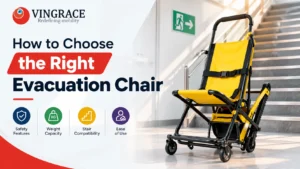
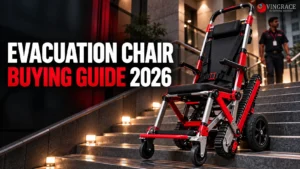
| Lifts & Staircases | Evacuation chairs at every staircase; lifts with Braille buttons | Fire safety for all | Buy 2–3 evacuation chairs |
| Examination Tables | Height-adjustable tables in OPD and wards | Doctors can examine without lifting | Add adjustable tables in key OPDs |
| Emergency Alarms | Visual (flashing lights) + audio alarms | Deaf and blind patients get equal alert | Upgrade existing fire system |
| Signage | Clear, high-contrast, tactile, Braille | Independent navigation | Replace old signs |
Digital Accessibility – No Longer Optional
Patients now book appointments, view reports, and attend telemedicine calls online. Your systems must work for everyone.
What you must do:
- Hospital website and patient portal must meet WCAG 2.1 AA level.
- Follow IS 17802 (India’s official ICT accessibility standard) for all digital services.
- Provide alt text for images, keyboard navigation, captions for videos, and screen-reader friendly forms.
- Telemedicine platforms must have audio descriptions and sign-language options where needed.
Quick wins: Run a free WCAG audit tool today. Fix colour contrast and add “skip to content” links. Train your IT team on IS 17802 basics. Most hospitals complete basic digital fixes within ₹2–5 lakh.
Common Gaps We See in Indian Hospitals
Most hospitals we audit have these three problems:
- Steep ramps or no ramps – Many entrances have steps only. Fix: Build 1:12 slope ramp with handrails.
- No accessible toilets – Or toilets with narrow doors and no grab bars. Fix: Convert one toilet per floor (cost-effective and high-impact).
- Inaccessible billing counters – High counters block wheelchair users. Fix: Lower one section to 800 mm with knee space underneath.
These gaps cause patient complaints, lower NABH scores, and lost business. Fix them and you turn complaints into 5-star reviews.
Cost Bands – Realistic Budgets for 2026
Costs depend on hospital size and whether you do minor fixes or full retrofitting.
- Small clinic / 20–50 bed hospital: ₹10–20 lakh (ramps, 2 toilets, signage, 1 adjustable table).
- Medium hospital / 50–150 beds: ₹20–35 lakh (plus corridors, digital portal, evacuation chairs).
- Large hospital / 150+ beds: ₹35–50 lakh (full matrix + staff training programme).
Break the work into phases: Phase 1 (ground floor + digital) in Year 1, upper floors in Year 2. Many hospitals spread cost over 2–3 financial years.
ROI – Why This Investment Pays Back Fast
Accessibility is not charity – it is smart business.
- NABH scoring: Full compliance in PRE and FMS chapters improves your overall grade and speeds up reaccreditation.
- Patient base: Persons with disabilities and their families make up a large group. Meeting standards brings repeat visits and referrals.
- Insurance tie-ups: Many insurers now prefer NABH hospitals with strong accessibility scores for empanelment.
- Reputation: Happy PwD patients leave positive Google and Practo reviews. Word spreads fast in support groups.
- Risk avoidance: One penalty of ₹5 lakh + bad press hurts more than the compliance cost.
Hospitals that finish accessibility work report 15–25% rise in outpatient footfall from PwD patients within 12 months.
Case Study: CityCare Hospital, Hyderabad (Hypothetical but Based on Real Projects)
CityCare (180 beds) faced NABH renewal in 2025. An internal audit showed only 40% compliance. They spent ₹28 lakh on ramps, 8 accessible toilets, digital portal upgrade, and staff training.
Results after 10 months:
- NABH score jumped from 82% to 96%.
- PwD outpatient visits rose 22%.
- Zero accessibility complaints.
- Received preferred provider status with two major insurers.
The hospital recovered the investment in 14 months through extra revenue. The CEO now calls it “one of the best decisions we made.”
Ready to Act? Download Your Free Hospital Accessibility Audit Checklist
Get our 18-point PDF checklist (with photos, measurements, and NABH mapping) absolutely free. Just enter your email and we will send it instantly.
Free Hospital Accessibility Audit Checklist PDF
After the checklist, many administrators book our paid Hospital Accessibility Compliance Consultancy (₹10 lakh to ₹50 lakh projects). Our team helps with drawings, vendor selection, NABH documentation, and full implementation.
Start today. Make your hospital truly inclusive. Protect your accreditation. Grow your patient base.
FAQs
Q1. Is accessibility mandatory even for small clinics?
Yes. RPwD Act applies to all clinical establishments, big or small.
Q2. What is the penalty for non-compliance?
Up to ₹5 lakh per violation plus possible NABH suspension.
Q3. Do we need to make 100% of rooms accessible?
No. Minimum 5% is the standard, but more is better for high-volume hospitals.
Q4. How long do we have to comply?
Existing hospitals must show continuous progress. NABH expects visible action within 12–18 months.
Q5. Can we do digital accessibility cheaply?
Yes. Many free tools and plugins fix 80% of issues. Budget ₹2–4 lakh for full compliance.
Q6. Who pays – hospital or owner?
The owner or management of the clinical establishment is responsible under RPwD Rules.
Q7. Is staff training required?
Yes. MoHFW guidelines mandate sensitivity training. One-day sessions cost very little and count toward NABH HRM points.
Q8. How do we start?
Download the free Hospital Accessibility Audit Checklist below and walk your facility in one afternoon.
Related guides: Accessibility for CBSE, ICSE & IB Schools in India | Compliance Guide · Accessibility for Corporate Offices & Headquarters in India – A Detailed Guide · Ramps vs Lifts for Home Accessibility in India | Affordable Solutions for Small Households & Elderly