Why Accessibility Is No Longer Optional for Indian Schools
If your school isn’t accessible, it’s more than just missing a checkbox. You’re leaving children out.
India has over 26 million people living with disabilities. A significant number of them are school-going children. Most Indian schools, including CBSE, ICSE, and IB, still face basic accessibility issues.
Narrow doorways. No ramps. Toilets that wheelchair users cannot enter. Classrooms that hearing-impaired students cannot fully participate in.
This isn’t just a moral problem. Since 2016, it’s been a legal one.
The Rights of Persons with Disabilities Act (RPwD Act, 2016) mandates that all educational institutions in India provide equal access to students with disabilities.
The Ministry of Education has been tightening enforcement. And in 2026, school boards — including CBSE — are expected to scrutinize accessibility compliance more closely during affiliation reviews.
For Principals, School Admins, Facility Managers, and CSR Heads, the question is not if they should act. The question is: where do you start?
This guide gives you the answer.
What the Law Actually Says: RPwD Act and Schools
The Rights of Persons with Disabilities Act, 2016 replaced the old Persons with Disabilities Act of 1995. It is far more comprehensive — and far more enforceable.
Under the RPwD Act:
All schools and colleges, public and private, must be accessible. This includes students, teachers, and staff with disabilities.
Schools must provide “reasonable accommodations.” This means making practical changes that help students participate. These adjustments shouldn’t create a big burden.
The law clearly bans schools from discriminating against students with disabilities. This applies to both admissions and access.
Schools that don’t follow the rules might face complaints. These complaints can be filed with State Commissioners for Persons with Disabilities.
The Act addresses 21 types of disabilities. These include locomotor, visual, hearing, intellectual, and multiple disabilities. This is important.
Many school administrators think of “accessibility” as only meaning ramps for wheelchair users. In reality, it covers a much wider spectrum.
The National Building Code of India (NBC 2016) also has rules for barrier-free design in public buildings, like schools.
These are not suggestions. They are the technical standards your infrastructure must meet.
CBSE Accessibility Rules: What Affiliated Schools Must Know
CBSE’s affiliation by-laws require that schools maintain infrastructure that is inclusive and non-discriminatory. CBSE doesn’t have a separate “accessibility checklist.” However, its affiliation conditions meet the RPwD Act and NBC 2016 requirements.
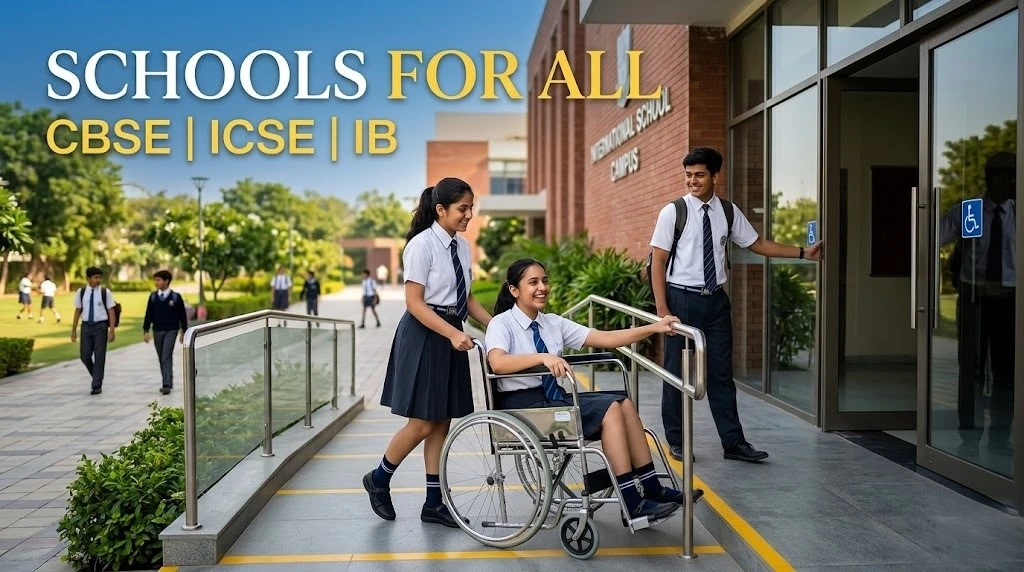
Here’s what CBSE-affiliated schools specifically need to address:
CBSE inspections check school buildings to make sure they meet the needs of all students. A school that can’t fit a wheelchair-using student in its classrooms, library, or labs is breaking affiliation standards.
CBSE strongly supports inclusive education. This aligns with its National Curriculum Framework. Schools need to show they have policies, not just buildings, to help students with special needs.
CBSE says schools with students who have special needs must hire trained special educators. This is an active compliance point during inspections.
Examination Accommodations CBSE offers clear guidelines for accommodations in board exams. These include extra time, scribes, and different question paper formats.
Schools must be equipped and trained to implement these.
The biggest risk for CBSE schools is losing their legal status during affiliation renewal. Schools that can’t show they meet accessibility rules might face conditional affiliation. In some cases, they could even lose their affiliation completely. Don’t wait until renewal to fix structural problems.
ICSE Accessibility Expectations: What’s Different?
The Council for the Indian School Certificate Examinations (CISCE) manages ICSE and ISC schools. Its approach to accessibility is similar in spirit to CBSE but with some differences in how compliance is assessed.
ICSE schools tend to be older, often operating out of heritage or older buildings. This creates unique infrastructure challenges — high thresholds, narrow corridors, multi-floor campuses without lifts. The law requires older buildings to meet accessibility rules. However, it understands that retrofitting can be complicated.
For ICSE schools, key focus areas include:
Reasonable accommodation policies: Have a clear, board-approved policy to support students with disabilities.
Examination accommodations: CISCE has its own accommodation framework for ISC examinations. Schools must align with this.
Physical accessibility: Schools must show active progress in heritage buildings. They need to explain what they have done and what they plan to do.
A critical tip for ICSE school admins: document everything. If building rules stop full physical access, write an accessibility improvement plan.
Include timelines and budgets. This demonstrates good faith and significantly reduces legal exposure.
IB Schools and Accessibility: A Global Standard Meets Indian Law
International Baccalaureate schools in India follow IB’s strict standards. Accessibility is a key part of IB’s inclusive education philosophy.
IB’s mission explicitly supports access for all learners. The IB Programme Standards say schools must create and keep an inclusive learning environment. This goes beyond physical access to include:
Universal Design for Learning (UDL): IB urges schools to create lessons and assessments that are accessible to all learners. This approach cuts down on the need for individual accommodations.
Every IB school must have a written, published Access and Inclusion Policy. This is a mandatory document reviewed during IB authorisation and evaluation.
Assessment accommodations: IB has a detailed Candidates with Assessment Access Requirements (CAAR) process. Schools must apply in advance for accommodations for students with documented needs.
IB schools in India have two main requirements: they must follow the IB’s international standards and comply with India’s RPwD Act.
The good news is that these two frameworks are largely compatible. Meeting IB’s inclusion requirements usually gets you near RPwD compliance. But you still need to fix physical infrastructure gaps as per Indian law.
IB schools often excel at policy and pedagogy. They often struggle with physical infrastructure. This is especially true for schools that grew fast but didn’t upgrade their facilities for more students.
The 7 Core Areas of School Accessibility: A Practical Framework
No matter your board affiliation, all schools must tackle these seven areas:
1. Entry and Approach The school entrance must be accessible. This means step-free access (ramps with the correct gradient — a maximum of 1:12 per NBC 2016), non-slip surfaces, and accessible parking. Many schools have a grand staircase entrance that is the only entrance. This is a compliance failure.
2. Circulation in the building corridors should be wide enough for wheelchair users. The minimum width is 1,800mm, according to NBC 2016. Ramps or lifts must connect all floors used by students. Internal doors must have lever handles, not round knobs.
3. Accessible Toilets An accessible toilet is not just a “bigger” toilet. It needs grab rails, a wheelchair turning radius, a lowered wash basin, and a door that opens outward. One accessible toilet per floor, with separate provisions for male and female students, is the baseline.
4. Classrooms and Learning Spaces Classrooms must be navigable by wheelchair. Desks and seating arrangements must accommodate mobility aid users. Whiteboards and display screens must be at a height accessible to seated students.
5. Sensory Accessibility For students with visual impairments:
Tactile flooring strips on key paths
Good lighting
High-contrast color coding on steps and hazards
For students with hearing impairments:
Visual fire alarms
Good acoustics
Induction loop systems in larger halls
6. Outdoor Spaces and Playgrounds Playgrounds cannot be de-facto exclusion zones. At least some outdoor activity spaces must be accessible. Paths to sports facilities must be paved and obstacle-free.
7. Reception desks, counselor offices, health rooms, and library spaces need to be accessible. Students with disabilities should access all services available to other students.
Common Accessibility Mistakes Indian Schools Make
Many Indian school campuses show the same accessibility errors again and again. Here are the most common — and how to fix them:
The “We Have One Ramp” Mistake Having one ramp at the main entrance and nothing else is not accessibility. If a student in a wheelchair can’t reach their classroom, science lab, library, or restroom alone, then you are not accessible.
Fix: Map the complete journey a wheelchair user would take through your school. Find every break point. Address each one.
The Broken Lift Problem Many schools have put in lifts for accessibility. But often, these lifts are not maintained and fall into disrepair.
A broken lift is worse than no lift, because it creates a false assurance. Fix: Lifts for accessibility need a regular maintenance schedule. They also require a clear plan for what to do if they break down.
Many accessible toilets are locked. The only key is kept in an office three floors away. This scenario is not hypothetical — it is common. Accessible toilets must always be unlocked and ready for use during school hours. Students shouldn’t need to ask for permission to use them.
Accommodation by Charity, Not Policy “Oh, we always help students who need it” is not a policy. It is goodwill — and goodwill is not enforceable, consistent, or dignified. Fix: Write and publish a formal Accessibility and Inclusion Policy. Make it part of your school handbook.
Forgetting Staff with Disabilities Accessibility is not only for students. Teachers, staff, and visitors with disabilities should be able to access the school, too. Many schools forget this entirely. Fix: Include staff needs in your accessibility audit.
Retrofitting vs. Building New: What’s Realistic
For schools in old buildings, making them fully accessible is tough, but it can be done. Here’s a realistic approach:
Prioritise quick wins first. Door handles, signage, accessible parking bays, and toilet grab rails can be installed quickly and cheaply. Do them now.
Plan for medium-term structural changes. Ramps, widened doorways, and lift installations take planning, budgeting, and often building permissions. Start the process now. Even if execution is 18 months away, having a plan in place demonstrates compliance intent.
Budget realistically. A basic accessibility retrofit for a medium-sized school campus typically costs between ₹15 lakhs and ₹60 lakhs. The price varies based on how much work is required. This is significant — but spread over 2–3 financial years, it is achievable.
Engage a certified accessibility consultant. The NBC 2016 standards are technical. Having a consultant who understands both the legal requirements and the practical construction realities will save you time, money, and legal exposure.
For new school buildings: There is simply no excuse. New construction must be designed accessible from the ground up. Adding accessibility to a new project usually costs less than 1% of the total construction cost. Retrofitting the same features later can cost 5–10x more.
The Role of CSR in School Accessibility
For CSR Heads funding school infrastructure, or school administrators looking for CSR partners, accessibility is becoming a key part of corporate social responsibility goals.
Why? Because:
Accessibility spending directly supports disability inclusion, which ties to SDG 10: Reduced Inequalities.
It has clear outputs: ramps built, lifts installed, and toilets upgraded. These are easy to report in CSR disclosures.
Companies with ESG commitments increasingly want education CSR projects that specifically address inclusion.
If your school wants CSR funding for accessibility upgrades, focus on the impact. This initiative will help 100 students with disabilities.
It will remove barriers like limited access to resources and support. This aligns with the funder’s ESG goals by promoting inclusion and equity.
A well-prepared accessibility improvement plan with costs, timelines, and impact metrics is essential.
Your 2026 Accessibility Action Plan: Where to Start
Here’s a simple 90-day starting framework for any school:
Month 1 — Audit Conduct a formal accessibility audit of your campus. Walk the entire school as if you are a wheelchair user. Note every barrier. Also assess sensory accessibility, policy gaps, and staff training needs.
Month 2 — Plan Prioritize findings into three categories:
Immediate fixes: Under ₹1 lakh, done within 30 days.
Medium-term projects: ₹1–10 lakhs, completed within 12 months.
Long-term changes: Above ₹10 lakhs, planned over 2–3 years.
Draft or update your Accessibility and Inclusion Policy.
Month 3 — Act and Document Begin immediate fixes. Initiate planning and budgeting for medium-term projects. Document everything — your audit findings, your plan, your completed actions. This documentation is your compliance evidence.
The School Accessibility Compliance Checklist covers:
Physical infrastructure (entry, circulation, toilets, classrooms, outdoors)
Sensory accessibility (visual, auditory)
Policy and documentation requirements
Staff training benchmarks
Examination accommodation readiness
Board-specific requirements (CBSE, ICSE, IB)
Final Word: Accessibility Is a Leadership Decision
The schools that lead on accessibility don’t do it because they are afraid of inspectors. They do it because their leadership team has decided that every child deserves to be fully present in school.
Compliance follows from that decision. Leaders build the ramps, write the policies, and maintain the lifts. They act not because CBSE or IB mandates it, but because it is the right thing to do. Furthermore, by 2026, the legal, reputational, and human cost of exclusion is simply too high.
FAQs
1. What does the RPwD Act 2016 mandate for Indian schools?
The RPwD Act 2016 requires all schools to provide barrier-free infrastructure, reasonable accommodations, and inclusive education for students with disabilities. Non-compliance risks legal complaints and affects CBSE/ICSE affiliation.
2. Are accessibility requirements different for CBSE, ICSE, and IB schools?
Yes. CBSE focuses on infrastructure checks and special educators during affiliation. ICSE emphasizes documented progress for older buildings. IB requires a published Access and Inclusion Policy and Universal Design for Learning (UDL) along with RPwD compliance.
3. What are the 7 core areas of school accessibility compliance?
The 7 core areas are:
- Entry & Approach
- Internal Circulation
- Accessible Toilets
- Classrooms & Learning Spaces
- Sensory Accessibility
- Outdoor & Play Areas
- Support Services (library, reception, health room)
4. How much does school accessibility retrofit cost and where to start?
Basic accessibility retrofit costs ₹15–60 lakhs. Start with a school accessibility audit, followed by quick wins like ramps, grab rails, lever handles, and drafting an inclusive education policy.
5. What are common mistakes in school barrier-free infrastructure?
Common mistakes include single-ramp solutions, locked or broken accessible toilets, lack of maintenance for lifts, treating accommodations as charity instead of policy, and ignoring staff accessibility needs.