Why Corporate Accessibility in India Is No Longer Optional
India has over 26.8 million persons with disabilities according to the 2011 Census. Independent researchers and the World Health Organization estimate that the real number is about 70–90 million. This is roughly 5–7% of the population.
Yet walk into most corporate offices and headquarters in India — even premium ones in Bengaluru, Mumbai, or Gurugram — and you will find steps with no ramps, inaccessible toilets, lifts without audio announcements, and emergency plans that completely ignore employees with disabilities.
This is a problem for three clear reasons:
Content Overview
ToggleLegal risk: The Rights of Persons with Disabilities Act, 2016 (RPwD Act) requires all workplaces to be accessible.
Talent risk: You are excluding a large, qualified talent pool from your workforce
ESG risk: SEBI now mandates BRSR reporting for the top 1,000 listed companies. This includes disclosure requirements. Investors can easily see gaps in these disclosures.
This guide offers CHROs, Facility Heads, and ESG/DEI leaders a clear, practical roadmap. It helps them plan, budget, and implement workplace accessibility in Indian corporate offices.
What Does Indian Law Require on Workplace Accessibility?
The Rights of Persons with Disabilities Act, 2016 (RPwD Act)
The RPwD Act is the central law. It took the place of the older Persons with Disabilities Act of 1995. This new law made the framework much stronger. Key obligations for private sector employers:
Equal Opportunity Policy (EOP): Every establishment with 20 or more employees must create, display, and register an EOP with the relevant government authority. The EOP must include specific provisions for accessibility.
21 recognised disability categories: The Act expanded coverage from 7 to 21 categories. This now includes autism spectrum disorder, intellectual disabilities, mental illness, muscular dystrophy, multiple sclerosis, speech and language disabilities, thalassemia, haemophilia, sickle cell disease, and chronic neurological conditions — not just visible physical disabilities.
Grievance mechanism: Employers must designate a Grievance Redressal Officer for disability-related complaints.
Penalties: Non-compliance can attract fines and disqualification from government tenders and contracts.
The National Building Code of India, 2016 (NBC 2016)
The NBC 2016 sets minimum physical standards for accessible buildings. Part 3 of the Code has mandatory requirements for all commercial buildings:
| Accessibility Feature | NBC 2016 Minimum Standard |
|---|---|
| Ramp gradient | 1:12 (max 1 cm rise per 12 cm horizontal) |
| Corridor clear width | 1,500 mm (1.5 metres) |
| Door clear opening width | 900 mm |
| Accessible parking bays | 2% of total capacity, minimum 2 bays |
| Lift car minimum size | 1,100 mm x 1,400 mm |
| Lift door clear width | 900 mm |
| Accessible toilet minimum size | 1,750 mm x 1,750 mm |
| Maximum button height in lift | 1,200 mm from floor |
Source: Bureau of Indian Standards, National Building Code 2016, Part 3
State-Level Building Bye-Laws
Maharashtra, Karnataka, Delhi, Tamil Nadu, and Telangana all have additional state-level accessibility requirements layered on top of the NBC.
Any new office lease, fit-out, or major renovation must be checked against local bye-laws before design begins. Facility teams should get a written compliance opinion from a registered architect before committing to a layout.
What Are the Essential Accessibility Features Every Corporate Office Needs?
Building Entry and Approach
The entrance is where most employees and visitors with disabilities encounter the first barrier. Getting this right matters enormously.
Ramps: Every entrance with steps must have a compliant ramp. The ramp needs handrails on both sides. They should be at two heights: 900 mm for adults and 700 mm for wheelchair users and shorter people.
The ramp surface must be non-slip. Ramps with a lip at the bottom are common in Indian buildings and must be avoided — they catch wheelchair front wheels and are dangerous.
Automatic or power-assisted doors: Sensor-based automatic sliding doors are the gold standard. Push-pad power-assist doors are an acceptable alternative. Heavy manual swing doors can block wheelchair users, people with weak upper bodies, and those using crutches or walkers.
Tactile guidance paths: Yellow raised-dot and bar tactile tiles must run from the building entrance to the reception desk. These guide visually impaired employees and visitors independently. This is required under NBC 2016 for commercial buildings. Yet, it’s often absent, even in top corporate campuses.
Covered drop-off zone: A covered, step-free area for vehicle drop-off is best. It should be right next to the accessible entrance. In cities like Mumbai and Chennai, heavy monsoon rains make uncovered drop-off zones unsafe. This situation raises concerns about safety and dignity.
Accessible Parking
Accessible parking bays must meet all of these requirements simultaneously — not just some of them:
Width: Minimum 3,600 mm (standard bays are 2,400–2,700 mm) to allow wheelchair transfer alongside the vehicle
Location: The bays nearest to the accessible building entrance, not the unused ones far away.
Surface: Level, firm, non-slip — no drainage gratings or loose gravel within the bay
Marking: Place the International Symbol of Access on the floor and on a vertical sign.
Path to entrance: A continuous accessible path (no kerbs, no steps) from the parking bay to the building entrance
A common issue on Indian corporate campuses is that accessible bays are marked correctly. But they are often located 200–300 meters from the lifts or accessible entrance. This defeats the entire purpose.
Lifts and Vertical Circulation
For any multi-floor office, lift accessibility is critical. A person who uses a wheelchair cannot use stairs. An employee with a visual impairment cannot safely read a standard lift panel in poor lighting.
Required features in every corporate lift:
Braille and raised tactile numbering on all buttons, including door open/close and alarm
Audio floor announcements — a clear voice announcement of the floor number at every stop
Contrasting Button Colors Buttons should stand out from the panel background. This helps low-vision users see them easily.
Low-mounted control panel — the highest button must be no more than 1,200 mm from the floor, reachable from a wheelchair
Adequate car size — minimum 1,100 mm x 1,400 mm; for a headquarters-grade office, 1,400 mm x 1,600 mm is recommended for comfortable wheelchair use
Sufficient Door Hold Time The door should stay open for at least 5–7 seconds. This allows wheelchair users and those walking slowly to enter and exit safely.
In many older commercial buildings in Nariman Point, Connaught Place, or Old Madras Road commercial areas, lift upgrades are the single highest-impact investment available.
Accessible Toilets
An accessible toilet is not simply a bigger cubicle. It is a specifically designed space with multiple features working together:
Internal dimensions: Minimum 1,750 mm x 1,750 mm clear floor space
Door: Must open outward or be a sliding door — an inward-opening door can trap a wheelchair user who falls behind it
Grab rails: Fixed grab rails on at least two walls beside the WC, at 700–800 mm height
WC height: 450–480 mm from floor — standard Indian WC heights of 380–400 mm are too low for safe wheelchair transfer
Lever taps: Round knob taps cannot be operated by people with limited hand grip or dexterity
Mirror: Bottom edge at 900 mm from floor, usable from seated position
Hand dryer and soap dispenser: At 900–1,100 mm height, reachable without stretching
Emergency pull cord: Red pull cord reachable from the floor (for use if someone falls), hanging to 100 mm from floor
Best practice standard: One fully accessible toilet on every floor that your employees occupy. Making an employee with a disability travel between floors to use a compliant toilet is both undignified and a legal risk.
Workstations and Desk Areas
Inclusive workstation design is often overlooked because it feels less visible than ramps or lifts. But for a wheelchair user or someone with a chronic pain condition, the wrong desk makes daily work genuinely painful.
Height-adjustable (sit-stand) desks: Let wheelchair users set the desk at their height. They also let all employees change their posture easily. Indian brands like Godrej Interio, Durian, and Spacewood now sell electric height-adjustable desks. Prices range from ₹25,000 to ₹65,000 each.
Under-desk clearance: Minimum 700 mm height and 600 mm depth so a wheelchair user can pull up to the desk
Accessible power sockets: At desk or worksurface level — not at floor level, which wheelchair users cannot reach safely
Quiet zones: Special areas with less noise, dimmer lights, and fewer distractions. These are vital for employees with autism, ADHD, anxiety, or sensory processing issues. This group is growing and remains underserved in Indian workplaces.
Meeting Rooms and Conference Spaces
Each floor must have at least one fully accessible meeting room. This means:
A wide door (at least 900 mm)
Clear floor space for a wheelchair next to the conference table, not just at the end
An accessible presentation screen or whiteboard that can be used from a seated position
Hearing loops (induction loops): These transmit audio directly to hearing aids. They are low-cost (₹40,000–₹1.5 lakhs per room) and transformative for employees with hearing loss. Every large conference room in a headquarters should have one.
Captioning displays: For town halls and large meetings, live captioning helps. It’s available through Microsoft Teams, Google Meet, and other services. This makes content accessible for deaf and hard-of-hearing employees.
Signage and Wayfinding
Large-format signs with high contrast (black on white or white on dark, minimum font size 18pt for directional signage)
Braille and tactile signage on room name plates, at lift lobbies, and on toilet doors
Pictogram-based signage for key facilities — do not rely on text alone
Consistent placement — mount all wayfinding signage at 1,400–1,600 mm height (readable from both standing and seated positions)
Emergency Evacuation — The Most Neglected Area
A 2022 audit by the Disability Rights India Foundation found fewer than 15% of large private sector offices had documented Personal Emergency Evacuation Plans (PEEPs) for employees with disabilities.
Every corporate office must have:
Personal Emergency Evacuation Plans (PEEPs): These are individual plans for each employee needing help during an evacuation. They should be documented, rehearsed, and agreed upon with the employee.
Refuge areas: Safe, enclosed waiting spots on every floor. They have a two-way communication system, so people can connect with the fire control point.
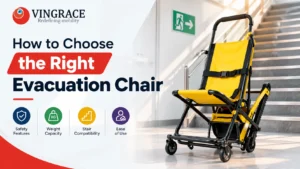
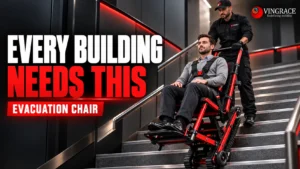
Evacuation chairs: Stored on upper floors, with trained members of staff who practice using them in drills
Accessible emergency exits: At least one emergency exit route that is step-free and wide enough for wheelchair use
This is not just ethical — it is a direct legal liability. If an employee with a disability gets hurt in an emergency due to a lack of an evacuation plan, the employer could face significant legal risks.
How Much Does Corporate Office Accessibility Cost in India?
New Office Fit-Out (Building Accessibility In From the Start)
Adding accessibility during design increases total fit-out costs by about 1–3%. For a 15,000 sq ft office with a ₹2 Cr fit-out budget, this is ₹2–6 lakhs — a very small increment for full compliance and genuine usability.
Retrofit of Existing Headquarters (20,000–60,000 sq ft)
| Intervention | Estimated Cost (India, 2026) |
|---|---|
| Accessible toilets — 1 per floor, 5 floors | ₹10–25 lakhs |
| Ramps and tactile guidance paths | ₹2–7 lakhs |
| Lift upgrades (audio, Braille, controls) | ₹3–12 lakhs per lift |
| Height-adjustable desks — 20 units | ₹5–13 lakhs |
| Accessible parking bay marking and paths | ₹1–3 lakhs |
| Signage — full office | ₹1.5–4 lakhs |
| Hearing loops — 3 conference rooms | ₹1.5–4.5 lakhs |
| Emergency evacuation equipment + PEEPs | ₹1–5 lakhs |
| Total mid-range estimate | ₹25–74 lakhs |
| Total premium headquarters retrofit | ₹75 lakhs – ₹2.5 Crore |
Costs vary by city, building age, scope, and finish level. Figures based on 2025–2026 contractor quotes in Mumbai, Bengaluru, Delhi NCR, and Hyderabad.
How Does Accessibility Connect to ESG, DEI, and BRSR Reporting?
BRSR (Business Responsibility and Sustainability Reporting)
SEBI made BRSR mandatory for India’s top 1,000 listed companies from FY2022–23, and the framework is expanding. Principle 5 of BRSR covers human rights, including the rights of persons with disabilities. Physical workplace accessibility, EOP compliance, and disability hiring data are all directly relevant disclosures.
Companies that cannot demonstrate meaningful accessibility programmes face increasing scrutiny from institutional investors, proxy advisors, and ESG rating agencies including MSCI, Sustainalytics, and CRISIL ESG.
GRI Standards
For companies using Global Reporting Initiative standards:
- GRI 406: Non-Discrimination — covers equal access and reasonable accommodation
- GRI 401: Employment — covers support for employees with disabilities
- GRI 403: Occupational Health and Safety — includes emergency evacuation planning for all employees
Investor and Talent Expectations
A 2023 Deloitte Global survey found that 83% of Gen Z employees consider a company’s DEI record — including disability inclusion — when choosing an employer. For CHROs competing for talent in India’s tight technology and financial services sectors, this matters directly.
The ILO has documented that companies with strong disability inclusion programmes see:
- Up to 30% lower attrition among employees with disabilities
- Measurably higher engagement scores across all employees — not just those with disabilities
- Reduced absenteeism linked to ergonomic and sensory improvements that benefit everyone
What Is a Practical Step-by-Step Plan for a CHRO or Facility Head?
Phase 1: Audit (Month 1–2) — ₹1–5 Lakhs
Commission a formal accessibility audit by a qualified architect or specialist firm. The audit should cover all building features against NBC 2016 standards, the RPwD Act, and international best practice (ISO 21542:2021 is the international standard for accessibility in buildings). You cannot fix what you have not measured.
Phase 2: Policy and People (Month 2–3) — Internal Cost
Update or create your Equal Opportunity Policy. Appoint a Grievance Redressal Officer. Create a disability disclosure framework that encourages employees to share access needs confidentially. Train your HR business partners and line managers on disability etiquette and reasonable accommodation.
Phase 3: Quick Wins (Month 3–6) — ₹5–20 Lakhs
Fix the things that cost little but matter enormously: accessible parking bay marking, tactile tiles at entrances, lift audio and Braille upgrades, signage replacement, accessible toilet grab rails and lever taps, and PEEP documentation for any employees who already have declared disabilities.
Phase 4: Major Infrastructure (Month 6–18) — ₹20 Lakhs–₹2.5 Crore
Full accessible toilet construction, height-adjustable workstations rollout, hearing loops in conference rooms, ramp construction, refuge area creation, and evacuation chair procurement. This phase may span multiple budget cycles and should be planned with your finance leadership.
Phase 5: Sustain and Report (Ongoing)
Conduct annual accessibility reviews. Include accessibility metrics in your BRSR and internal DEI dashboards. Collect feedback from employees with disabilities directly — they are the most reliable audit instrument you have.
Conclusion | Accessibility Is Infrastructure, Not Charity
The most important mindset shift for CHROs, Facility Heads, and ESG leaders is this: workplace accessibility is infrastructure. It is no different from air conditioning, internet connectivity, or fire safety. It is a baseline condition for a functional, legal, and humane workplace.
India’s corporate sector is maturing rapidly on this issue. SEBI, investors, employees, and regulators are all moving in the same direction. Companies that build genuine accessibility into their headquarters and offices now will spend less, comply more easily, attract better talent, and report stronger ESG numbers.
The companies that wait will spend more fixing it under pressure — and take the reputational and legal risk in the meantime.
Frequently Asked Questions (FAQ)
Q: Is workplace accessibility mandatory for private companies in India?
Yes. The RPwD Act 2016 applies to all establishments with 20 or more employees, including private sector companies. An Equal Opportunity Policy is legally required.
Q: Does the law apply to leased offices, not just owned buildings?
Yes. The obligation is on the employer, not only the building owner. Tenants must negotiate accessibility improvements with landlords or choose accessible buildings.
Q: What is a reasonable accommodation under Indian law?
A reasonable accommodation is any modification — to the workspace, schedule, equipment, or process — that allows a person with a disability to do their job. The employer must provide this unless it causes undue hardship to the business.
Q: How do I start if my building is old and retrofitting seems expensive?
Start with an audit. Prioritise the changes that affect the most people and carry the highest legal risk — accessible toilets, evacuation plans, and lift upgrades. Use a phased budget across financial years. Even partial progress is better than inaction.
Q: Are there tax benefits for spending on accessibility in India?
Under Section 80DD and 80U of the Income Tax Act, there are deductions related to disability. For corporate spending on accessibility infrastructure, consult your tax advisor on applicable deductions under capital expenditure rules.
Sources and References:
- Census of India 2011, Office of the Registrar General
- Rights of Persons with Disabilities Act, 2016, Ministry of Law and Justice, Government of India
- National Building Code of India 2016, Bureau of Indian Standards
- ILO: Disability Inclusion in the Workplace, 2019
- Deloitte Global: 2023 Gen Z and Millennial Survey
- Disability Rights India Foundation: Workplace Emergency Evacuation Audit Report, 2022
- SEBI: Business Responsibility and Sustainability Reporting Framework, 2021
- ISO 21542:2021 — Building Construction: Accessibility and Usability of the Built Environment
Related guides: Ramps vs Lifts for Home Accessibility in India | Affordable Solutions for Small Households & Elderly · Mobility Solutions for the Elderly in India – A Family’s Complete Guide 2026 · Hospital & Clinic Accessibility in India | NABH + RPwD Compliance Guide