You have an elderly parent. Or a family member who uses a wheelchair. Or someone recovering from surgery.
And your home has stairs.
Every single day, those stairs become a problem. A risk. A source of worry.
You’ve probably heard about stairlifts, home lifts, and stair climbing wheelchairs. But which one is actually right for your home? Which one fits your budget? Which one is safe, practical, and worth the money?
This guide answers all of that – clearly and honestly.
We will compare all three options side by side, explain how they work, what they cost in India, who they are best for, and help you make the right decision for your family in 2026.
Let’s start from the beginning.
What Is a Stairlift?
A stairlift is a motorized chair that is fixed to a rail along your staircase. The person sits on the chair, presses a button, and the chair carries them up or down the stairs smoothly and safely.
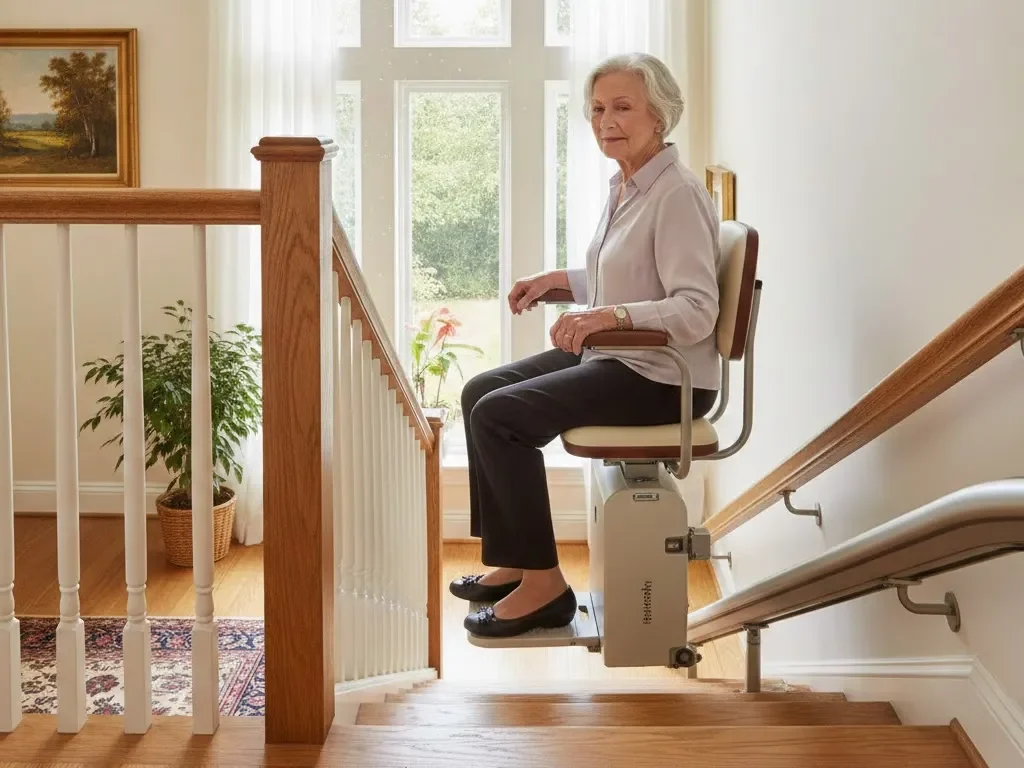
The stairlift stays attached to the wall or staircase rail permanently. It does not take up much space. The person using it does not need to be in a wheelchair – they just need to be able to sit down and stand up with some support.
How it works:
- A rail is fixed along the staircase wall or steps
- A motorized seat glides along the rail
- The user sits, buckles a seatbelt, and presses up or down
- Speed is slow and steady – completely safe
Best for: Elderly people, people with weak knees or hips, people who can walk short distances but struggle with stairs
Not suitable for: Full-time wheelchair users who cannot transfer to a seat independently
What Is a Home Lift?
A home lift (also called a residential lift or home elevator) is a small elevator installed inside or outside your home. It carries the person – along with their wheelchair, walker, or mobility aid – between floors.
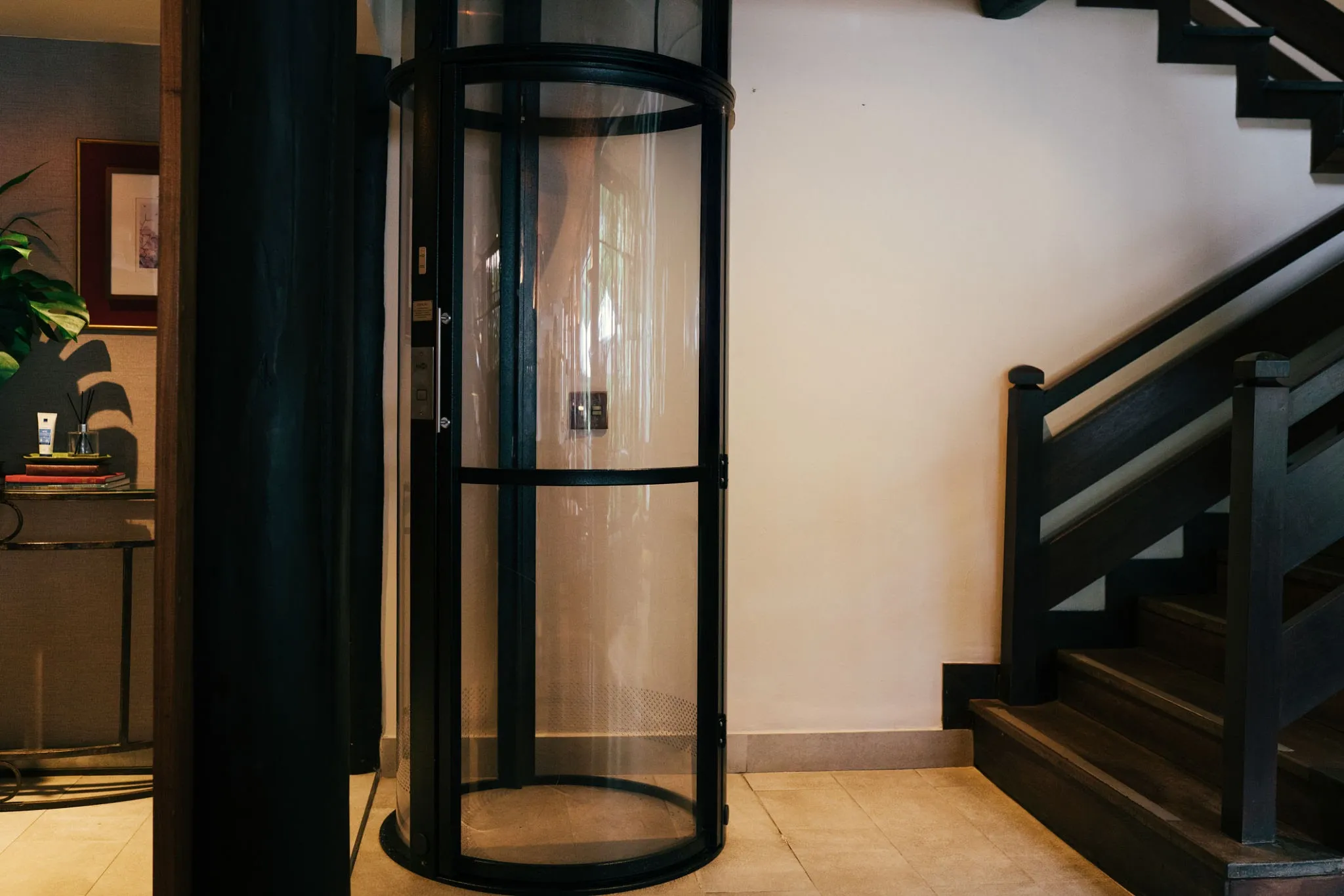
A home lift is the most comfortable and most permanent solution. It works just like a commercial elevator but is designed for residential use.
How it works:
- A shaft or enclosed structure is built in or attached to your home
- A platform or cab moves up and down using hydraulic, electric, or pneumatic systems
- The user wheels in (or walks in) and presses the floor button
Best for: Full-time wheelchair users, people with serious mobility issues, homes where long-term accessibility is needed
Not suitable for: Homes with very limited space, rented homes, or tight budgets
What Is a Stair Climbing Wheelchair?
A stair climbing wheelchair is a special wheelchair that can go up and down stairs – with the help of a caregiver or through its own motorized system.
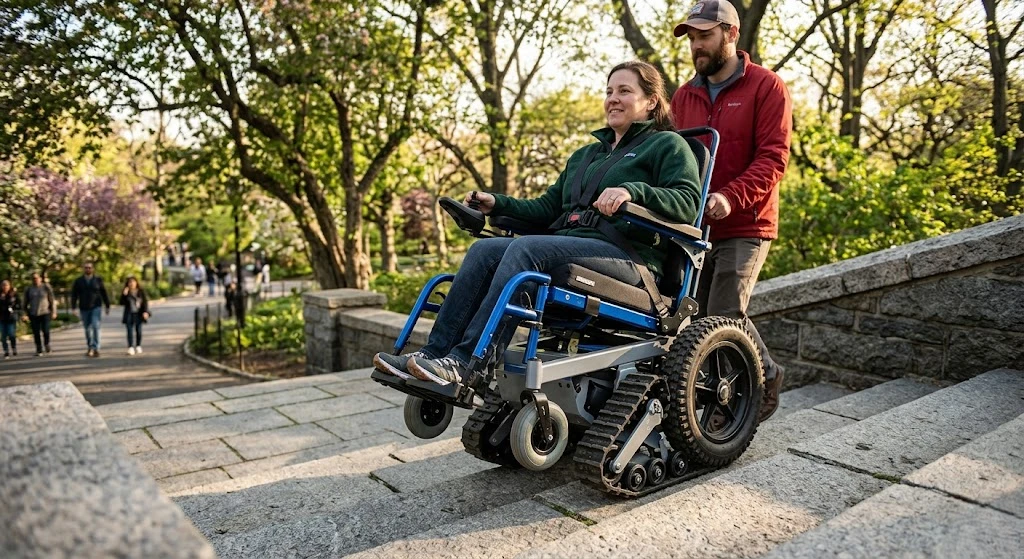
Unlike normal wheelchairs, these use special track systems, rotating wheel clusters, or motorized legs to climb stairs step by step.
How it works:
- The user sits in the wheelchair as usual
- The chair’s track or wheel system engages with the stairs
- A caregiver guides it (manual) or the motor drives it (electric)
- The chair goes up or down safely, step by step
Best for: Full-time wheelchair users, people who travel outside the home, situations where a permanent installation is not possible
Not suitable for: Very heavy users beyond the weight limit, extremely narrow staircases, or users without any caregiver support (for manual models)
Quick Comparison Table
| Feature | Stairlift | Home Lift | Stair Climbing Wheelchair |
|---|---|---|---|
| Installation needed | Yes – rail on stairs | Yes – major installation | No installation needed |
| Works for wheelchair users | No (transfer needed) | Yes | Yes |
| Works outside the home | No | No | Yes |
| Cost in India | ₹1.5L – ₹6L | ₹5L – ₹25L+ | ₹15K – ₹12L |
| Space required | Minimal | Moderate to high | None (portable) |
| Suitable for rented homes | Not ideal | Not ideal | Yes |
| Permanent modification to home | Yes | Yes | No |
| Can be used in multiple locations | No | No | Yes |
| Maintenance required | Moderate | High | Low to moderate |
| Best for | Elderly, partial mobility | Full wheelchair users, long-term | Wheelchair users, travel |
Detailed Comparison – Factor by Factor
1. Cost – Which Is Most Affordable in India?
This is usually the first question Indian families ask. Let’s be honest about the costs.
Stairlift Cost in India: A basic stairlift for a straight staircase starts at around ₹1,50,000 to ₹2,50,000. For curved staircases (which are more complex to install), costs can go up to ₹5,00,000 – ₹6,00,000 or more. Installation charges are usually extra.
Popular brands available in India: Acorn Stairlifts, Brooks Stairlifts, Handicare
Home Lift Cost in India: A residential home lift is the most expensive option. Basic hydraulic or scissor-lift home elevators start at ₹5,00,000 and can go up to ₹20,00,000 – ₹25,00,000 or more depending on the type, floors covered, cabin size, and brand.
Civil work (breaking walls, making a shaft) is an additional cost.
Popular brands in India: Nibav Lifts, Pneumatic Vacuum Elevator (PVE), Otis, Schindler Residential, Kone, Cibes Lifts
Stair Climbing Wheelchair Cost in India: This has the widest price range. Basic manual models cost ₹15,000 – ₹60,000. Electric stair climbing attachment devices cost ₹1,80,000 – ₹3,00,000. Full electric stair climbing wheelchairs cost ₹4,00,000 – ₹12,00,000+.
Winner on Cost: Stair Climbing Wheelchair (most flexible range, no installation cost)
2. Space – What Works in a Typical Indian Home?
Most Indian homes – especially in cities like Mumbai, Delhi, Bangalore, Chennai, or Pune – are not very large. Space is a major factor.
Stairlift: Uses very little space. The rail is fixed along the staircase, and the seat folds up when not in use. A staircase that is at least 70–80 cm wide can usually accommodate a stairlift. This is a good option for compact homes.
Home Lift: Requires the most space. A new shaft or enclosure needs to be created. In existing homes, this means civil work – breaking walls, modifying the floor plan. Not always possible in apartment buildings or older homes with limited space.
Stair Climbing Wheelchair: Requires no space modifications at all. The wheelchair itself navigates the stairs. However, the staircase must be wide enough for the wheelchair – typically at least 70–80 cm. No walls are touched, no rails are fixed.
Winner on Space: Stairlift (rail-based, compact) and Stair Climbing Wheelchair (no installation) – both win for small homes.
3. Suitability for Wheelchair Users
This is a critical difference that many people miss.
Stairlift: A stairlift is NOT designed for wheelchair users. The user must be able to transfer from their wheelchair to the stairlift seat – sit down and stand up with some support. If your family member cannot do this independently, a stairlift will not help them.
Home Lift: A home lift IS suitable for wheelchair users. The user rolls in with their wheelchair, stands in or sits comfortably, and the lift takes them to the next floor. This is one of the biggest advantages of a home lift.
Stair Climbing Wheelchair: Also fully suitable for wheelchair users – because the user stays in the wheelchair throughout the stair-climbing process. There is no transfer needed. This is very convenient, especially for people with paralysis, severe disability, or post-surgery recovery.
Winner for Wheelchair Users: Home Lift or Stair Climbing Wheelchair
4. Permanent vs Temporary – Renting or Relocating?
Many families in India live in rented homes. Or they may need a solution only for a few months – like after a hip surgery or knee replacement.
Stairlift: Installation involves drilling into walls and fixing a rail. Not ideal for rented homes. If you move, you cannot take the stairlift easily. Removal costs extra too.
Home Lift: Major civil modification. Completely permanent. Not at all suitable for rented homes or temporary needs.
Stair Climbing Wheelchair: No installation at all. Fully portable. You can use it in your home, take it to a relative’s house, use it at a hospital, or pack it in your car boot (for foldable models). Best choice for temporary use or rented homes.
Winner for Flexibility: Stair Climbing Wheelchair
5. Safety – Which Is the Safest Option?
All three options, when used correctly, are safe. But each has different safety considerations.
Stairlift: Very safe for people who can transfer independently. Modern stairlifts have seat sensors, seatbelts, obstacle detection, and smooth start-stop controls. Risk is mainly during transfer – getting on and off the seat.
Home Lift: Highly safe. Enclosed cab, smooth ride, no transfer needed. Regular maintenance and annual servicing is essential. Power backup is important – in India, power cuts can be an issue. Good home lifts come with battery backup for emergencies.
Stair Climbing Wheelchair: Safe when used correctly with proper caregiver training. Electric models have automatic braking and anti-tip protection. Key safety factor: the caregiver must be trained and confident. The staircase must be clear and dry.
Winner on Safety: Home Lift (most enclosed and controlled), followed closely by Stairlift
6. Ease of Use – How Simple Is It Day to Day?
Stairlift: Very easy for the user. Sit, buckle, press a button, glide. No caregiver needed during the ride itself. Very independent for elderly users.
Home Lift: Also easy to use. Roll in, press a button, arrive at the next floor. Very smooth. Slightly more process involved (opening doors, ensuring the landing area is clear).
Stair Climbing Wheelchair: Easiest for the user – they just sit and let the caregiver or the electric motor do the work. But it does require an active caregiver for manual models. Electric models are simpler to operate.
Winner on Ease of Use: Stairlift (for users with partial mobility) / Home Lift (for wheelchair users)
7. Maintenance and Running Costs
Stairlift: Requires periodic servicing – usually once a year. Battery-powered rail motors are low-maintenance. Spare parts may need to be imported for some brands, which can be an issue in smaller Indian cities.
Home Lift: Highest maintenance requirement. Annual AMC (Annual Maintenance Contract) is usually mandatory and costs ₹15,000 – ₹50,000 per year depending on the brand and model. Hydraulic systems need oil checks. Electrical systems need regular inspection.
Stair Climbing Wheelchair: Lowest maintenance. For manual models, almost no maintenance needed beyond cleaning. For electric models, battery replacement every few years is the main cost.
Winner on Low Maintenance: Stair Climbing Wheelchair
8. Works Outside the Home?
This is where the stair climbing wheelchair clearly wins.
Stairlift: Fixed to your home. Useless outside. Home Lift: Fixed to your home. Useless outside. Stair Climbing Wheelchair: Goes wherever you go – hospitals, relatives’ homes, temples, government offices, public buildings.
For Indian families where outings, hospital visits, and social events are regular, this matters a lot.
Winner: Stair Climbing Wheelchair
Which Option Is Best for Different Indian Home Types?
Old Independent House or Bungalow (2–3 floors, owned)
Best option: Home Lift or Stairlift
If you own your home and plan to stay long-term, a stairlift (for elderly with partial mobility) or home lift (for full wheelchair users) is the right investment. The permanence is an advantage here.
Apartment in a High-Rise Building
Best option: Stairlift or Stair Climbing Wheelchair
In most apartments, you cannot install a home lift inside your flat – there’s no space for a shaft. A stairlift on the internal staircase (if you have one in a duplex or maisonette flat) or a stair climbing wheelchair is more practical.
For single-floor apartments where the challenge is the building’s common staircase (if the lift is broken or not available), a stair climbing wheelchair is the only real solution.
Rented Home or Temporary Situation
Best option: Stair Climbing Wheelchair
No doubt about it. No installation, no damage, fully portable. When the lease ends or the need is over, you can return or resell the chair.
Post-Surgery Recovery (Short-Term Need)
Best option: Stair Climbing Wheelchair (can also rent one)
After hip replacement, knee surgery, or spine surgery, a patient may need stair help for 3–6 months. A stair climbing wheelchair (or even a rental) makes more sense than installing a stairlift or lift for a temporary need.
Rural or Semi-Urban Homes in India
Best option: Manual Stair Climbing Wheelchair or Basic Stairlift
In tier 2 and tier 3 cities, and rural areas – where after-sales service for expensive home lifts is hard to find – simpler solutions are smarter. A good manual stair climbing wheelchair is low-maintenance, affordable, and doesn’t need any infrastructure.
Real-Life Scenarios – Which Would You Choose?
Scenario 1: 75-year-old grandmother with weak knees, lives in own house in Jaipur, 2 floors She can walk slowly but cannot climb stairs anymore. She does not use a wheelchair. Best choice: Stairlift Simple, safe, she can use it independently. No need for a full lift or wheelchair.
Scenario 2: 55-year-old man with paraplegia, full-time wheelchair user, rented apartment in Mumbai He uses a wheelchair permanently. The building lift is often out of order. He visits clients and hospitals regularly. Best choice: Electric Stair Climbing Wheelchair Portable, works inside and outside the home, no installation needed in a rented apartment.
Scenario 3: Family with elderly father (post-stroke, wheelchair user) in owned 3-floor house in Hyderabad He needs to move between floors daily. Long-term need. Family can invest in a good solution. Best choice: Home Lift Comfortable, dignified, long-term. Worth the investment for a permanent home.
Scenario 4: 40-year-old woman recovering from knee surgery in Chennai, needs 4 months of stair help Temporary need. Rented home. She can walk but not climb stairs yet. Best choice: Stair Climbing Wheelchair (rented) or Stairlift (rented) Short-term rental is smarter than buying or installing anything permanent.
Can You Combine Two Solutions?
Yes – and many Indian families do this.
For example:
- A home lift for daily use inside the house + a stair climbing wheelchair for outside trips
- A stairlift for the main staircase + a stair climbing wheelchair for hospital visits
- A manual stair climbing wheelchair for home use + a portable ramp for short steps outside
Think of your complete access needs – not just the stairs at home, but everywhere your loved one needs to go.
Where to Buy in India
Stairlifts in India
- Vin Grace – A authorised dealer in India, and Vin Grace is the top choice in India for stairlifts, home lifts, and wheelchairs.
- Acorn Stairlifts India – acornstairlifts.com/in
- Brooks Stairlifts India
- ThyssenKrupp Access
- Search on IndiaMart for local dealers in your city
Home Lifts in India
- Vin Grace Lifts – (Mumbai, Chennai, Bangalore, Hyderabad, Delhi, Mostly covers in India)
- Pneumatic Vacuum Elevators –
- Cibes Lifts India
- Otis India, Kone India, Schindler India (for more premium residential options)
Stair Climbing Wheelchairs in India
- Vin Grace – search “stair climbing wheelchair”
- IndiaMart – for bulk or dealer purchases
- Karma Healthcare dealers – pan-India
- Alber Scalamobil – through medical equipment importers
- Justdial – to find local dealers in Delhi, Mumbai, Bangalore, Chennai, Pune, Hyderabad
Government Help and Financial Assistance in India
Regardless of which solution you choose, there may be financial support available.
ADIP Scheme – Assistive Devices for Persons with Disabilities. Run by the Ministry of Social Justice. Provides devices free or subsidized to persons with 40%+ disability and low income. Covers wheelchairs, but check latest updates for stairlift coverage.
Section 80DD and 80U – Tax deduction for expenditure on disabled dependents or self. Consult your CA for details on whether home accessibility equipment qualifies.
State Disability Welfare Boards – Maharashtra, Tamil Nadu, Kerala, Karnataka, and other states have their own schemes. Contact your District Social Welfare Officer.
CGHS / ESI – Government employees may be able to claim partial reimbursement for assistive devices.
Summary – Which Is Best for Indian Homes?
There is no single winner for everyone. The right choice depends on your specific situation.
Choose a Stairlift if: Your loved one can still walk short distances and transfer to a seat. You own your home. The need is long-term. Budget is moderate (₹2L – ₹5L). Staircase is straight and at least 70 cm wide.
Choose a Home Lift if: Your loved one uses a wheelchair full-time or has severe mobility issues. You own your home. You want the most comfortable, permanent solution. Budget is available (₹5L – ₹20L+). You are willing to do civil work.
Choose a Stair Climbing Wheelchair if: Your loved one is a full-time wheelchair user. You live in a rented home or need portability. The need is temporary (recovery period). Budget is limited. You need a solution that works both inside and outside the home. You live in a city where installation-based solutions are not practical.
Final Thoughts
Stairs in Indian homes are a daily reality. And for millions of families caring for elderly parents, disabled relatives, or recovering patients – those stairs are a daily challenge.
The good news is that in 2026, you have real, practical options. Stairlifts, home lifts, and stair climbing wheelchairs are all available in India at different price points.
Take your time. Visit a showroom if possible. Ask for a demo. Involve your loved one in the decision. And choose what works best for your home, your budget, and your life.
Because everyone deserves to move freely – without stairs standing in the way.