At first glance, a stair-climbing wheelchair looks almost like magic – a chair that glides up and down a staircase, carrying a person safely with each step. But there’s no magic involved, just smart engineering. Here’s a simple, easy-to-understand breakdown of how these machines actually work.
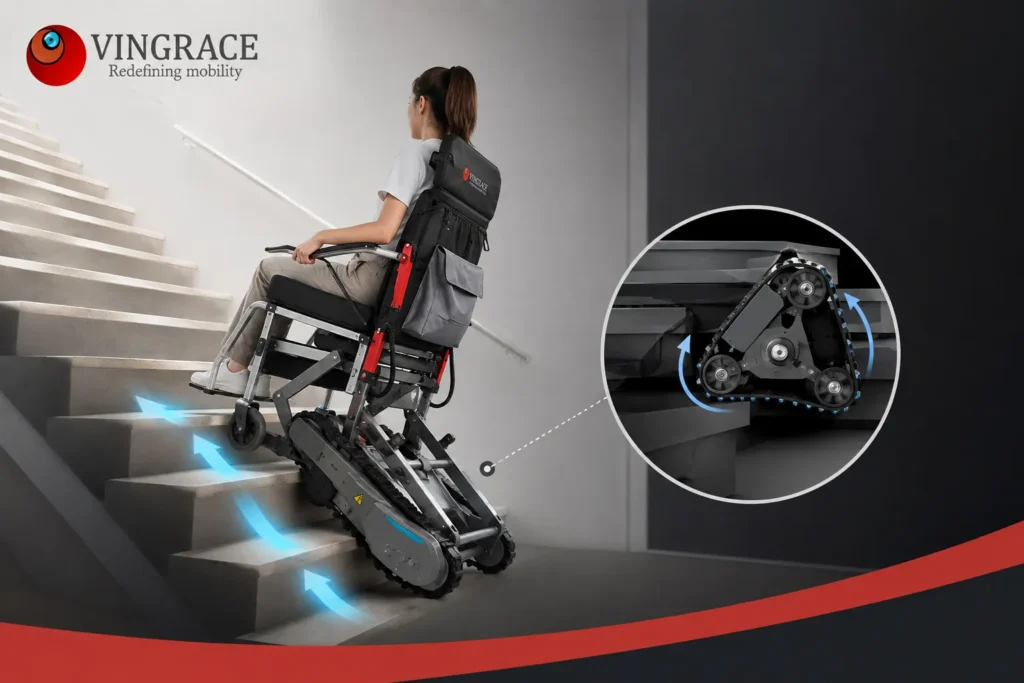
The Core Mechanism – Tracks, Wheels, and Motors
Most stair-climbing wheelchairs use one of two systems to grip the stairs:
- Caterpillar Tracks: Rubberised tracks – similar to those on a small tank – wrap around a set of rollers. These tracks spread the wheelchair’s weight evenly across each step, giving strong grip and stability even on slippery surfaces.
- Rotating Wheel Clusters: Instead of tracks, some models use a cluster of three small wheels arranged in a triangle. As the wheelchair moves, each wheel rotates onto the next step in sequence, creating a smooth stepping motion.
In electric models, a battery-powered motor drives the tracks or wheel clusters. The caregiver controls direction and speed using a joystick or control panel, so very little physical effort is needed.
In manual models, the same track or wheel system is present, but the caregiver provides the pushing force using a handle or lever instead of a motor.
Step-by-Step | How It Climbs a Staircase
- Positioning: The wheelchair is aligned at the base (or top) of the staircase, with the user secured by a harness or seat belt.
- Mode switch: The chair shifts from normal “wheel mode” (for flat ground) into “track mode” for the stairs.
- Sensing the incline: Built-in sensors detect the angle and edge of each step, helping the system know exactly when to move and stop.
- Seat balancing: As the chair moves up or down, an internal tilt mechanism keeps the seat level, so the user always stays upright and comfortable — never tipped forward or backward.
- Step-by-step movement: The tracks or wheels grip one step at a time, moving in a slow, controlled rhythm rather than one continuous motion.
- Braking: If the chair stops midway — say, for a rest — automatic brakes lock the tracks in place so it cannot slide or roll back.
The Safety Features Behind Every Climb
A stair climbing wheelchair isn’t just about movement — it’s built around multiple layers of safety:
- Anti-slip tracks – maintain firm grip on every step, even on textured or slightly wet surfaces
- Automatic braking system – engages instantly if the chair stops mid-staircase, preventing any rolling or sliding
- Seat tilt balancing – keeps the user level and centered throughout the climb
- Adjustable harness/seat belt – holds the user securely in place
- Anti-tip design – prevents the chair from tipping backward during ascent
- Shock absorbers – smooth out vibrations for a more comfortable ride
What Powers an Electric Stair Climbing Wheelchair?
Electric models run on a rechargeable battery – most commonly lithium-ion. On a full charge, a typical unit can climb somewhere between 80–120 stairs before needing a recharge.

A battery indicator on the control panel alerts the caregiver when it’s time to charge. With proper care, batteries generally last well over a year of regular use before they need replacing.
Manual models, by comparison, have no battery at all – the mechanism relies entirely on the tracks or wheel system plus the caregiver’s controlled push, using the lever for balance and speed control.
Why Understanding the Mechanism Matters When Buying
Knowing how the machine actually works helps you ask the right questions before buying:
- Does it use tracks or a wheel-cluster system? (Tracks generally offer more stability on uneven or outdoor stairs.)
- How many sensors does it have, and do they detect both ascent and descent?
- What’s the battery backup time, and how long does a full charge take?
- Does it have auto-braking, or does stopping rely fully on the caregiver?
These are the details that separate a safe, reliable stair-climbing wheelchair from a poorly built one – and they matter just as much as the price tag.
Explore Vin Grace’s Range
Every model at Vin Grace – manual or electric – is built around this same safety-first mechanism: strong tracks, secure harnesses, and stable, step-by-step movement, tested to meet international mobility standards.

If you’d like to see how each option compares in person, you can see all stair climbing wheelchair models and find the one that best fits your staircase and daily needs.
Frequently Asked Questions
Q. Does a stair climbing wheelchair work on curved staircases?
Most standard models are designed for straight or slightly curved stairs. For sharply curved or very narrow staircases, it’s best to consult a mobility expert first.
Q. How long does the battery last on an electric model?
A full charge typically allows 80–120 stairs of climbing, and the battery itself usually lasts 12–18 months with proper care before needing replacement.
Q. Is the seat kept level during the climb, or does it tilt with the stairs?
The seat stays level. A built-in tilt-balancing mechanism automatically adjusts the seat angle so the user remains upright and comfortable throughout the climb.
Q. What happens if the wheelchair stops in the middle of the stairs?
Automatic brakes engage the moment the chair stops, locking the tracks in place so it cannot slide or roll, even mid-staircase.
Q. Can one person operate an electric stair climbing wheelchair alone?
Yes. Since the motor does the climbing work, one caregiver can usually guide the chair using the joystick or control panel, though a second person is recommended for very steep or unusual staircases.