If you’ve ever tried to carry an elderly parent or a wheelchair-bound family member up a flight of stairs, you already know the problem — most Indian homes, clinics, and old apartment buildings weren’t built with lifts or ramps. For millions of families, a normal wheelchair stops working the moment the floor stops being flat.
That’s exactly the gap a stair-climbing wheelchair fills. It’s a mobility device built specifically to move a person up and down steps safely, with or without a caregiver’s help, without anyone having to be lifted or dragged.
This guide breaks down everything a first-time buyer in India needs to know – how these chairs work, what features actually matter, the safety checks you should never skip, realistic price ranges for 2026, and a simple framework to pick the right one for your home. We’ve kept the language simple on purpose, because this decision is usually made by tired, worried families, not engineers.
What Is a Stair Climbing Wheelchair?
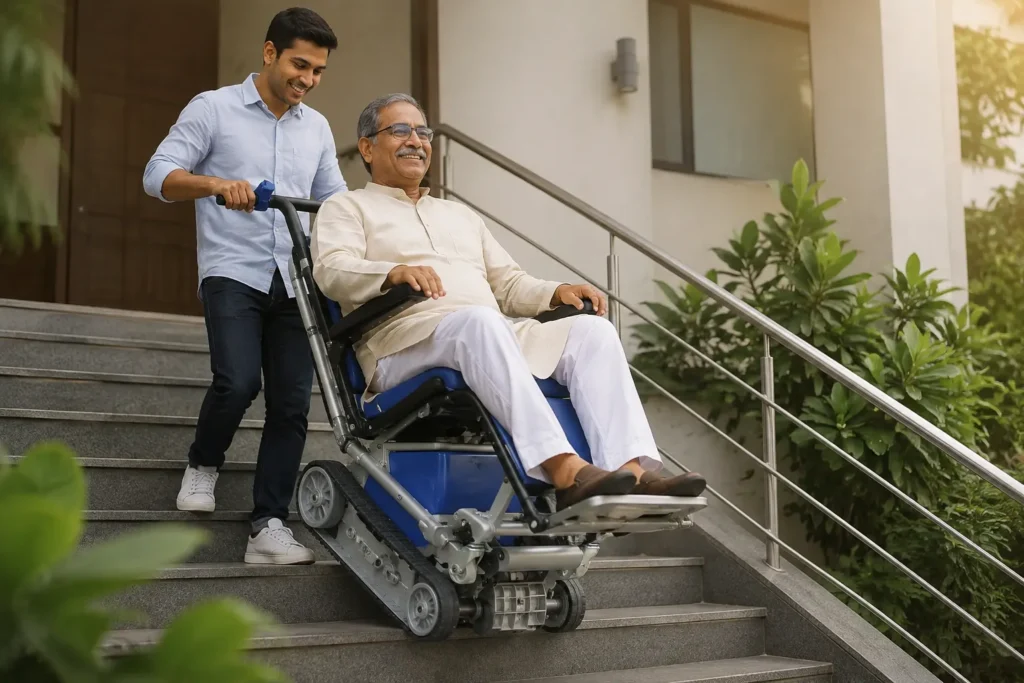
A stair-climbing wheelchair (also called a staircase wheelchair, track wheelchair, or stair chair) is a mobility aid designed to carry a person up and down stairs in a controlled, stable way.
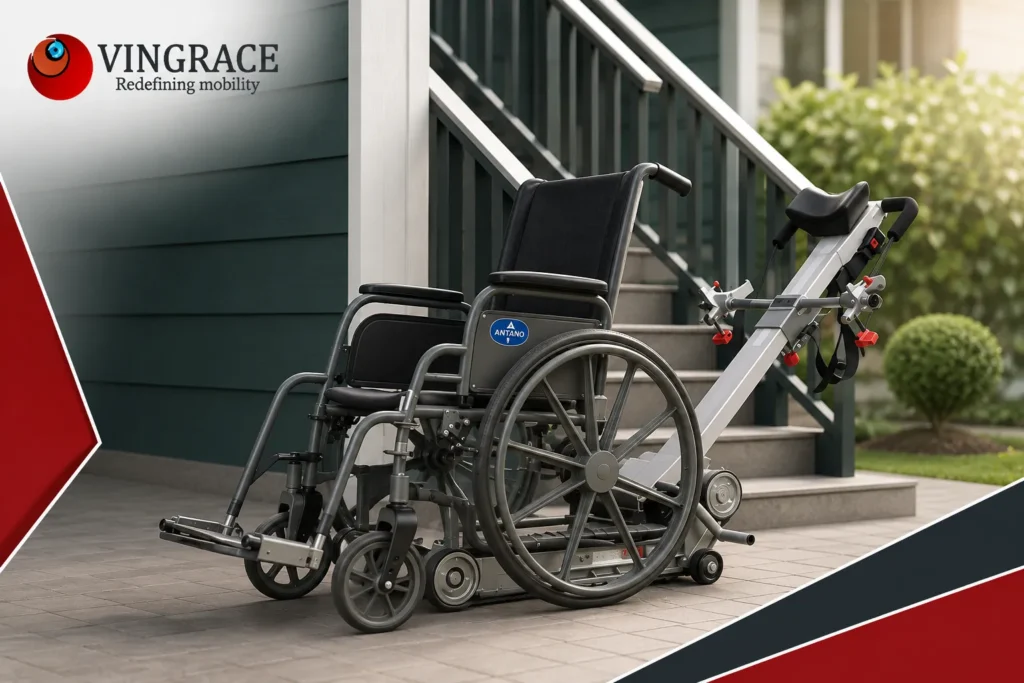
Unlike a regular wheelchair that needs a flat surface or a ramp, this device uses either motorised tracks, stepped wheel clusters, or a caregiver-operated crawler mechanism to grip each step and move the user safely, one level at a time.
Think of it as the middle ground between a manual wheelchair (great indoors, useless on stairs) and a fixed stairlift (great for stairs, useless everywhere else).
A stair-climbing wheelchair is portable – it works on the stairs and rolls like a normal chair once you’re on flat ground. If you want to see how it compares with Vin Grace’s full mobility range, our complete range of products covers stairlifts, home lifts, evacuation chairs, and ramps as well.
Who Actually Needs One?
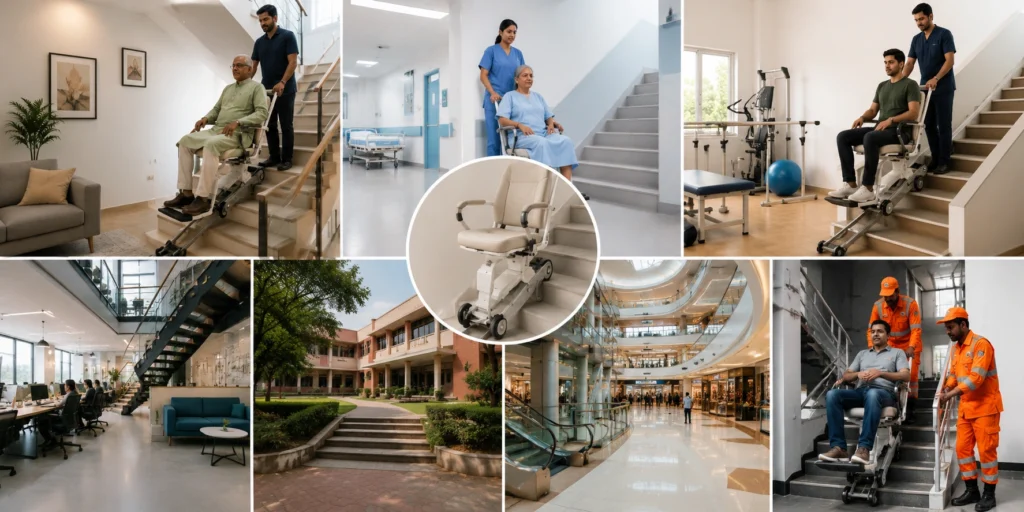
This isn’t a niche gadget. In India, it’s genuinely useful for:
- Elderly parents living in homes or societies without a lift
- Post-surgery patients (hip replacement, knee surgery, spine surgery) who need temporary support
- People with permanent locomotor disabilities who live or work in multi-storey buildings
- Hospitals and nursing homes that need to shift non-ambulatory patients between floors
- Housing societies and hostels that want an evacuation-ready mobility solution for emergencies (paired with an evacuation chair for building-wide emergency readiness)
If stairs are the one thing standing between a person and their independence, this device is built for exactly that situation.
How Does a Stair Climbing Wheelchair Work?
Most modern stair chairs use one of three mechanisms:
- Track-based systems – Rubber caterpillar-style tracks wrap around the wheels. When climbing, the tracks extend and grip the edge of each step, moving the chair up smoothly instead of bumping over each stair.
- Wheel-cluster (star wheel) systems – Small triangular sets of wheels rotate around a central axle, “walking” over each step. These are common in manual, caregiver-assisted models.
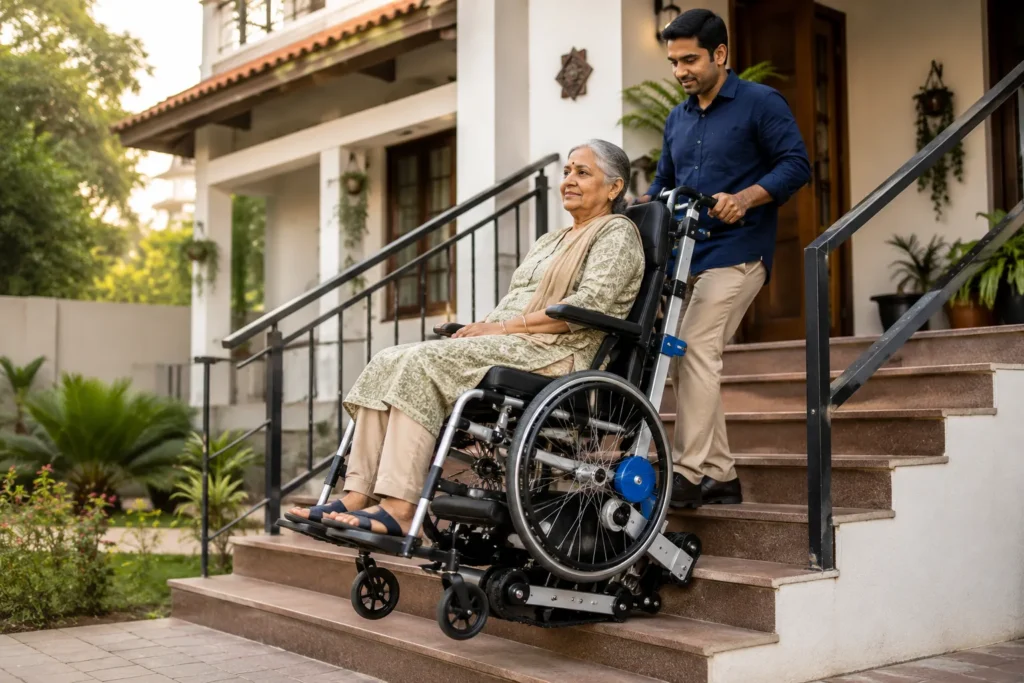
- Attachment-style climbers – A separate motorised base that clips onto an existing wheelchair or is operated by a caregiver, letting the user’s own chair go up stairs without buying an entirely new chair.
Electric models are usually operated with a joystick or push-button remote, either by the user or an assisting caregiver, while manual versions rely on the caregiver controlling the pace using handlebars and a balance mechanism.
Types of Stair Climbing Wheelchairs Available in India
| Type | Best For | Who Operates It |
|---|---|---|
| Manual crawler wheelchair | Budget buyers, short-term recovery | Caregiver-assisted |
| Electric track-based wheelchair | Daily home use, elderly users | User or caregiver via joystick |
| Stair-climbing attachment (e.g., Scalamobil-style) | Users who already own a wheelchair | Caregiver-operated |
| Premium robotic/self-balancing models | Users wanting full independence | Self-operated |
If you’d like to see a real premium example, the Permobil M3 Corpus is an indoor-outdoor, stair-capable wheelchair available through Vin Grace.
Key Features to Check Before You Buy
This is where most buyers get confused, so here’s a practical checklist rather than a marketing list.
1. Battery and Motor Performance
For electric models, check the battery type (lithium batteries are lighter and last longer than lead-acid ones), how many stairs it can climb on a single charge, and how long a full recharge takes. A weak motor will struggle on steep or narrow Indian staircases.
2. Load-Bearing Capacity
Always check the maximum user weight the chair supports, and add a safety margin. A chair rated for exactly the user’s weight isn’t a safe buy.
3. Track or Wheel Design
Anti-slip rubber tracks with good grip matter more than the brand name. Ask for a live demo on your actual staircase before deciding — tiles, marble, and stone steps all behave differently.
4. Stair Compatibility
Not every model handles curved, spiral, or very narrow staircases. Measure your stair width and step height, and confirm compatibility with the seller in writing.
5. Foldability and Portability
If the chair needs to be carried in a car or stored in a small home, check its folded dimensions and weight. Some models fold flat in seconds; others don’t fold at all.
6. Seating Comfort and Adjustability
Look for a padded seat, adjustable footrests, armrests, and headrest support — especially for users who will spend long periods in the chair, not just during stair transfers.
7. Control System
Joystick controls suit users with good hand strength; caregiver-operated push-button panels suit frail or elderly users who can’t manage a joystick themselves.
8. After-Sales Support
This is the most overlooked feature. Ask specifically about warranty period, spare part availability in your city, and whether the company offers on-site servicing – not just phone support.
Safety First – What You Must Never Compromise On
A stair-climbing wheelchair carries a person over a genuinely risky surface — stairs. Safety features aren’t optional extras; they’re the whole point of buying one.
- Seat belts and harness straps — non-negotiable, especially for elderly or disoriented users
- Auto-brake / auto-hold — the chair should lock automatically if paused mid-stair or if power drops
- Anti-tip and anti-slip design — rubber tracks or wheels with proven grip on wet or polished stairs
- Emergency stop button — accessible instantly to both the user and the caregiver
- Weight and balance sensors (in premium models) — prevent tipping if the user shifts position
- Caregiver training — ask the seller for a hands-on demo and, ideally, a short training session before first use
- Certification — check for ISO or equivalent quality certification, and ask for the product’s safety test documentation
A good rule of thumb: if a seller can’t clearly explain the braking and fail-safe mechanism, don’t buy from them.
For broader guidance on selecting appropriate mobility aids, the World Health Organization’s wheelchair provision guidelines are a useful independent reference, even though they don’t cover stair-climbing models specifically.
Stair Climbing Wheelchair Price in India (2026)
Prices vary widely based on mechanism, battery type, build quality, and brand support. Here’s a realistic breakdown based on the current Indian market:
| Category | Approximate Price Range |
|---|---|
| Entry-level manual crawler wheelchairs | ₹15,000 – ₹45,000 |
| Mid-range manual/semi-automatic models | ₹45,000 – ₹1,00,000 |
| Electric track-based wheelchairs | ₹1,00,000 – ₹1,80,000 |
| Stair-climbing attachments (add-on units) | ₹1,80,000 – ₹3,00,000 |
| Premium self-balancing electric models | ₹6,00,000 and above |
Renting is also common for short-term needs, such as recovery after surgery, and typically starts around ₹15,000 per month.
Note: Prices change frequently based on GST, import duty, and raw material costs — always confirm the current price directly with the seller before purchase.
Government Support – The ADIP Scheme
Cost is a genuine barrier for many Indian families, and it helps to know the government has a scheme for exactly this.
Under the ADIP Scheme (Assistance to Disabled Persons for Purchase/Fitting of Aids and Appliances), run by the Department of Empowerment of Persons with Disabilities under the Ministry of Social Justice and Empowerment:
- Persons with 40% or more disability and a monthly household income below ₹15,000 may receive an assistive device, including a wheelchair, free of cost
- Households earning between ₹15,000–₹20,000 a month may be eligible for a 50% subsidy
- Motorised/joystick wheelchairs typically require 80% or more locomotor disability for eligibility
- Applications can be made through the ADIP portal, ALIMCO centres, District Disability Rehabilitation Centres (DDRCs), or Pradhanmantri Divyangjan Kendras
You’ll generally need a UDID (Unique Disability ID) card to apply. It’s worth checking eligibility before you finalise a purchase — it can meaningfully reduce your out-of-pocket cost. For official terms and the full list of approved aids, the ADIP scheme guidelines are publicly available on the department’s website.
Should You Buy or Rent?
| Situation | Better Option |
|---|---|
| Permanent disability or long-term elderly care | Buy |
| Recovery after surgery (weeks to a few months) | Rent |
| Testing whether the device suits your staircase | Rent first, then buy |
| Institutional use (hospital, hostel, society) | Buy, with a service contract |
Renting is a smart way to trial a model on your actual stairs before committing to a purchase – especially since stair width, slope, and flooring vary so much between Indian homes.
How to Choose the Right Stair Climbing Wheelchair – A Simple Framework
Before you buy, walk through these five questions with your family:
- Who is the primary user, and how much hand strength or balance do they have? This decides manual vs. electric.
- What does your staircase actually look like? Measure width, step height, and note if it’s straight, curved, or spiral.
- Is this for daily long-term use or short-term recovery? This decides buy vs. rent.
- What’s your realistic budget, including servicing? Don’t just budget for the chair — budget for annual maintenance too.
- Does the seller offer a demo, training, and local after-sales support? If not, keep looking, regardless of how good the price looks.
Always insist on seeing the chair in person and testing it on your own stairs, or stairs of a similar type, before finalising payment.
Maintenance Tips to Extend the Life of Your Wheelchair
- Charge electric models fully after each significant use; avoid letting the battery drain completely
- Clean tracks or wheels regularly to remove dust and grit that reduce grip
- Get brakes and safety locks inspected every few months, even if nothing feels wrong
- Store the chair in a dry area to prevent rusting of metal parts
- Keep the service contact number and warranty card easily accessible for the whole family
Final Thoughts
A stair-climbing wheelchair isn’t just equipment – it’s what lets someone visit a relative’s first-floor home, get to their own hospital appointment, or simply move around their own house without fear or dependence on being physically lifted.
The right choice comes down to matching the mechanism, safety features, and budget to your specific staircase and your loved one’s needs – not just picking the most advertised model.
Take your time, ask for a demo, check the after-sales support, and don’t hesitate to explore government schemes like ADIP if cost is a concern. The goal isn’t just mobility – it’s dignity and independence for the person using it.
If you’d like personalised guidance, you can explore Vin Grace’s full range of stair climbing wheelchairs or read more mobility guides on the Vin Grace blog, including our earlier piece on the benefits of stair climbing wheelchairs.
Frequently Asked Questions
Q. Is a stair climbing wheelchair safe for elderly users?
Yes, when it has proper seat belts, auto-brake, and anti-slip tracks, and is used with a trained caregiver. Safety comes down to correct usage as much as the product itself.
Q. Can it be used on all types of staircases?
Most models handle straight and gently curved staircases well. Spiral or very narrow stairs need a specific compatibility check with the manufacturer before purchase.
Q. What’s the difference between a stair-climbing wheelchair and a stairlift?
A stairlift is fixed permanently to one staircase and can’t be moved. A stair-climbing wheelchair is portable and works across different locations — home, hospital, or a relative’s house.
Q. Do I need a caregiver to operate it?
Manual and attachment-style models generally need caregiver assistance. Many electric models can be self-operated by the user via joystick, depending on their hand strength and mobility.
Q. Is financial help available for buying one in India?
Yes — the government’s ADIP scheme offers free or subsidised assistive devices, including wheelchairs, to eligible persons with disabilities based on income and disability percentage.
Q. How long does a stair-climbing wheelchair battery last?
This depends on the model and battery type, but most electric wheelchairs need charging after a day’s active use. Always confirm the exact battery backup and charging time with the seller.