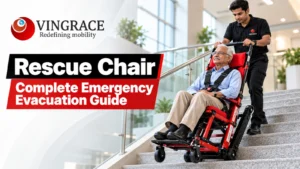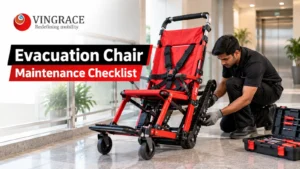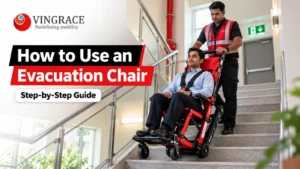
An evacuation chair can save a life. But only if the person using it knows exactly what to do. In a real emergency there is smoke, noise and panic. There is no time to read the manual.
This guide gives you a simple, step-by-step method for how to use an evacuation chair during emergencies, plus the mistakes to avoid and how to practise.
Whether you manage a hospital, an office, a school or a high-rise apartment in India, these steps will help your team act calmly and safely when every second counts.
Quick Answer: How Do You Use an Evacuation Chair?
To use an evacuation chair: (1) bring it to the stair landing, (2) unfold and lock the frame, (3) help the person sit and fasten all straps, (4) tilt the chair back and roll it to the top step, (5) let the tracks rest on the stair edges and walk down slowly behind it with both hands on the handle, (6) turn on landings using the rear wheels, and (7) roll the person to the exit or assembly point. Only trained operators should do this.
Important: Every model is a little different. Always follow the maker’s instructions and get hands-on training before using a chair with a real person.
Before an Emergency: Get Ready
Most of the work happens before the alarm rings. A good plan makes the evacuation calm and quick.
- Know where the chairs are. They are usually at the top of each fire stair or near a refuge area.
- Know who needs help. Each person should have a PEEP (Personal Emergency Evacuation Plan) that names their helpers and route.
- Get trained. Practise with a volunteer, on real stairs, under supervision.
- Check the chair. Monthly checks make sure it opens, brakes and belts work. See our evacuation chair maintenance checklist.
New to these devices? Read what an evacuation chair is first.
How to Use an Evacuation Chair: Step-by-Step
Step 1: Raise the alarm and fetch the chair
Follow your building’s fire plan and call the fire service on 101 (or 112, India’s single emergency number). Do not use normal lifts. Get the chair from its storage point and bring it to the stair landing where the person is waiting.
Step 2: Unfold and lock the chair
Release the storage catch and open the frame until it locks. Pull up the handle to the right height. Check the seat, head rest and belts are ready. Keep the chair on the flat landing, away from the top step.
Step 3: Help the person into the chair
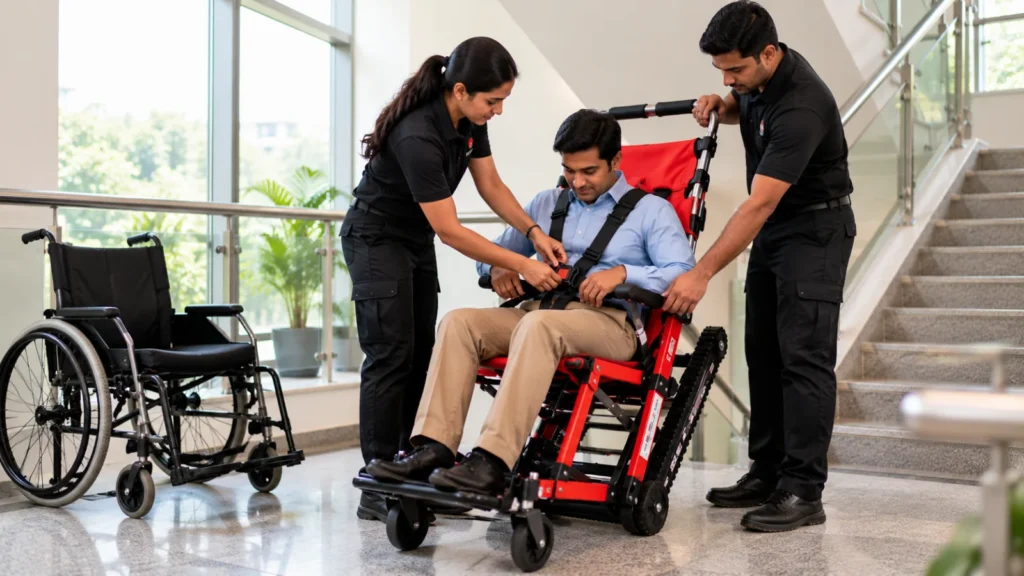
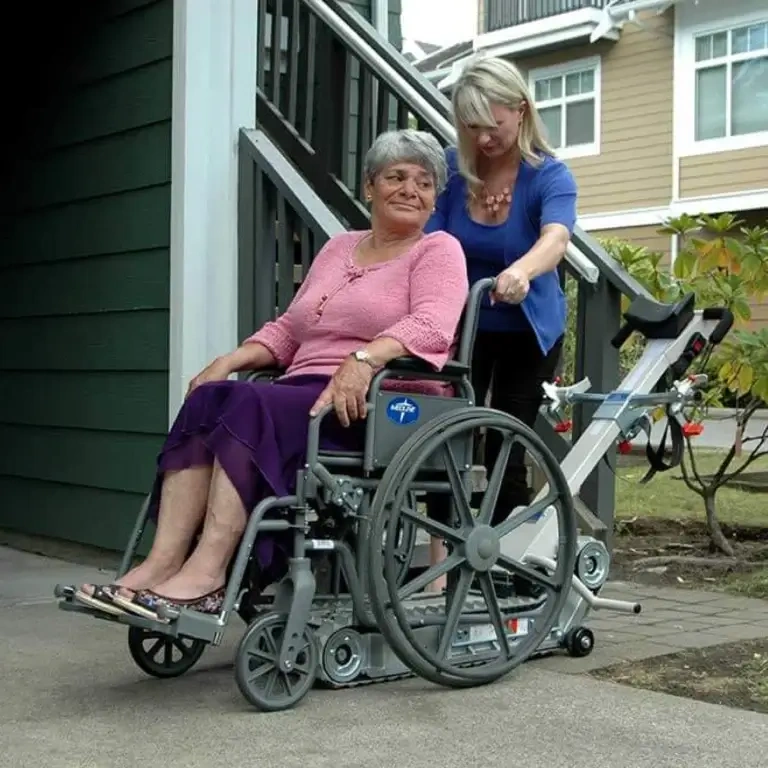
Explain what you are going to do in a calm voice. Ask the person how they prefer to be moved. If they use a wheelchair, put the wheelchair brakes on, line it up next to the evacuation chair and help them across. Use a second helper if needed. Never lift more than you safely can.
Step 4: Fasten all safety straps
Fasten the lap belt first, then chest straps and the head rest if the chair has them. Make sure arms and feet are inside the chair. Ask the person to keep their hands on their lap.
Step 5: Move to the top of the stairs
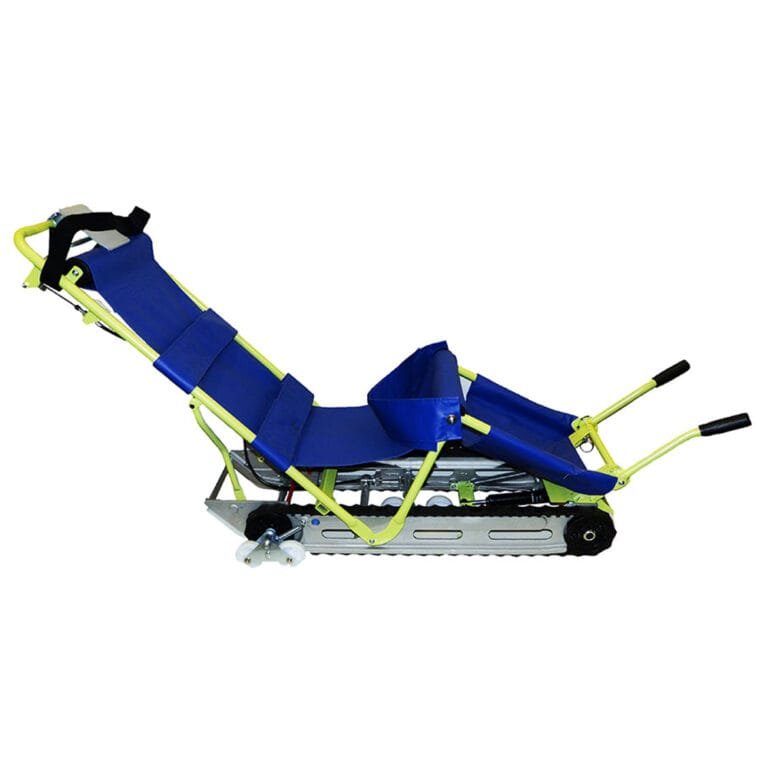
Stand behind the chair. Tilt it back onto its rear wheels and roll it to the edge of the top step. On most track-type chairs, the person faces down the stairs.
Step 6: Go down the stairs slowly
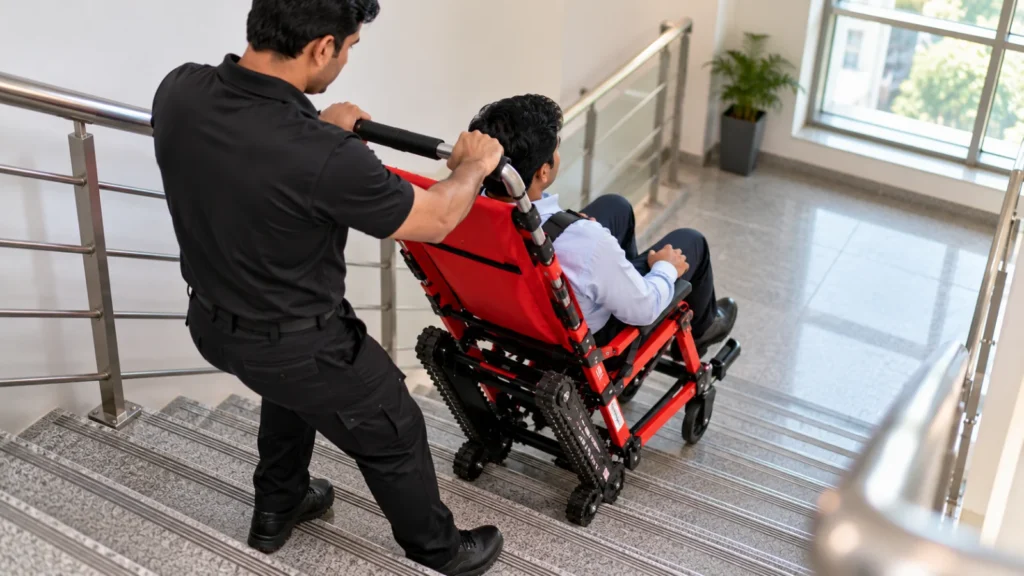
Gently move the chair over the edge until the tracks rest on the stair edges. Hold the handle with both hands. Walk down one step at a time behind the chair. Let the tracks and brakes control the speed. Do not rush and never let go of the handle.
A second helper can walk ahead to open doors and watch the route, but should not pull the chair.
Step 7: Turn safely on landings
At each landing, roll the chair fully onto the flat floor. Tilt it back onto the rear wheels and turn it to face the next flight. Then continue as in Step 6.
Step 8: Reach the exit and hand over
At the bottom, roll the chair away from the stairs to a safe exit or assembly point. Keep the person seated and strapped until they are safe. Hand over to the fire team, medical staff or family. Report that the person is out.
Step 9: After the emergency
Inspect the chair for damage, clean it, and get it checked before it goes back into service. Record the use in your log book.
Using a Powered Evacuation Chair
Powered stair-climbing chairs, such as the Garaventa Power-Trac, can carry a person up as well as down. They are useful for basements, metro stations and hospitals. The basic steps (seat, strap, approach, travel, landing) are similar, but you also need to:
- Check the battery is charged before every shift
- Use the control buttons exactly as trained
- Keep the stair angle within the chair’s rated range
Manual descent chairs, like the Garaventa Evacu-Trac, need no battery and are designed for going down. To compare, read how to choose the right evacuation chair.
Do’s and Don’ts
| Do | Don’t |
|---|---|
| Fasten every strap before moving | Move a person who is not strapped in |
| Keep both hands on the handle | Let go of the chair on the stairs |
| Go slowly, one step at a time | Rush or run down the stairs |
| Check the load limit | Overload the chair |
| Talk calmly to the person | Use normal lifts during a fire |
| Turn on flat landings only | Try to go up with a descent-only chair |
How to Practise: Training and Drills
Skills fade fast if not used. Good practice includes:
- Hands-on training for every operator before they join the evacuation team
- A refresher at least every 6 to 12 months
- Using the chair with a volunteer in at least one fire drill each year
- Training enough people to cover every shift, holiday and night duty
The NFPA and the UK government guide on means of escape for disabled people both stress planning and practice, not just equipment. For Indian rules, see our guide on evacuation chair safety standards in India.
Final Thoughts | Practice Today Makes a Calm Evacuation Tomorrow
Using an evacuation chair is simple once you have done it a few times. The hard part is doing it for the first time during a real emergency. Train your team, practise in drills and keep your chairs checked, so that everyone in your building has a safe way out.
Need training or a demo? Contact Vin Grace for a free on-site demo, or explore our evacuation chairs for stairs.
Frequently Asked Questions
Q. How do you use an evacuation chair step by step?
Bring the chair to the stair landing, unfold and lock it, seat and strap in the person, tilt the chair back and roll it to the top step, let the tracks rest on the stair edges, then walk down slowly behind it with both hands on the handle. Turn on landings using the rear wheels and roll the person to a safe exit at the bottom.
Q. How many people are needed to operate an evacuation chair?
Most manual evacuation chairs can be used by one trained operator. A second helper is useful to open doors, carry the person’s aids and watch the route. Powered chairs and carry chairs may need two people, so follow the maker’s instructions.
Q. Can you use an evacuation chair without training?
It is not safe. Untrained use can cause the chair to tip or run too fast. Every operator should get hands-on training before an emergency and a refresher at least every 6 to 12 months.
Q. Should the person face up or down the stairs?
On most track-type evacuation chairs, the person faces down the stairs and the operator stands behind the chair at the higher step. Always follow the instructions printed on your chair, as designs vary.
Q. Can I use the lift instead of an evacuation chair?
No. In a fire, do not use normal lifts. Use them only if the building has a certified fire or evacuation lift and the fire team tells you it is safe.
Q. What should you do if the person is too heavy for the chair?
Never exceed the chair’s load limit. If a person is over the limit, the PEEP should name another method, such as a higher-capacity chair, a powered chair or waiting in a protected refuge area for the fire service.