Quick answer: An evacuation chair is a light, foldable stair descent device. It lets one or two trained helpers bring a person with limited mobility safely down the stairs during a fire, earthquake, power failure, or lift breakdown, when lifts must not be used. Every multi-storey building needs at least one, because in an emergency the stairs become the only legal way out. For someone who can’t use stairs, there is no way out without one.
Key takeaways
- Lifts shut down in a fire. Once the alarm goes off, the stairs are the only escape route.
- Many people can’t use stairs. About 1.3 billion people worldwide live with a significant disability, and many more have temporary conditions like fractures, pregnancy, or recent surgery.
- Time is everything. In one real case, evacuating a man from the 69th floor took over six hours without a chair, and 1 hour 30 minutes with one.
- No power needed. Manual chairs work even during a total blackout.
- How many: A good starting point is one chair per protected staircase, per floor group.
- Price in India: Certified chairs cost ₹50,000 to ₹1,50,000.
What is an evacuation chair?
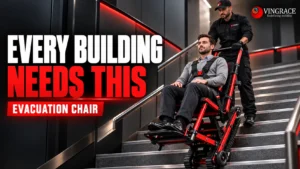
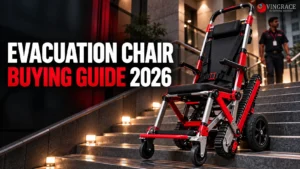
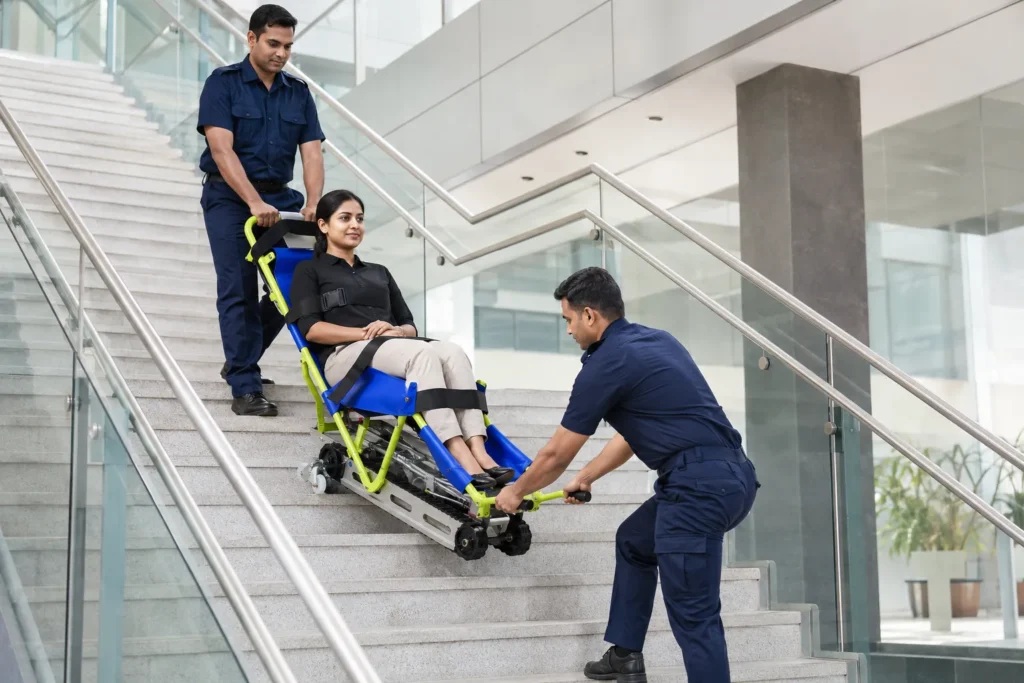
An evacuation chair (also called an emergency stair chair, escape chair, or stair descent device) is a purpose-built piece of fire evacuation equipment. It folds flat against a wall in a bracket or cabinet, opens in seconds, and carries a seated passenger down the stairs at a controlled speed.
How does an evacuation chair work?
The design is simple and deliberately low-tech, so there’s very little that can go wrong.
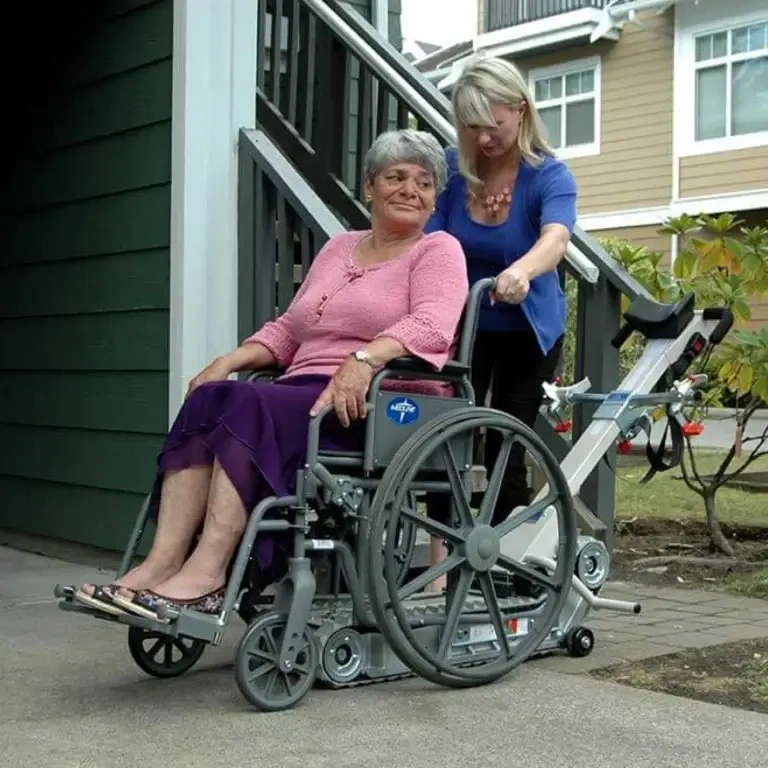
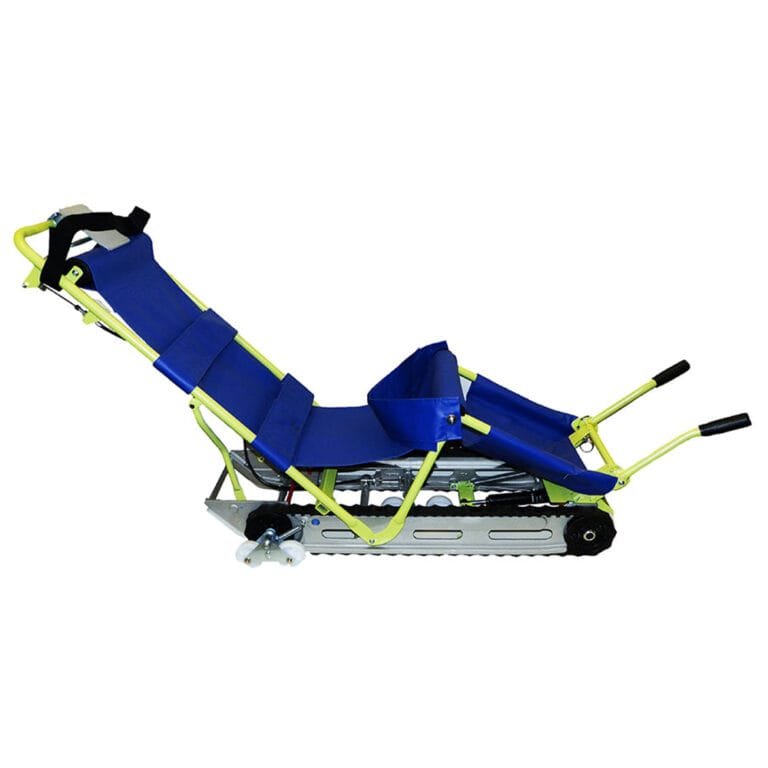
The chair runs on caterpillar tracks. On flat floors, you push it in front of you, just like a wheelchair. When you reach the stairwell, you tilt it back so the tracks rest on the stair treads.
From there, the rubber track grips each step, the passenger’s own weight drives the chair down, and a governor keeps the speed in check. (Source: Wikipedia)
Key features of a certified evacuation chair
- Continuous track belt: Spreads the load across several steps, so the chair glides down smoothly instead of bumping from step to step.
- Descent control brake: The passenger’s weight moves the chair down, a speed governor controls the pace, and a failsafe brake brings the chair to a complete stop on its own.
- Restraint straps: Usually three straps that hold an injured person steady, or support someone with no upper-body control. (Source: Vin Grace)
- Fire-retardant seat fabric: Built to handle fire conditions safely.
- Auxiliary wheels: For crossing landings and corridors quickly.
- Single-operator design: No lifting, no team of four, no risky makeshift carry.
What are the main types of evacuation chairs?
| Type | How it works | Best suited to |
|---|---|---|
| Manual descent chair | Gravity-driven, brake-controlled, goes down only | Offices, schools, hotels, apartments (the default choice) |
| Powered/tracked evacuation chair | Battery motor drives the tracks up and down | Basements, hospitals, buildings that need upward movement |
| Evacuation sledge/mat | A sledge placed under the mattress slides down the stairs | Hospital wards, care homes, bed-bound patients |
| Carry chair (two-person) | Lifted and carried, no tracks | Ambulance and paramedic use, not building evacuation |
Manual or powered | which should you choose?
If you need to move someone upward to reach the exit level, for example from a car park, basement or split-level lobby, choose a powered chair like the Garaventa Power Evacu-Trac.
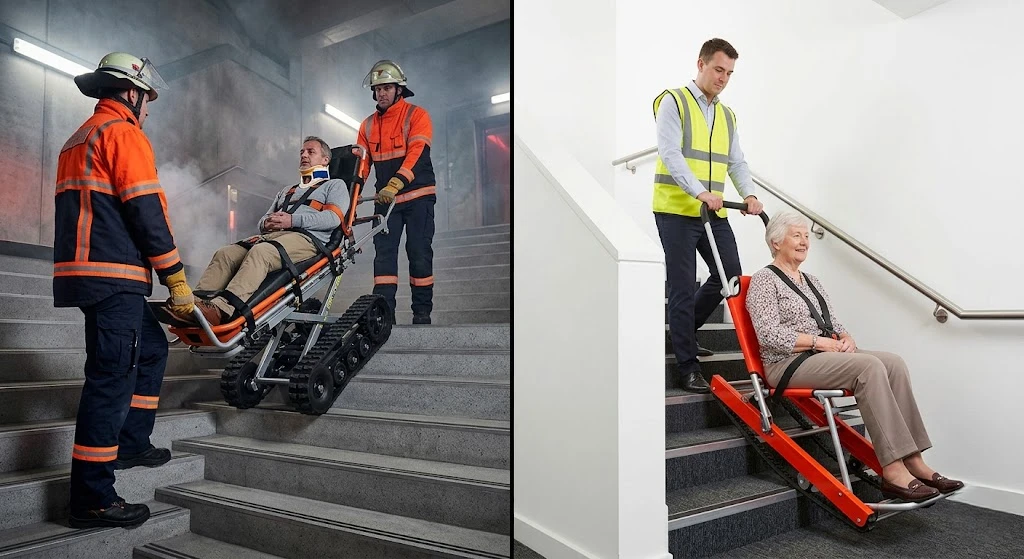
Its strong motor and battery let even a small attendant move a heavy passenger up and down the stairs at the push of a button. An electromagnetic brake stops and holds the chair on the stairs. (Source: Vin Grace)
For standard downward escape, a manual chair such as the Evacu-Trac emergency evacuation chair is lighter, cheaper, and needs no power at all.
Why can’t you use lifts during a fire?
This is the point most building managers miss.
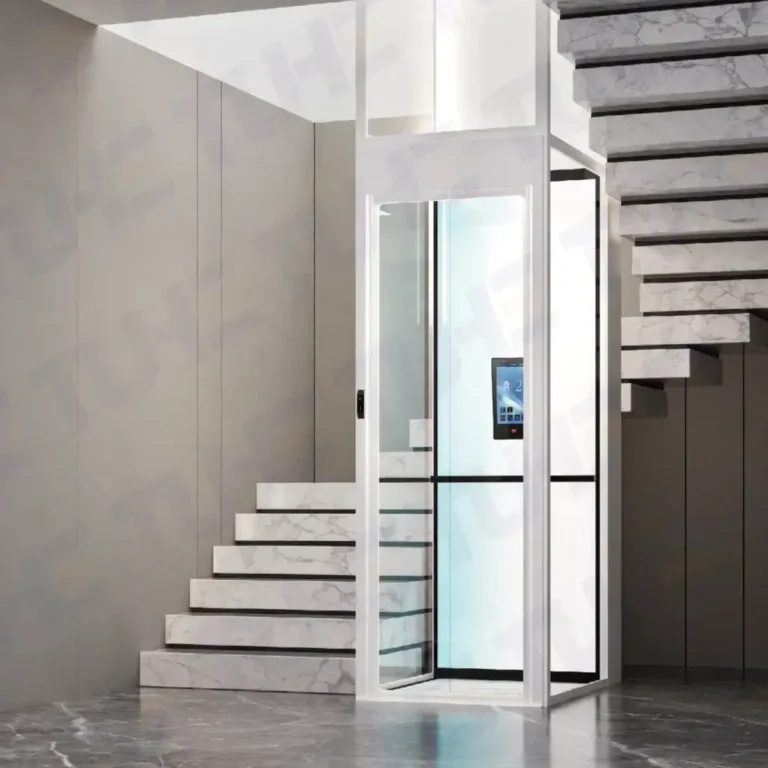
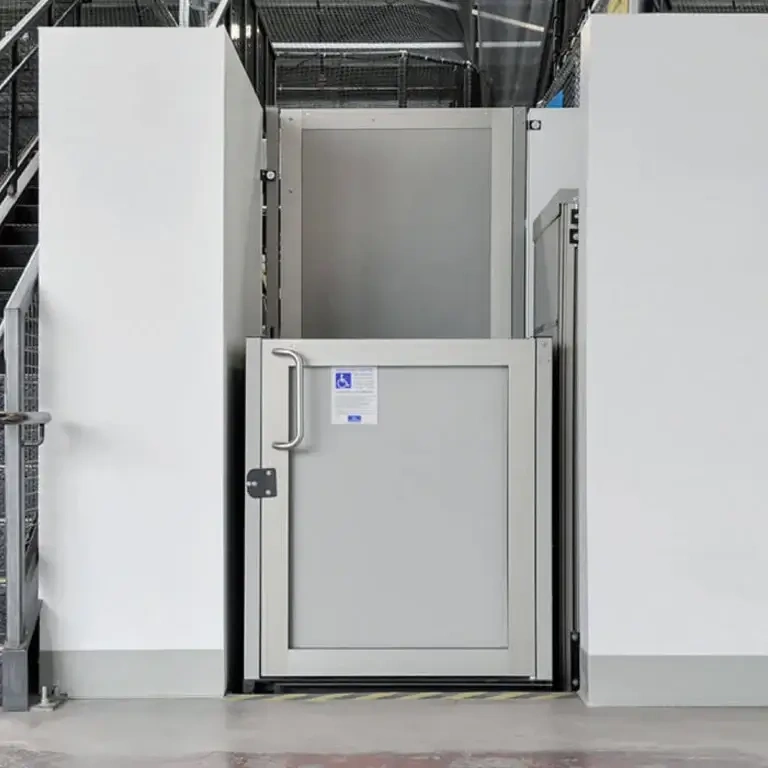
When the fire alarm goes off, every lift in a commercial building is programmed to return to the ground floor and shut down. Even if the building has a fireman’s lift, it is reserved for the fire service, runs on a separate power supply, and is not available to occupants.
That leaves the protected staircase as the only way out. And that’s exactly where the problem lies. A wheelchair user, an employee recovering from surgery, a pregnant visitor, a heart patient, or an elderly resident on the seventh floor suddenly has no route out of the building.
Aren’t refuge areas enough?
Refuge areas help, but they are a waiting point, not an escape. Under Indian fire and life safety rules, a refuge area is a temporary safe zone with cross-ventilation, away from smoke paths.
People who can’t use the stairs wait there for the fire service to rescue them. It is not a final destination. (Source: Infralens)
Waiting only works if firefighters arrive in time and can reach that floor. An evacuation chair removes that dependency.
Why does every building need an evacuation chair?
1. More people need one than you think
The World Health Organization estimates that 1.3 billion people, or 16% of the world’s population, live with a significant disability. That number is growing, as people live longer and noncommunicable diseases rise.
Now add temporary conditions: fractures, late-stage pregnancy, recent surgery, severe asthma, obesity, or an 80-year-old visitor. On any given day, a large office floor almost certainly has someone who can’t walk down fifteen flights of stairs alone.
2. Every minute counts
A real case from the NFPA’s evacuation guidance shows the difference clearly.
During the 1993 World Trade Center bombing, a man with a mobility impairment was on the 69th floor. He had no plan and no evacuation device. Getting him out took over six hours.
In 2001, the same man had an evacuation chair, which he kept under his desk. With help from others, he was out in one hour and thirty minutes. (Source: NFPA Emergency Evacuation Planning Guide)
3. Makeshift carries put everyone at risk
Without a chair, colleagues improvise: a two-person seat carry, dragging someone down concrete steps, or tipping a wheelchair backwards. In a smoky stairwell, with other people rushing past, this injures the rescuer just as often as the passenger.
In fact, researchers study track-type stair descent devices precisely because manual carries put too much physical strain on people, even on trained firefighters.
4. Building codes and duty of care now expect it
India: Fire and life safety rules are issued by the Bureau of Indian Standards (BIS). They become mandatory in practice once states and local bodies adopt them into their building bye-laws.
The framework changed recently. On 30 April 2026, BIS gazetted the National Building Construction Standards, 2026 (SP 7:2026), replacing the National Building Code 2016.
Part 4 (Fire and Life Safety) has been restructured as Part F – Fire and Life Safety. Reported changes include a shift from fixed, prescriptive rules to performance-based guidance, and a rise in the high-rise fire threshold from 15 m to 24 m.
Keep in mind that the new standard is advisory until your state building authority formally adopts it into its bye-laws. Always confirm the current requirement with your state fire service before you submit for a fire NOC. (Source: Directorate General Fire Services, Civil Defence & Home Guards, Ministry of Home Affairs)
Separately, the Rights of Persons with Disabilities Act, 2016 and the Harmonised Guidelines and Standards for Universal Accessibility in India, 2021 place an accessibility duty on public and commercial buildings. That duty doesn’t stop at the entrance door. It covers the way out, too.
United States: The NFPA 101 Life Safety Code recognises stair descent devices as a valid evacuation method. ANSI/RESNA ED-1:2013 is the American National Standard that specifically covers emergency stair travel devices for people with disabilities.
United Kingdom: The rules have just become stricter. New regulations on residential Personal Emergency Evacuation Plans (PEEPs) came into force in England on 6 April 2026. They aim to make sure people living in high-rise buildings who can’t easily evacuate on their own, including people with disabilities, can escape in a fire.
The Fire Safety (Residential Evacuation Plans) (England) Regulations 2025 trace back to the Grenfell Tower Inquiry Phase 1 Report. It found that residents with disabilities were often left without any clear or agreed evacuation plan. (Sources: House of Commons Library, Charles Russell Speechlys)
5. The liability is real
Picture a building that holds a fire NOC and runs regular drills, but still has no way of getting a mobility-impaired person off an upper floor. That gap is on record, and it cannot be defended.
Under UK law, if someone dies in a building because of a lack of proper evacuation equipment, the owners or operators could face corporate manslaughter charges. (Source: Wikipedia) In India, occupier liability under state fire acts follows similar logic.
Which buildings need an evacuation chair the most?
- Hospitals and nursing homes: They have the most people who can’t walk. Patients are first moved sideways to a safe zone, but sooner or later they still need to go down.
- Schools and colleges: Students with disabilities, labs on upper floors, and no lift access during alarms.
- Corporate offices and IT parks: Large floors, long walking distances, and an ageing workforce.
- Hotels: Guests don’t know the building, and staff can’t predict who will need help.
- Malls, cinemas and assembly buildings: Large crowds with an unknown mix of people.
- High-rise residential towers: Elderly residents, and “stay-put” strategies that don’t work for every household.
- Metro stations, airports and government buildings: They have public accessibility duties.
A practical minimum: one evacuation chair per protected staircase, per floor group, in buildings above three storeys. In hospitals, schools and high-rise towers, keep one on every floor above the ground floor.
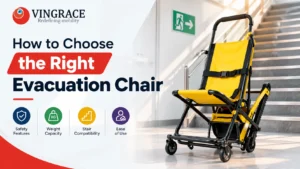
How to choose the right evacuation chair
- Safe working load. Match the rated capacity to the people in your building. Typical certified chairs carry up to 136 kg (300 lbs), and some models are rated for 150 kg or more. (Source: Vin Grace)
- One-person operation. If it needs two trained people, it will fail on a night shift.
- Fits your stairs. Measure step depth, step height, landing width, and the turning space on dog-leg stairs. Narrow or winding stairs rule out some models.
- Manual or powered. Go powered only if you need to move people upward or have very long descents. Otherwise, a manual chair is quicker to set up and has no battery to maintain.
- Storage and signage. Keep the chair in a storage cabinet near the upper stair landing, ready for instant use. Mark it with clear signs and keep the path to it free. (Source: Vin Grace)
- Certification and after-sales support. Before you buy, ask for test certificates, a warranty, spare track belts and a servicing schedule.
- Training included. A chair nobody has practised with is a prop, not a safety device.
You can compare specifications across the full evacuation chair for stairs range, and see how they fit alongside other options in the Vin Grace mobility products line-up.
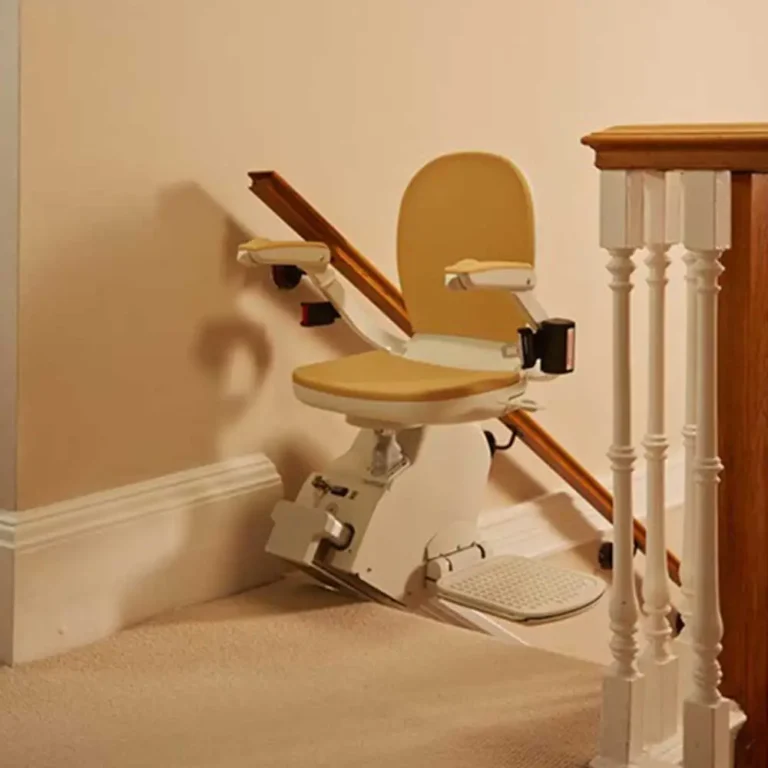
Evacuation chair vs stairlift vs stair climbing wheelchair
People mix these three up all the time, but they solve different problems.
| Feature | Evacuation chair | Stairlift | Stair climbing wheelchair |
|---|---|---|---|
| Purpose | Emergency escape only | Daily access | Daily access, portable |
| Power | None (or battery) | Mains + battery backup | Battery |
| Installation | Wall bracket, no civil work | Rail fixed to the staircase | None |
| Works in a fire or power cut | Yes | No | Limited |
| Blocks the staircase | No | Rail takes up part of the stair | No |
An evacuation chair does not replace daily accessibility. If your building needs everyday step-free movement, look at stair climbing wheelchairs or platform lifts. But keep an evacuation chair for emergencies too, because you can’t count on those when the power goes.
Training, drills and maintenance
Buying the chair is only about 30% of the job. The rest is people and practice.
- Train evacuation assistants on every floor, at least two per shift. Training should cover opening the chair, moving someone across from a wheelchair, fitting the straps, controlling the brake, and turning on landings.
- Use the chair in every fire drill. A drill that never uses the chair tells you nothing about whether your plan actually works.
- Write individual evacuation plans. Note who needs help, where they usually are, who will help them, and which staircase they’ll use. Ask each person how they’d like to be helped, because preferences vary a lot. And make sure emergency services are told right away about anyone still inside and where they are. (Source: Stanford University)
- Inspect monthly, service yearly. Check track wear, brake function, strap condition, battery charge on powered units, and that the cabinet is unlocked and easy to reach.
- Review after any change, such as a new tenant, a new floor layout, a renovated staircase or a new resident with mobility needs.
Evacuation chair price in India
The price depends on three things: manual vs powered, load rating, and brand.
In India, certified emergency evacuation chairs for hospitals, offices, hotels, and public buildings currently cost between ₹50,000 and ₹1,50,000. Powered tracked models cost more. (Source: Vin Grace)
Compared with the cost of a single life-safety failure, it is the cheapest item in any fire safety budget.
The bottom line
When the fire alarm goes off, every lift in the building becomes useless, and every staircase becomes the only way out. For most people, that’s an inconvenience. For one person on your fourth floor, it’s the difference between walking out and waiting.
A manual evacuation chair costs less than a workstation. It needs no civil work, no power, and no special permission. And it’s the one piece of equipment in your building that closes that gap.
If you’re planning fire safety equipment for an office, hospital, school, or residential tower, start with a certified evacuation chair and build your training and drill schedule around it.
Frequently asked questions
Q. Is an evacuation chair mandatory in India?
No single national rule names the product. The requirement comes indirectly. Fire and life safety provisions in the BIS building standards are enforced through state and municipal bye-laws, and the Rights of Persons with Disabilities Act, 2016 requires buildings to be usable and escapable by persons with disabilities. In practice, fire officers and accessibility auditors increasingly expect to see one. Confirm the current position with your state fire service.
Q. Can one person operate an evacuation chair?
Yes. Certified stair descent chairs are designed for one person to operate when going down. A second person at the front helps on wide or steep stairs, but isn’t required. Going up the stairs usually needs a powered model.
Q. How fast is an evacuation chair?
A trained operator can open the chair and start going down in under 60 seconds, then move at roughly one floor every 20 to 30 seconds.
Q. Does an evacuation chair need electricity?
Manual models need none, which is the whole point: they work during a total power failure. Powered models use a rechargeable battery, not mains power.
Q. How many evacuation chairs does a building need?
Base it on your fire risk assessment: the number of protected staircases, the floors above ground, and the number of people who can’t evacuate on their own. One per staircase, per floor group, is a sound starting point.
Q. Where should an evacuation chair be stored?
In a marked cabinet or wall bracket at the top landing of each protected staircase, inside the fire-protected zone. Never keep it behind a locked door.
Q. Why can’t lifts be used during a fire?
Lifts in commercial buildings are programmed to return to the ground floor and shut down when the fire alarm goes off. A fireman’s lift, if there is one, is reserved for the fire service. That leaves the protected staircase as the only way out for everyone else.
Q. What is the difference between an evacuation chair and a stairlift?
An evacuation chair is emergency equipment. It needs no civil work and works in a fire or power cut. A stairlift is for daily use, runs on a rail fixed to the staircase, and does not work in a fire.
Q. How much does an evacuation chair cost in India?
Certified evacuation chairs in India cost between ₹50,000 and ₹1,50,000, depending on manual vs powered, load rating and brand. Powered tracked models cost more.