In India’s rapidly growing urban landscape—with high-rise apartments, hospitals, corporate offices, schools, and malls—ensuring safe emergency evacuation is critical.
When elevators fail during fires, earthquakes, or power outages, people with mobility challenges, the elderly, or injured individuals need specialized equipment. This brings us to two commonly discussed solutions: rescue chairs and evacuation chairs.
Many use these terms interchangeably, but understanding their differences helps Indian facility managers, building owners, and safety officers make the right choice for compliance with the National Building Code (NBC) 2016, RPwD Act 2016, and local fire safety norms.
What is an Evacuation Chair?
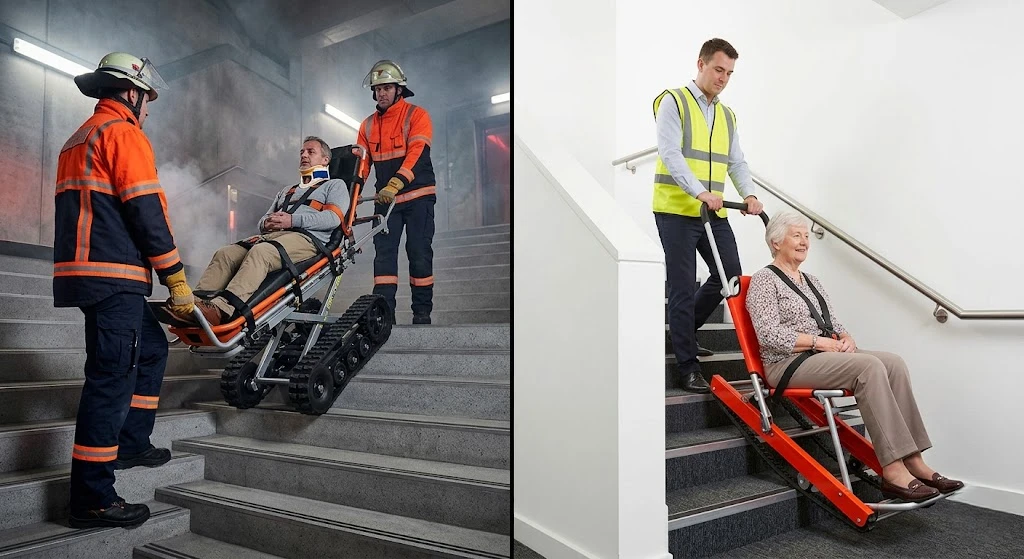
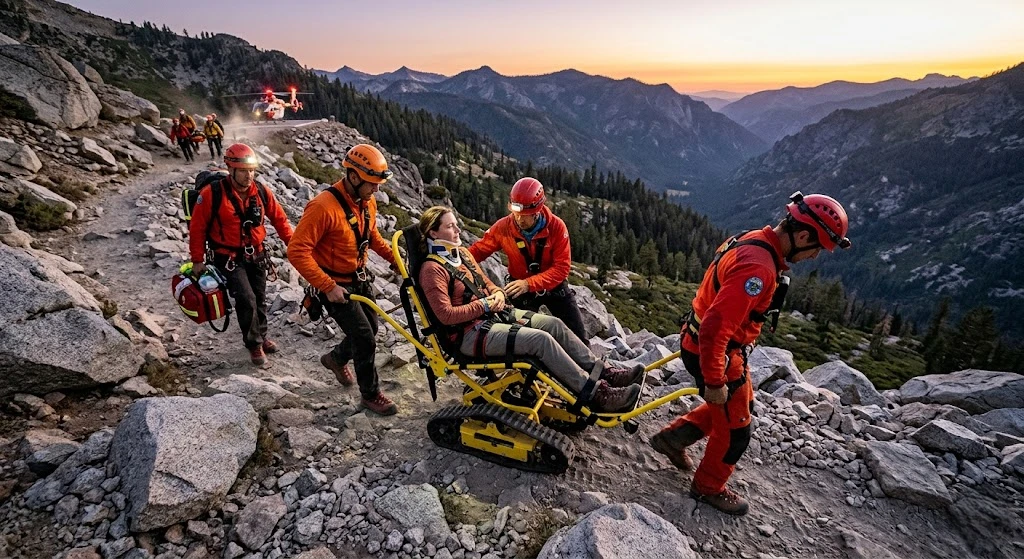
An evacuation chair (also called a stair evacuation chair or escape chair) is a lightweight, foldable, track-equipped device designed specifically for descending stairs during emergencies. It allows one or two trained operators to safely transport a seated person down multiple floors when elevators are unavailable.
Key Features:
- Rubber or caterpillar tracks for controlled descent on stairs.
- Secure harnesses/straps to hold the occupant.
- Compact, wall-mountable design for quick access.
- Weight capacity typically 110–180 kg (varies by model).
- Suitable for conscious individuals who can sit upright.
These are ideal for offices, high-rise residential buildings, hotels, and educational institutions across India.
What is a Rescue Chair?
A rescue chair is often a broader or interchangeable term for emergency transport chairs used in rescue operations. In some contexts, it refers to:
- Heavy-duty versions for EMS or hospital use.
- Chairs designed for both evacuation and patient rescue in medical emergencies.
- Variants like confined space rescue chairs or those that can handle unconscious/injured patients better.
Some manufacturers market “rescue chairs” as multi-purpose devices that may include wheels for flat surfaces and tracks for stairs, sometimes with higher durability for frequent medical transfers.
Note: True distinctions are minimal in most Indian markets. Many suppliers (including Vin Grace) use the terms synonymously for stair-descent devices. For non-ambulatory or lying-down patients, rescue sleds, evacuation mattresses, or stretchers are alternatives.
Key Differences: Rescue Chair vs Evacuation Chair
| Aspect | Evacuation Chair | Rescue Chair (or Heavy-Duty Variant) |
|---|---|---|
| Primary Use | Emergency building evacuation (fire, quake) | Medical rescue + evacuation |
| Patient Position | Seated (conscious/cooperative) | Seated or adaptable for injured |
| Operator | Usually 1 trained person | 1–2 persons |
| Stair Performance | Excellent with tracks | Good, may be bulkier |
| Storage | Wall-mounted, compact | May be stackable or vehicle-based |
| Weight Capacity | 110–160 kg typical | Up to 180+ kg |
| Best For | Offices, apartments, schools | Hospitals, EMS, high-risk facilities |
| Speed | Fast deployment | Slightly slower if more robust |
Bottom line: For most Indian buildings, a quality evacuation chair suffices as a “rescue chair.” Hospitals or EMS may prefer more robust rescue-oriented models.
Common Uses in India
- High-Rise Apartments & Offices: Mandatory risk assessments under fire safety rules. Delhi, Mumbai, Bengaluru, and Hyderabad see increasing demand due to dense vertical living.
- Hospitals & Healthcare: Evacuating patients during fires or disasters.
- Schools & Colleges: Supporting students and staff with disabilities under RPwD Act.
- Shopping Malls & Hotels: Public safety compliance.
- Industrial Facilities: Handling workers in multi-level plants.
Evacuation chairs shine in scenarios where elevators are out of service—the most common issue in Indian fire incidents.
Benefits of Using Evacuation/Rescue Chairs
- Enables independent, dignified evacuation for PwD (Persons with Disabilities).
- Reduces reliance on firefighters carrying people manually (risky and time-consuming).
- Helps meet legal obligations and obtain Fire NOC.
- Compact and low-maintenance.
- Trainable in a single session for staff.
Indian Regulations & Compliance (2026 Update)
While no specific BIS standard exclusively mandates evacuation chairs yet, compliance is driven by:
- National Building Code (NBC) 2016 – Emphasizes safe egress for all occupants.
- Rights of Persons with Disabilities (RPwD) Act 2016 – Requires reasonable accommodations for evacuation.
- Fire Safety Norms (State Fire Departments) – Many cities require evacuation plans for buildings above certain heights.
- International references like BS 8485:2015 often specified in tenders.
Recommendation: Consult your local fire authority. Installing certified chairs demonstrates due diligence and can reduce liability.
Which One Do You Need in India?
Choose an Evacuation Chair if:
- You manage offices, apartments, schools, or commercial buildings.
- Budget is a concern (good models start affordably).
- Primary need is quick stair descent for seated occupants.
Choose a Robust Rescue Chair if:
- You run a hospital or handle frequent medical transfers.
- Higher weight capacity or durability is needed.
- You deal with potentially unconscious patients (consider sleds too).
For most users in India: A reliable single-operator evacuation chair like those from Vin Grace, Garaventa, or Evac+Chair equivalents is the practical choice.
Top Considerations When Buying in India
- Certifications — CE, BS 8485, or equivalent.
- Weight Capacity — At least 150 kg for Indian demographics.
- Track Quality — Rubber tracks for smooth, controlled glide.
- Ease of Use — Single-person operation preferred.
- After-Sales Service — Critical in India; choose brands with local support (Vin Grace excels here).
- Price Range — ₹35,000 – ₹1,50,000 depending on model and features.
- Training — Ensure supplier provides staff training.
Why Vin Grace for Your Evacuation Needs?
At vingrace.com, we specialize in mobility and safety solutions tailored for Indian conditions. Our evacuation chairs are:
- Suitable for Indian staircases (narrow landings common).
- Backed by strong after-sales and installation support across major cities.
- Compliant with global standards while being competitively priced.
We help with site assessment, product recommendation, training, and maintenance contracts.
Conclusion: Invest in Safety Today
Whether you call it a rescue chair or evacuation chair, having the right device can save lives during India’s frequent fire and seismic risks. Don’t wait for an incident—conduct a fire risk assessment and equip your building responsibly.
Ready to choose the right evacuation solution for your facility? Contact Vin Grace today for expert guidance, demos, and quotes tailored to your building in India.
FAQs
Q1. Is there a difference between a rescue chair and an evacuation chair?
Answer: In most Indian markets, the terms rescue chair and evacuation chair are often used interchangeably. However, evacuation chairs are primarily designed for safely transporting people down stairs during emergencies, while some rescue chairs may offer additional features for medical transfers or handling injured patients. For most buildings, a quality evacuation chair serves both purposes effectively.
Q2. Who should install evacuation or rescue chairs in India?
Answer: Evacuation or rescue chairs are recommended for high-rise apartments, offices, hospitals, schools, colleges, hotels, shopping malls, and other multi-story buildings. They help ensure safe evacuation of elderly individuals, people with disabilities, and injured occupants during emergencies when elevators cannot be used.
Q3. Are evacuation chairs mandatory under Indian regulations?
Answer: While Indian laws do not specifically mandate evacuation chairs by name, the National Building Code (NBC) 2016 and the Rights of Persons with Disabilities (RPwD) Act 2016 require safe evacuation arrangements for all occupants, including persons with disabilities. Installing evacuation chairs is one of the most practical ways to meet these requirements.
Q4. Can one person operate an evacuation chair on stairs?
Answer: Yes. Most modern evacuation chairs are designed for single-operator use and feature controlled descent tracks that allow trained staff to move a seated occupant safely down stairs. Some heavier-duty models may require two operators depending on the occupant’s weight and the building layout.
Q5. What is the price of an evacuation chair or rescue chair in India?
Answer: The price of evacuation and rescue chairs in India typically ranges from ₹35,000 to ₹1,50,000, depending on the model, weight capacity, track system, certifications, and additional features. Premium models designed for hospitals or heavy-duty applications may cost more.
Q6. What is the best option for evacuating unconscious patients?
Answer: Standard evacuation chairs are best suited for seated occupants. For unconscious, bedridden, or severely injured patients, facilities should consider evacuation sleds, evacuation mattresses, or stretchers, which provide better support during emergency evacuations.