As parents grow older, something as simple as walking up to the bedroom or coming down for meals can quietly turn into a daily source of anxiety – for them, and for you.
Most Indian homes are multi-storey, often without a lift, which means stairs are one of the single biggest safety risks facing elderly parents living at home.
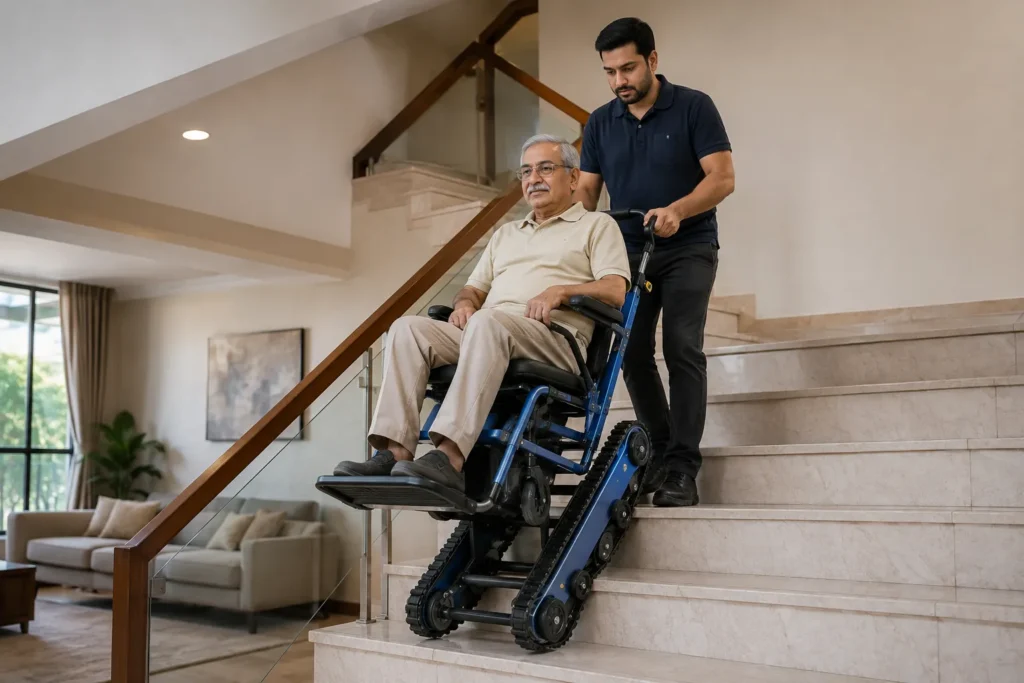
A stair-climbing wheelchair is built exactly for this situation. It gives your parents back their independence while giving you real peace of mind – without construction, structural changes, or the recurring cost of a stairlift installation.
This guide covers everything a caregiver in India needs to know: why stairs are risky for ageing parents, how these wheelchairs work, manual vs electric models, current price ranges in India, and a practical checklist before you buy.
Why Stairs Are a Real Risk for Elderly Parents
Ageing brings changes that make stairs genuinely dangerous: weaker knees, poor balance, arthritis, reduced vision, or recovery from a fall or surgery. Even a short flight of 10–12 steps can feel like climbing a mountain.
The fear isn’t exaggerated. Research on older adults in India shows that a large majority who fall end up with an injury — over 65% suffer outcomes such as fractures or head trauma.
A single stair fall can mean a fractured hip, weeks of hospitalisation, or a lasting fear of moving around the house at all – a fear that, left unaddressed, causes many seniors to avoid stairs altogether and gradually confine themselves to a single floor.
For families, this usually plays out in one of two ways:
- Parents self-restrict — sticking to one floor and missing out on parts of their own home (their bedroom, terrace, or puja room).
- A family member becomes the “human stairlift” — physically supporting or carrying the parent every single time, which is exhausting and risky for both people, especially if the caregiver is also older.
Neither outcome is sustainable long-term. This is exactly the gap a stair climbing wheelchair fills.
What Is a Stair Climbing Wheelchair — and How Does It Work?
A stair climbing wheelchair (also called a stair-climbing chair, track wheelchair, or motorized stair wheelchair) is a mobility device that carries a seated person up or down a staircase step-by-step, without them needing to walk, bend their knees, or bear weight on the stairs.
Instead of installing rails on the wall like a traditional stairlift for elderly, the chair itself does the climbing — using either:
- Caterpillar-style rubber tracks (similar to tank treads) that grip the edge of each step for a smooth, stable climb, or
- Rotating wheel clusters at the front and back that “walk” over each step.
A trained caregiver guides the chair from behind, or — in electric models — simply operates a joystick while the onboard motor does the physical work.
Key Benefits for Elderly Parents
- Fall prevention: Anti-slip tracks, seat harnesses, and auto-braking remove the single biggest risk factor on stairs — losing balance mid-step.
- More independence: Parents can move between floors, or travel to a mall, a relative’s home, or a hospital corridor, without depending entirely on someone else.
- Reduced caregiver strain: Instead of physically lifting or supporting an elderly parent, the caregiver simply guides the chair — far safer for both people, especially where the primary caregiver is themselves older.
- Dignity and comfort: No awkward lifting or carrying. Your parent moves with control and confidence, on their own terms.
- Mobility beyond the home: Portable models fold and travel in a car, so mobility isn’t limited to one building — useful for hospital visits, weddings, or family functions.
Manual vs Electric Stair Climbing Wheelchairs | Which Is Better for Elderly Parents?
The right choice depends mostly on who does the caregiving and how often the chair will be used.
| Factor | Manual Model | Electric / Motorized Model |
|---|---|---|
| Best for | Occasional use, younger/able caregiver present | Daily, multiple-times-a-day use |
| Effort on caregiver | Caregiver provides the climbing force | Motor does the work; caregiver just guides |
| Ideal caregiver profile | Physically fit adult child or attendant | Older or sole caregiver, or when parent lives semi-independently |
| Typical price in India | Starts around ₹16,500–₹45,000 | Starts around ₹1,00,000–₹1,60,000+ |
| Long-term suitability | Good for short recovery periods (post-surgery, post-fall) | Better for permanent, everyday mobility needs |
For families where parents live largely on their own with occasional help, many choose an electric stair climbing wheelchair simply because it lets a parent (or a lone caregiver) manage stairs with minimal physical effort.
Stair Climbing Wheelchair Price in India (2026)
Prices vary widely depending on whether the model is manual or electric, and the brand’s build quality and after-sales network:
- Entry-level manual models: roughly ₹16,500 – ₹45,000
- Mid-range electric models: roughly ₹80,000 – ₹1,15,000
- Premium automatic/imported models: roughly ₹1,20,000 – ₹1,65,000+
- Monthly rental (short-term recovery use): roughly ₹11,000 – ₹15,000 per month, plus a refundable deposit in most cases
If your parent’s mobility issue is temporary — for example, recovering from a fall or a knee surgery – renting is usually the more practical option compared to an outright purchase.
What to Check Before Buying for Elderly Parents
- Weight capacity — Confirm the model comfortably supports your parent’s weight, with a safety margin.
- Seat comfort — Look for a cushioned, washable seat, since elderly parents may use it for longer or more frequent trips than a typical user.
- Ease of transfer — Check how easily your parent can move from a bed, sofa, or regular wheelchair into the stair-climbing chair — this matters every single day.
- Staircase compatibility — Confirm the model works with your specific staircase: width, curve, spiral sections, and total number of steps. Indian homes often have riser heights and tread depths that differ from imported staircase standards, so this check matters.
- After-sales support — For elderly, everyday use, ongoing servicing (battery health checks, track maintenance) matters far more than for one-off or occasional use. Ask about the service network in your city before buying.
- Trial or home demo — Wherever possible, request an on-site demonstration on your actual staircase before finalising a purchase.
A Note for Families Living Away
If you’re managing your parents’ care from another city – a common situation for NRI families and working professionals across India — a stair-climbing wheelchair is one of the most practical investments you can make.
It directly reduces the day-to-day fall risk your parents face when you’re not physically around, and it removes one of the biggest sources of long-distance caregiving anxiety.
How Vin Grace Can Help
Vin Grace has helped families across India — from Delhi and Mumbai to smaller towns without easy access to lifts or ramps — choose the right mobility solution for ageing parents.
Our team offers a free home consultation to understand your staircase, your parent’s specific needs, and your caregiver situation, so you get a chair that actually fits your home — not just the most popular model on the market.
Frequently Asked Questions
Q. Is a stair-climbing wheelchair safe for elderly parents with arthritis or weak knees?
Yes. Because the chair does the climbing, your parent doesn’t need to bend their knees or bear weight on the stairs — this significantly reduces both pain and fall risk.
Q. Can one family member manage the wheelchair alone for an elderly parent?
With an electric model, usually yes — one caregiver can guide it comfortably. With a manual model, a physically able caregiver is recommended, especially for heavier parents or steep staircases.
Q. Is it worth buying if my parent only struggles with stairs occasionally, like after a fall?
Yes – though a manual model or a short-term rental is often the smarter choice here, since it’s far safer than physically carrying or supporting your parent during a temporary recovery period.
Q. Can the wheelchair be used outside the house too?
Many portable models fold down and travel in a car, so they can be used at hospitals, malls, or a relative’s home — mobility isn’t limited to just your house.
Q. How do I know which model fits my parent’s staircase?
The safest approach is a home consultation. Staircase width, curve, and total number of steps all affect which model will climb safely and smoothly in your specific home.
Q. Is a stair climbing wheelchair better than installing a stairlift?
It depends on your situation. A stairlift is fixed to one staircase and works well if the senior can still transfer in and out of a seat independently. A stair climbing wheelchair is more flexible – it moves with your parent between rooms, floors, and even outside the home — which makes it a better fit for full-time wheelchair users or homes with more than one staircase.
Q. Does health insurance in India cover a stair-climbing wheelchair?
Some policies partially cover mobility aids for individuals with a documented mobility impairment. Check directly with your insurer, and ask your supplier for the product documentation and certification needed to support a claim.