If stairs have become the hardest part of the day for you or someone you care for, you’ve probably landed on two names again and again: stair lift and stair-climbing wheelchair.
Both solve the same core problem – getting a person safely up and down stairs without being carried – but they solve it in very different ways, at very different price points, and for very different lifestyles.
This guide breaks down exactly how a stair lift and a stair-climbing wheelchair compare on cost, installation, portability, safety, and long-term suitability, so you can make a confident, informed decision for your home, your parent, or your patient — not just a quick guess.
Quick Answer | Stair Lift vs Stair Climbing Wheelchair
If you only have one minute, here’s the short version:
- Choose a stair lift if you need daily access to one fixed staircase at home, want the most affordable long-term solution, and prefer staying seated the whole way without transferring in and out of your own wheelchair.
- Choose a stair-climbing wheelchair if you need mobility across multiple staircases or buildings (home, hospital, a relative’s house), want zero installation, or are recovering temporarily and don’t want a permanent fixture on your stairs.
Many families – especially those caring for a full-time wheelchair user – end up using both: a stair lift for the home staircase used every day, and a stair-climbing wheelchair for travel, emergencies, and buildings without accessible entry.
What Is a Stair Lift?
A stair lift (also called a stairlift or chair lift for stairs) is a motorized chair permanently mounted on a rail fixed to the stair treads. The user sits down, buckles in, and the chair glides smoothly up or down the staircase at the push of a button.
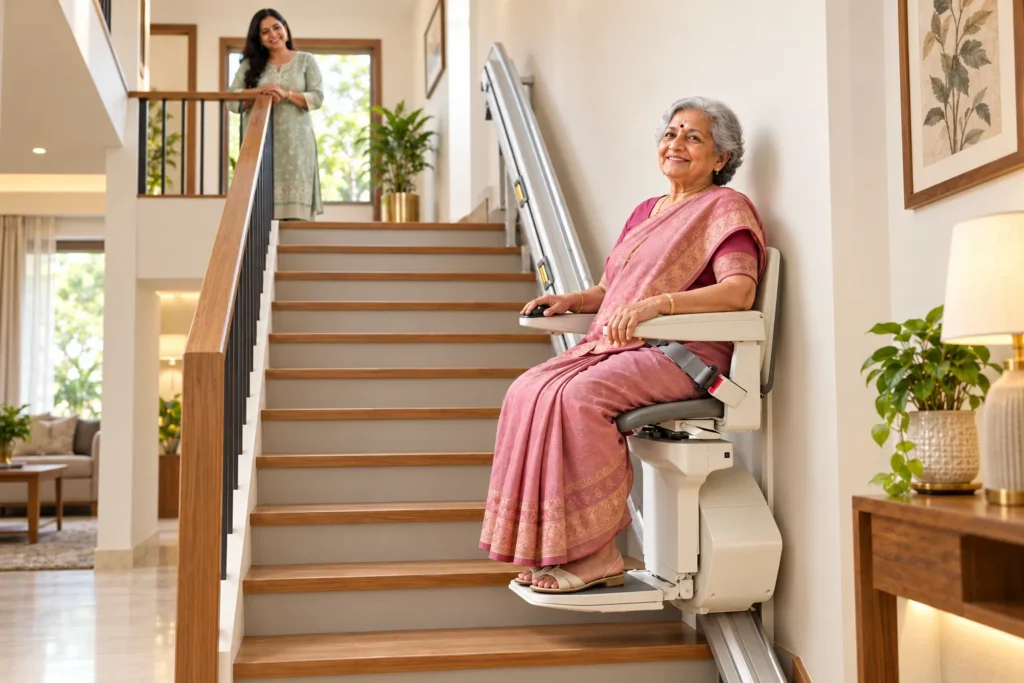
Modern stairlifts fold flush against the wall when not in use, run on rechargeable batteries (so they keep working during power cuts), and include safety features like seatbelts, swivel seats, and obstruction sensors that stop the chair automatically if something blocks the rail.
Stair lifts come in two main types:
- Straight stairlifts — for staircases with no bends, quick to manufacture and install (often within a day).
- Curved stairlifts — custom-built modular rails for staircases with turns, landings, or spiral sections; these take longer to fabricate but hug the exact shape of your stairs.
Outdoor and weatherproof versions are also available for porches, garden steps, and exterior entrances. You can see the full range on Vin Grace’s stair lifts page, including pricing for straight, curved, and outdoor models.
What Is a Stair Climbing Wheelchair?
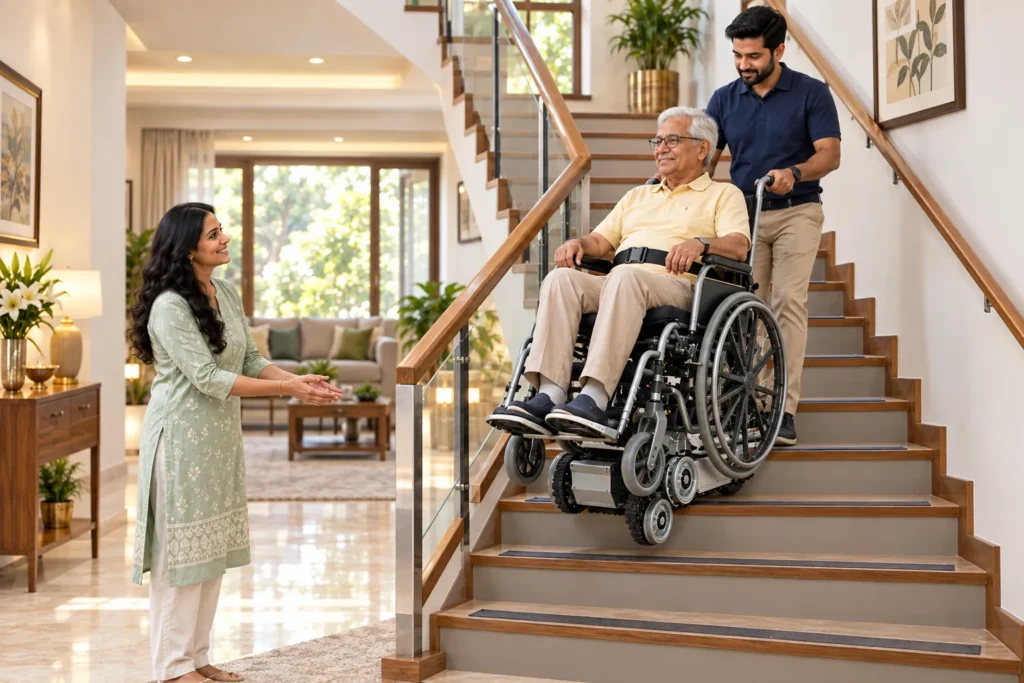
A stair-climbing wheelchair (also known as a stair climber or track wheelchair) is a portable, battery-powered device that carries a seated user up and down stairs without any fixed installation. Instead of a rail, it uses rubber tracks or motorized wheel clusters that grip each stair tread directly, keeping the seat level as it moves.
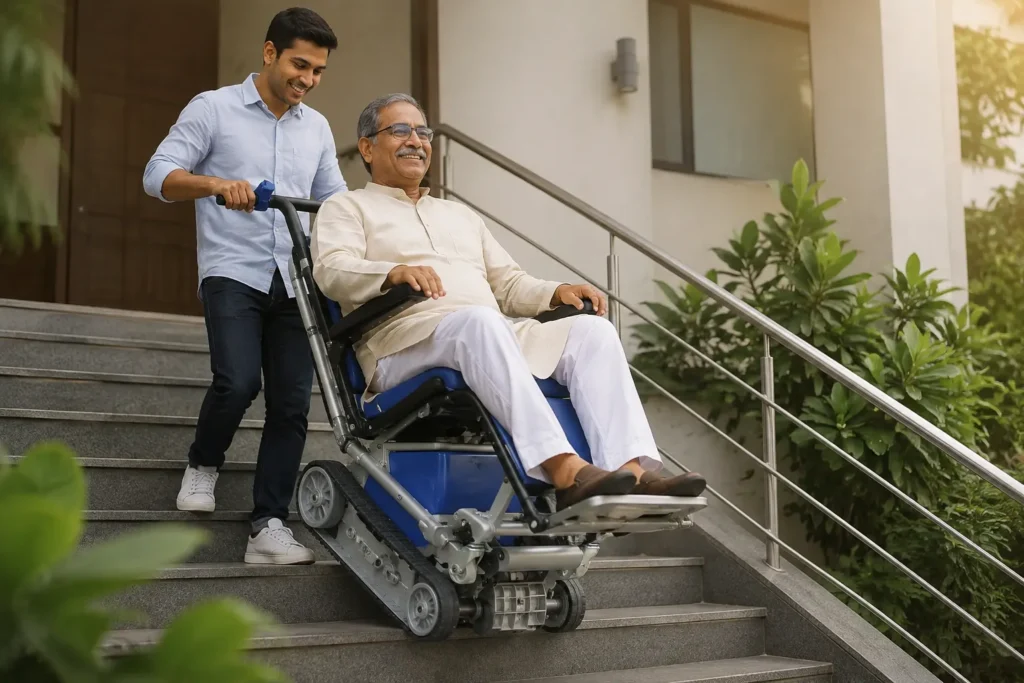
There are two broad categories:
- Manual/attendant-operated models – a trained caregiver guides the chair up and down the stairs; more affordable but physically demanding for the attendant.
- Electric/joystick-operated models – motorized tracks do the climbing; the user or an attendant controls the chair with a joystick, requiring far less physical effort.
Because it has no fixed point in the house, a stair-climbing wheelchair can travel between floors of a multi-storey home, ride in a car boot to a relative’s house, or move a patient between hospital floors during a lift breakdown. Explore the different types and prices on Vin Grace’s stair-climbing wheelchair page.
Stair Climbing Wheelchair vs Stair Lift | Side-by-Side Comparison
| Factor | Stair Lift | Stair Climbing Wheelchair |
|---|---|---|
| Installation | Permanently fixed rail on one staircase; straight models install in hours, curved in days | No installation – ready to use the moment it arrives |
| Portability | Fixed to one staircase; cannot be moved between homes | Fully portable; folds down for car travel or storage |
| Best for | Daily use on a single staircase at home | Multiple staircases, travel, temporary recovery, emergencies |
| Price in India (2026) | ₹1.5 Lakh – ₹3 Lakh (straight); ₹4.5 Lakh – ₹15 Lakh+ (curved) | ₹45,000 – ₹2.5 Lakh (manual); ₹1.8 Lakh – ₹12 Lakh (electric tracked) |
| Operation | Self-operated at the push of a button | Manual: needs a trained attendant. Electric: joystick with attendant nearby |
| Transfers required | Minimal — sit in the stairlift seat once | User transfers into the chair each use (or is already seated in it) |
| Staircase width needed | Works on staircases as narrow as ~24–26 inches with slim rail models | Typically needs 70–80 cm of stair width |
| Power cut backup | Battery backup, self-charges at parking points | Battery-powered; charge level should be checked before use |
| Structural impact | Mounted on treads, not walls; no permanent damage | None — no drilling, no fixed parts |
| Long-term cost | Lower over years for one staircase (one-time cost + annual service) | Higher upfront for premium electric models, but flexible across locations |
| Emergency use | Limited to the installed staircase | Doubles as an evacuation aid during lift breakdowns |
Stair Lift – Pros and Cons
Pros
- Most economical option for a single, frequently-used staircase
- No transfer difficulty — glide from top to bottom in one motion
- Compact folded profile keeps the staircase usable for the rest of the household
- Long lifespan (commonly 15+ years) with annual servicing
- Works seamlessly during power outages thanks to battery backup
Cons
- Tied to one staircase — no use elsewhere
- Curved staircases require custom manufacturing, which adds cost and lead time
- Not portable if the user needs to travel or visit other buildings
- Requires the user to be able to transfer from a wheelchair to the stairlift seat (unless a compatible platform model is used)
Stair Climbing Wheelchair – Pros and Cons
Pros
- Goes anywhere — home, a relative’s house, a clinic, or a building with no ramp
- No installation, no waiting for manufacturing
- One chair can serve every staircase in a multi-storey home
- Useful as a backup evacuation option during lift failures or power cuts
- Reduces caregiver strain compared to manually carrying someone up steps
Cons
- Manual models require a fit, trained attendant to operate safely
- Generally more expensive than a straight stairlift for single-staircase, single-home use
- User must transfer into the chair for every trip (unless already seated)
- Premium electric tracked models carry a higher upfront cost
Which One Is Better for You? A Decision Framework
There’s no single “better” option – the right choice depends on the situation. Use these questions to guide your decision:

1. How many staircases need to be covered? One staircase, used daily → a stair lift is usually the more economical long-term choice. Multiple staircases or buildings → a stair-climbing wheelchair is more practical.
2. Is this permanent or temporary? Long-term daily use in a forever home → stair lift. Temporary recovery after surgery, a short-term injury, or an uncertain living situation → a stair-climbing wheelchair (rental options may be available) avoids installing a permanent fixture.
3. Who is available to help? If the user can operate independently and just needs to stay seated, a stair lift removes the need for an attendant entirely. If a caregiver is present and the priority is flexibility across locations, a stair-climbing wheelchair — manual or electric — fits better.
4. What’s the staircase like? Very narrow, spiral, or multi-landing staircases may suit a slim modular stairlift rail or a compact wheeled stair climber better than a bulkier tracked model — this is worth checking during an in-person home survey.
5. What’s the budget, and is it a one-time or ongoing need? A straight stairlift is often the lowest-cost single-staircase solution. A stair-climbing wheelchair is a bigger upfront investment but pays off in flexibility if mobility needs extend beyond one home.
If your household has a wheelchair user who also needs full-time home access, many families install a stair lift or home lift for daily use and keep a stair-climbing wheelchair on hand for travel and emergencies.
Why This Decision Matters | Falls, Independence, and Safety
Stairs are one of the most common sites for falls at home, and the risk is not small. According to the U.S. Centers for Disease Control and Prevention, more than one in four adults aged 65 and older experiences a fall every year, and falls remain the leading cause of both fatal and non-fatal injuries in this age group.
Emergency departments in the U.S. alone treat millions of older adults for fall-related injuries annually – a trend that has been rising, not falling, over the past decade.
The National Institute on Aging specifically flags stairways, along with bathrooms and poorly lit hallways, as high-risk zones in the home, and recommends practical modifications – good lighting, secure handrails, and mobility aids like stairlifts – as part of any aging-in-place safety plan.
This is exactly the risk both a stair lift and a stair-climbing wheelchair are designed to remove. Rather than risking a fall on the stairs – or the physical strain of a caregiver manually carrying someone – either solution lets a person move between floors safely, seated, and supported at every step.
Cost Comparison in India (2026)
Pricing varies by brand, staircase complexity, weight capacity, and features, but here’s a general reference:
| Solution | Typical Price Range (INR) |
|---|---|
| Straight Stair Lift | ₹1,50,000 – ₹3,00,000 |
| Curved Stair Lift | ₹4,50,000 – ₹15,00,000 |
| Outdoor Stair Lift | ₹2,00,000 – ₹7,00,000 |
| Manual Attendant Stair-Climbing Wheelchair | ₹45,000 – ₹1,20,000 |
| Wheeled Stair Climber | ₹80,000 – ₹2,50,000 |
| Electric Tracked Stair-Climbing Wheelchair | ₹1,80,000 – ₹12,00,000 |
Most providers, including Vin Grace, offer no-cost EMI financing through partner banks, so the upfront cost can be spread over several months. A free home survey is the most reliable way to get an exact quote, since staircase width, number of turns, and weight capacity all affect the final price.
Maintenance and Long-Term Ownership
Both solutions need periodic upkeep to stay safe and reliable:
- Stair lifts: Annual servicing of the motor, rail, and battery; genuine spare parts; and a 24/7 support line for troubleshooting. Well-maintained units commonly last 15+ years.
- Stair-climbing wheelchairs: Regular checks on tracks, wheels, and joints; battery health monitoring for electric models; and caregiver refreshers so the attendant stays confident operating the chair safely.
Ask any provider about warranty coverage (commonly 1–5 years on parts and service), annual service costs, and how quickly a technician can respond if something needs repair — this matters more over a 10–15 year ownership period than the sticker price alone.
Frequently Asked Questions
Q. Is a stair-climbing wheelchair cheaper than a stair lift?
It depends on the model. Basic manual stair-climbing wheelchairs can be less expensive than a straight stair lift, but premium electric tracked models often cost more than a straight stairlift and can approach the price of a curved one. For a single staircase used daily, a straight stair lift is usually the most economical choice long-term.
Q. Can I use a stair-climbing wheelchair without a caregiver?
Most manual models require a trained attendant. Some advanced electric models offer more independent operation, but manufacturer guidelines generally recommend having an attendant nearby for safety, especially on longer or curved staircases.
Q. Will either option damage my staircase?
No. Stair lifts are mounted on the stair treads (not the walls) using small brackets and can be removed without structural damage. Stair-climbing wheelchairs use tracks or wheels that grip the treads without drilling or permanent modification.
Q. Which is better for a curved or narrow staircase?
Curved staircases typically need a custom-built modular stairlift rail, which takes longer to manufacture but fits the exact shape of the stairs. For narrow staircases, check the minimum width requirement of both a slim-rail stairlift and a compact wheeled stair climber — narrow homes sometimes suit one better than the other.
Q. Do these work during a power cut?
Yes, both typically run on rechargeable batteries. Stair lifts self-charge at parking points at the top and bottom of the rail, while stair-climbing wheelchair batteries should be checked and charged ahead of planned use.
Q. Can I rent a stair-climbing wheelchair instead of buying one?
In many cases, yes — rental is a practical option for short-term recovery after surgery, temporary injuries, or a rehabilitation period, without committing to a permanent installation. Availability depends on your location and the model needed.
Q. What’s the difference between a stair lift and a home lift (elevator)?
A stair lift moves a seated person along one staircase. A home lift is a compact residential elevator that moves between any floor of a multi-storey home and can typically carry more than one person or a full-size wheelchair a better fit for homes with several floors and space for a small shaft.
Q. Is a stair-climbing wheelchair the same as an evacuation chair?
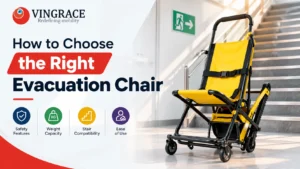
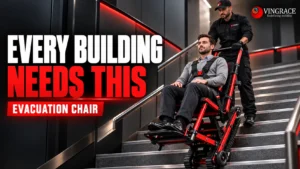
They’re related but not identical. A stair-climbing wheelchair is designed for regular daily or travel use. An evacuation chair is specifically built for emergency descent — lightweight, fast to deploy, and typically kept in hospitals, offices, and public buildings for fire or lift-failure situations.
Final Verdict
For a single staircase used every day at home, a stair lift is usually the more practical and cost-effective choice — it’s self-operated, requires no transfers beyond sitting down, and runs reliably for over a decade with minimal upkeep.
For anyone who needs mobility across multiple staircases, buildings, or a temporary recovery period, a stair-climbing wheelchair offers the flexibility a fixed rail simply can’t match.
The most reliable way to decide is an in-person assessment of your staircase, your budget, and who will be using or operating the equipment day-to-day.
Vin Grace offers a free home survey across major Indian cities, with a written quote – including EMI options – within 24 hours, so you can compare both options against your actual staircase before deciding.
Sources:
- Centers for Disease Control and Prevention, Facts About Falls
- National Institute on Aging, Home Safety Tips for Older Adults