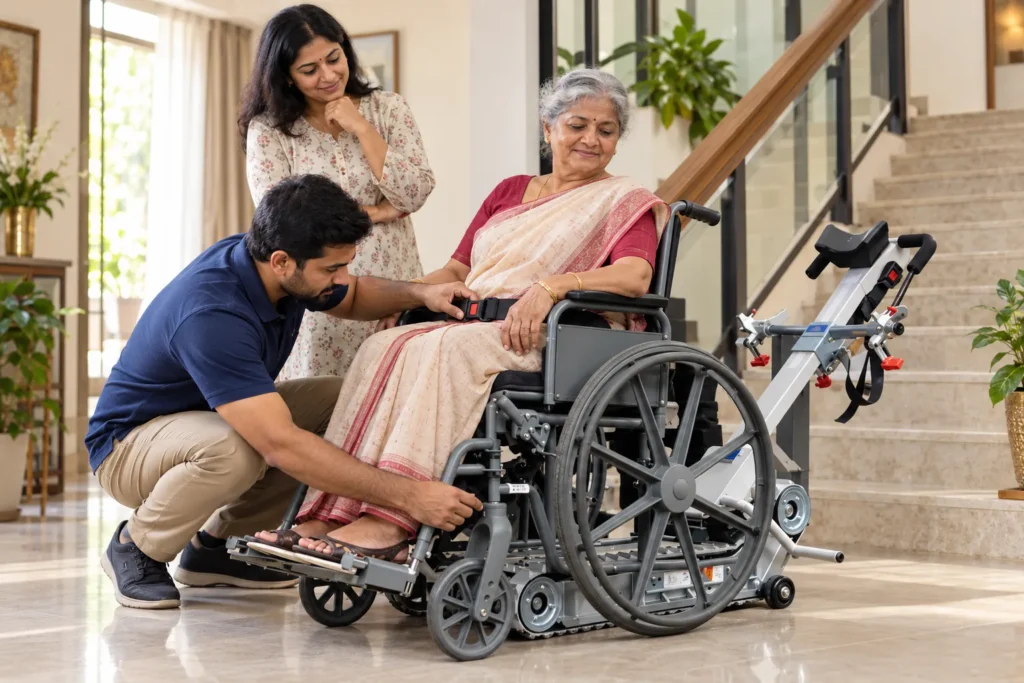
A stair-climbing wheelchair carries a person over the single most fall-prone part of any home – the staircase. That makes safety features the most important thing to evaluate before buying, ahead of price, brand, or even portability.
Two models can look nearly identical in a brochure and still differ enormously in how securely they hold a passenger, how they respond if something goes wrong mid-climb, and how much control the caregiver actually has.
This guide walks through the safety features that genuinely matter, why each one exists, and what to check for before you buy – so you can compare models on substance rather than marketing.
Why Safety Features Deserve Extra Scrutiny
Stairs are already one of the highest-risk areas in any home. The Centers for Disease Control and Prevention reports that more than one in four adults aged 65 and older falls each year, and falls remain the leading cause of both fatal and non-fatal injuries in this age group.
A stair-climbing wheelchair is meant to remove that risk – but only if the device itself is engineered with redundant safety systems, since it’s operating in the exact environment where falls are most dangerous.
In the United States, stair-climbing wheelchairs are regulated as a distinct class of medical device. The FDA’s requirements specifically call for a demonstrated braking mechanism (including how the device stops if the electrical brake fails), proven stability on inclines in every direction, and validated performance ascending and descending stairs before a device can be classified as safe for use.
That regulatory bar is a useful reference point for what to look for even when buying outside the U.S.
1. A Reliable, Redundant Braking System
The braking system is the single most important safety feature on any stair-climbing wheelchair. Look for:
- Automatic braking that engages the moment the joystick or control is released, preventing unintended movement mid-stair
- A mechanical backup brake that holds the chair in place even if the electrical braking system fails
- Wheel locks for wheeled (non-tracked) models, so the chair cannot roll once stopped
Ask any seller directly how the chair behaves in a power or motor failure — a well-designed model should stop and hold, not free-wheel down the stairs.
2. Anti-Tip and Stability Protection
Tipping is the primary risk on any staircase, particularly on turns, landings, or uneven steps. Good stair-climbing wheelchairs are engineered with:
- A low center of gravity and wide base to resist tipping forward, backward, or sideways
- Anti-tip mechanisms that physically prevent the chair from pitching over if weight shifts unexpectedly
- Stability sensors on premium tracked models that continuously monitor incline and adjust to keep the seat level
For tracked (caterpillar-style) models specifically, check whether the tracks distribute the user’s weight across the stairs, which reduces the balancing effort required from the operator compared to wheeled models.
3. Secure Seatbelts and Restraints
A seatbelt sounds basic, but it’s non-negotiable. Look for a properly rated lap belt (and, for some models, a chest strap or harness) plus:
- Secure, padded footrests that keep feet from slipping during the climb
- Armrests the user can grip for extra stability, especially on turns
- Restraints that are easy for a caregiver to check and adjust before every use
4. Obstacle and Incline Sensors
More advanced electric and tracked models include sensors that detect obstacles on the stairs, sudden changes in incline, or an edge the chair is approaching – automatically slowing or stopping the chair before a collision or misstep.
This is particularly valuable on staircases with landings, pets, or household clutter that a caregiver might not notice mid-climb.
5. Emergency Stop and Manual Override
Every stair-climbing wheelchair should have an easily reachable emergency stop button that halts the chair instantly, and ideally a manual override that allows a caregiver to control descent if the motor or electronics fail physically.
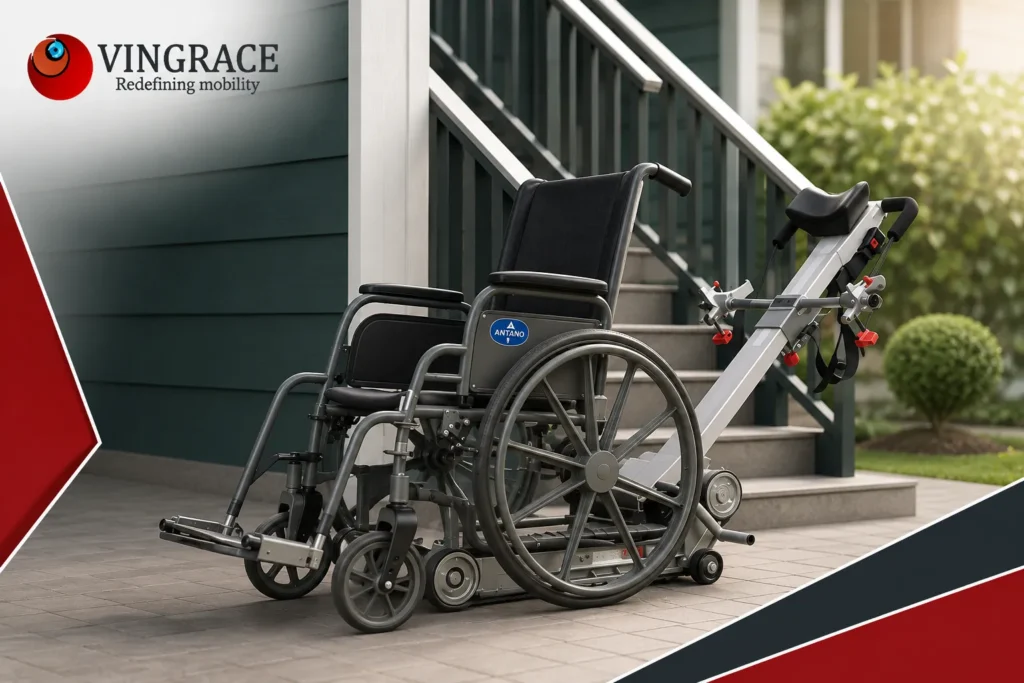
During a demo, confirm exactly where this control is positioned and how quickly it can be reached mid-climb — it should not require letting go of the chair to activate.
6. Anti-Slip Tracks or Grip-Rated Wheels
Whatever the chair contacts the stairs with — rubberized tracks or wheel treads — should be rated for grip on the stair material in your home (tile, stone, wood, or carpet).
Worn or low-grip tracks are one of the most common causes of slipping mid-climb, which makes track condition something to check even after purchase, not just at the time of buying.
7. Adjustable Speed Control
Being able to set a slow, controlled climbing speed matters more than raw power. Unlike a flat-ground electric wheelchair, speed on stairs should always favor caution – look for models that let the caregiver or user select a conservative ascent/descent speed rather than a single fixed rate.
8. Independently Powered, Dual-Motor Tracks (for Tracked Models)
On premium tracked stair-climbing wheelchairs, each track is often powered by its own independent motor. This allows finer control on turns and landings and means a single motor fault doesn’t leave the chair without any drive at all – a meaningful redundancy on a staircase.
9. Clear Weight Capacity Rating
Every safety feature above only works within the chair’s rated weight capacity. Confirm the user’s weight is comfortably within – not right at the edge of – the manufacturer’s rated limit, since components like brakes, tracks, and the frame are all engineered around that maximum. Vin Grace’s team checks this during every free home survey before recommending a specific model.
10. Battery Level Indicator and Low-Battery Warning
A stair-climbing wheelchair running low on charge mid-staircase is a genuine safety risk. Look for a visible battery indicator and an audible or visual low-battery warning that alerts the caregiver before starting a climb, not partway through one.
11. No-Transfer Design (Where Applicable)
Some stair-climbing systems are designed so the user’s own wheelchair locks directly onto the stair-climbing base, removing the need to transfer to a different seat.
Since transfers are one of the highest-risk moments for a fall, this design reduces risk for users who would otherwise need to move in and out of a separate chair for every trip up or down.
Safety Checklist Before You Buy
Use this quick checklist when comparing models or attending a demo:
- Does it have both automatic and manual/mechanical braking?
- Is there a visible anti-tip mechanism, and has it been demonstrated on an incline?
- Are the seatbelt, footrests, and armrests secure and easy to check?
- Where is the emergency stop, and how fast can it be reached?
- What is the rated weight capacity, and does the user fall comfortably within it?
- How is the tracks’ or wheels’ grip rated, and how often should they be inspected?
- Is there a battery indicator, and how much charge does a full staircase climb use?
- Has the caregiver been trained, and does the seller offer a hands-on demo before purchase?
Training Matters as Much as the Equipment
Even the safest stair-climbing wheelchair depends on a confident, trained operator. Before relying on any model daily, make sure the caregiver has practiced on the actual staircase it will be used on – not just a demo unit – and knows exactly how to respond to a brake engagement, an obstacle alert, or an emergency stop.
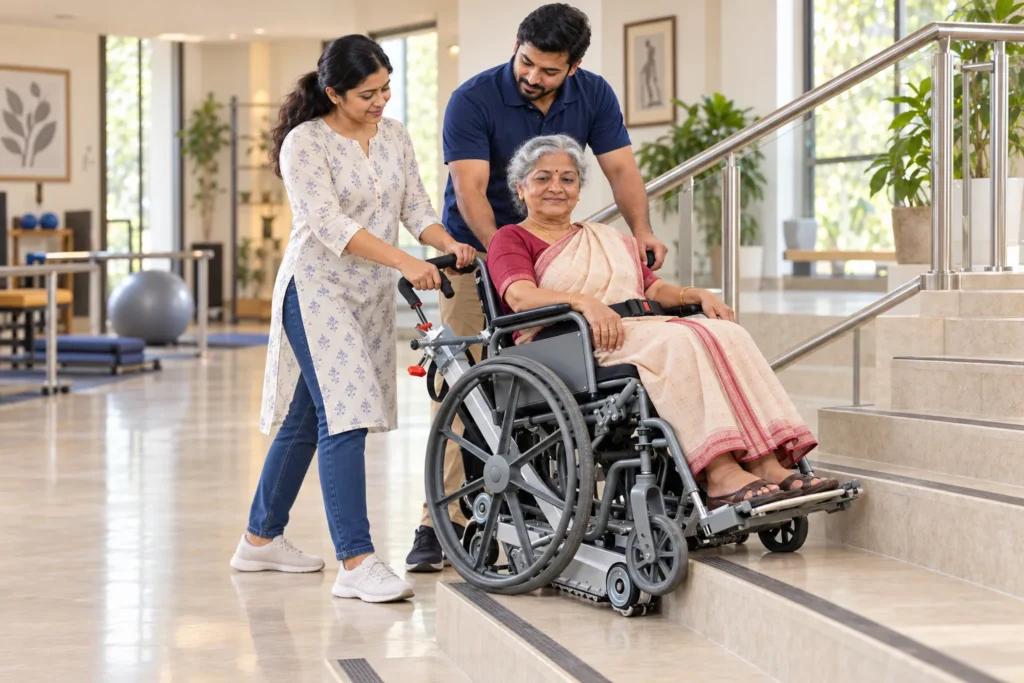
Reputable providers include a supervised training session as part of the purchase, and periodic refreshers are worth scheduling even after the caregiver is comfortable with the chair.
Choosing a Safe, Well-Built Stair-Climbing Wheelchair in India
Safety features are exactly why it’s worth seeing a stair-climbing wheelchair demonstrated in person, on a real staircase, before buying. Vin Grace offers in-home demos across major Indian cities so you can see the braking, anti-tip, and sensor systems in action, ask questions, and confirm the right model for your staircase and the user’s weight before committing.
Explore the full range on Vin Grace’s stair-climbing wheelchair page, or compare it against a permanent stair lift in our guide on stair-climbing wheelchair vs stair lift.
Frequently Asked Questions
Q. What is the most important safety feature on a stair-climbing wheelchair?
The braking system is the single most critical feature, since it’s what prevents unintended movement on a staircase. Look specifically for a mechanical backup brake that holds the chair even if the electrical system fails.
Q. Are tracked stair-climbing wheelchairs safer than wheeled ones?
Tracked models generally distribute the user’s weight across the stairs and reduce how much balancing the operator has to do manually, which many buyers consider safer for regular use. Wheeled models are lighter and more portable but place more of the stability burden on the caregiver, so a strong braking and anti-tip system matters even more on those models.
Q. Do stair-climbing wheelchairs need a certified safety standard?
In the United States, stair-climbing wheelchairs are regulated by the FDA as a specific device category, with defined testing for braking, stability, and safe stair performance.
When buying in India, ask the seller about the manufacturer’s safety certifications and request to see stability and braking demonstrated in person during your demo.
Q. How often should safety features be inspected?
Tracks, wheels, brakes, and battery health should be checked regularly — most providers recommend periodic servicing similar to other mobility equipment. Ask your provider about a maintenance schedule and what genuine spare parts cost before you buy.
Q. Can a stair-climbing wheelchair be used without a trained attendant?
Most manual models require a trained caregiver to operate safely. Some electric models offer more independent control, but manufacturer guidance generally recommends having an attendant present, particularly on longer or curved staircases.
Sources:
- U.S. Food and Drug Administration / eCFR, 21 CFR 890.3890 — Stair-Climbing Wheelchair
- Centers for Disease Control and Prevention, Facts About Falls