A fire breaks out on the 8th floor of a commercial building.
The lift shuts down immediately – as it should during a fire emergency. Everyone rushes to the staircase. People run down quickly.
But what about the person in a wheelchair? The elderly employee on the 6th floor? The patient on crutches? The visitor who cannot walk down stairs?
This is not a hypothetical situation. It happens in India. And in most buildings, there is no plan for it.
That is exactly why evacuation chairs exist.
In this complete guide, we will cover everything you need to know about evacuation chairs in India – what they are, how they work, which buildings need them, what Indian fire safety laws say, the best models available, prices, and where to buy them.
Whether you manage a hospital, a corporate office, a school, a mall, or a hotel – this guide is for you.
What Is an Evacuation Chair?
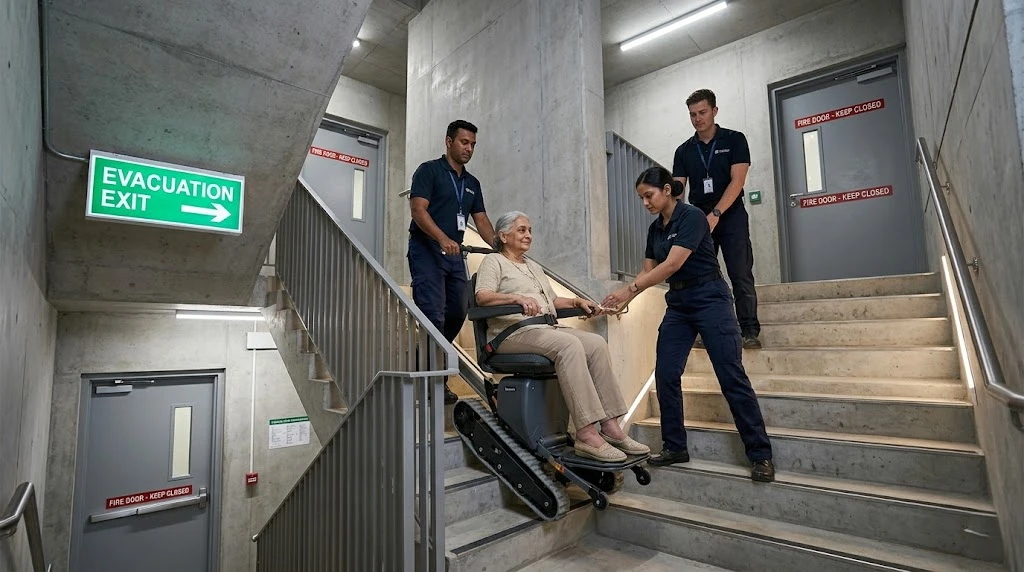
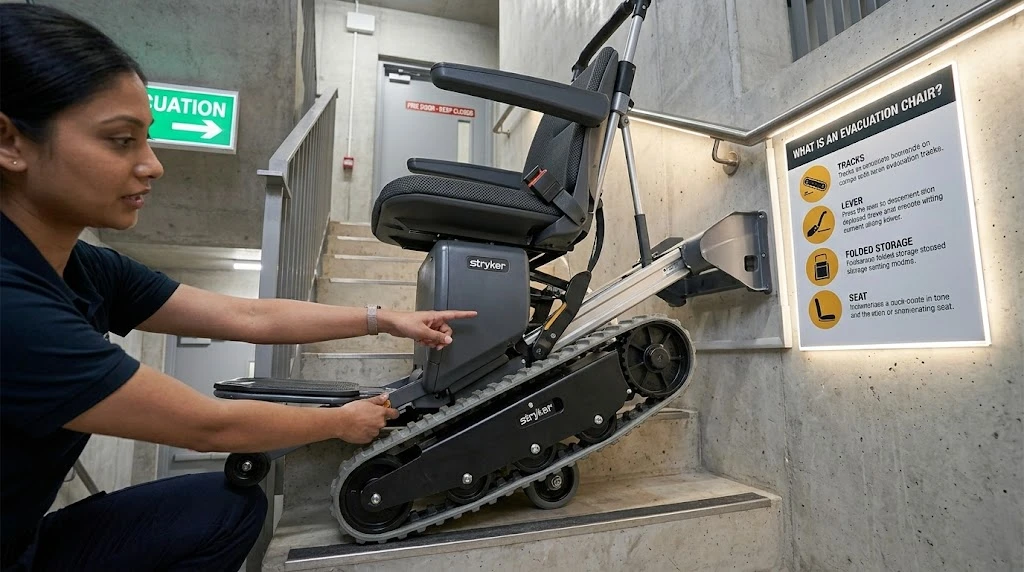
An evacuation chair is a specially designed chair that allows a person with limited mobility – or anyone who cannot walk down stairs during an emergency – to be evacuated safely and quickly via the staircase.
It is NOT a regular wheelchair. It is built specifically for staircase descent during emergencies like fires, earthquakes, power failures, or medical incidents.
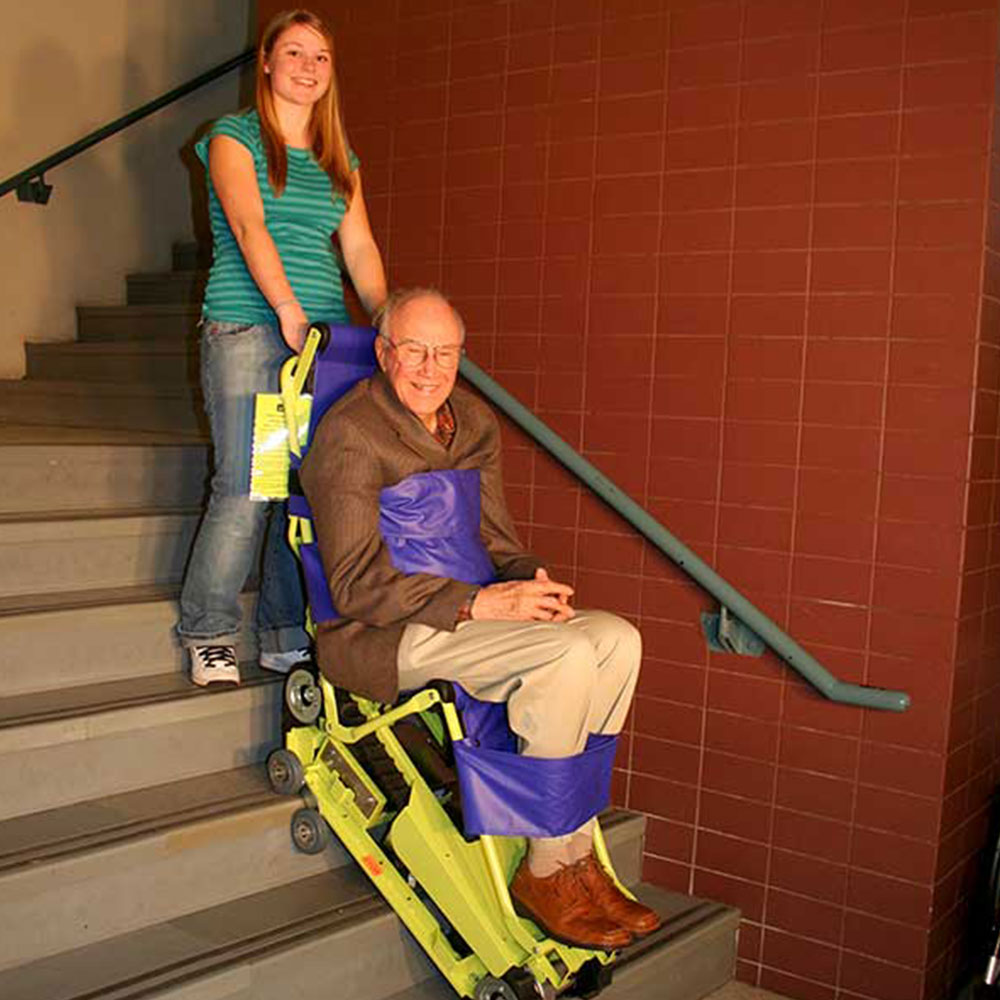
Evacuation chairs use a track-based system – similar to a rubber belt or track – that glides smoothly along the edge of the staircase steps. One trained operator (caregiver, fire warden, or staff member) can control the chair and evacuate a person of up to 150–160 kg safely, even on their own.
They are lightweight, foldable, and can be stored on a wall-mounted bracket near staircase landings. In an emergency, they are ready to use in seconds.
How Does an Evacuation Chair Work?
The mechanism is simple but very effective.
Step 1: The operator unfolds the evacuation chair from its storage bracket
Step 2: The person who needs assistance sits in the chair and is secured with a seatbelt or harness
Step 3: The operator tilts the chair back onto its rubber tracks
Step 4: The tracks rest on the stair edges and the chair glides down smoothly – controlled by the operator using handles
Step 5: The speed is controlled by a braking mechanism – the descent is slow and steady, not a slide
Step 6: At the bottom, the chair is wheeled out of the building on its rear wheels
The whole process is designed so that one trained person can handle it. No lifting required. No physical strain on the operator.
Most evacuation chairs can descend a full flight of stairs in under 60 seconds.
Who Needs an Evacuation Chair in India?
If your building has more than one floor and any of the following apply – you need an evacuation chair:
Buildings that must have evacuation chairs:
- Hospitals and nursing homes
- Corporate offices and IT parks
- Shopping malls and retail stores
- Hotels and resorts
- Schools, colleges, and universities
- Government offices and public buildings
- Airports and railway stations
- Cinemas and multiplexes
- Factories and industrial facilities
- Residential high-rise apartments
People who benefit from evacuation chairs:
- Wheelchair users
- Elderly employees or visitors
- Pregnant women
- People recovering from surgery or injury
- People with temporary or permanent disabilities
- Obese individuals who cannot move quickly
- Anyone who freezes or panics during emergencies (non-ambulatory due to fear or shock)
The truth is – during a fire or emergency, ANYONE can become non-ambulatory. Smoke inhalation, panic attacks, injuries sustained during evacuation – these can affect even physically fit people. An evacuation chair is a safety tool for everyone.
Indian Fire Safety Laws – What Do They Say?
This is where many building managers get confused. Let us break it down clearly.
National Building Code of India (NBC 2016)
The National Building Code of India (NBC 2016), published by the Bureau of Indian Standards (BIS), is the primary reference document for building safety in India.
The NBC 2016 specifically addresses fire safety, means of escape, and evacuation planning. Key relevant points include:
- Buildings must have clearly defined emergency evacuation plans
- Staircases are the primary means of escape during fire (lifts must not be used)
- Buildings must make provisions for evacuation of persons with disabilities (PwD)
- Fire wardens must be trained and designated in commercial buildings
- Emergency lighting, signage, and escape routes must be clearly marked
While the NBC 2016 does not yet use the exact term “evacuation chair” in all sections, it mandates that buildings must have provisions to evacuate ALL occupants – including those with mobility impairments.
This is where evacuation chairs become a legal necessity, not just a good practice.
Rights of Persons with Disabilities Act, 2016 (RPWD Act)
The RPWD Act is a landmark Indian law that mandates accessibility for persons with disabilities across all public and private establishments.
Section 40 and 41 of the RPWD Act require that:
- All public buildings must be made accessible to persons with disabilities
- Emergency evacuation plans must include provisions for PwD
- Non-compliance can result in penalties and legal action
If your building does not have a plan to evacuate wheelchair users or disabled persons during an emergency – you may be in violation of the RPWD Act.
Fire Safety NOC Requirements
In most Indian states, buildings require a Fire Safety NOC (No Objection Certificate) from the local fire department before receiving occupancy permission. Fire departments are increasingly checking for:
- Adequate fire exits and staircase widths
- Emergency lighting and signage
- Fire extinguishers and hose reels
- Evacuation plans posted on each floor
- Evidence of fire drills and staff training
Progressive fire departments in cities like Mumbai, Delhi, Bangalore, Hyderabad, and Pune are now asking buildings about their PwD evacuation provisions. Having evacuation chairs in place is a proactive step that supports your fire NOC compliance.
BIS Standards for Evacuation Chairs
The Bureau of Indian Standards (BIS) has been aligning Indian safety standards with international norms. For evacuation chairs, the relevant international standard is:
BS 8485:2015 (British Standard) – Code of practice for the provision of evacuation chair systems in buildings
While a dedicated Indian BIS standard for evacuation chairs is still evolving, most procurement officers, hospitals, and large corporates in India specify BS 8485 compliance as a minimum requirement when purchasing evacuation chairs.
Always ask your supplier if the product meets BS 8485 or equivalent international standards.
Types of Evacuation Chairs Available in India
1. Standard Track-Based Evacuation Chair (Most Common)
Uses rubber tracks to glide down stairs. One operator required. Suitable for most straight staircases.
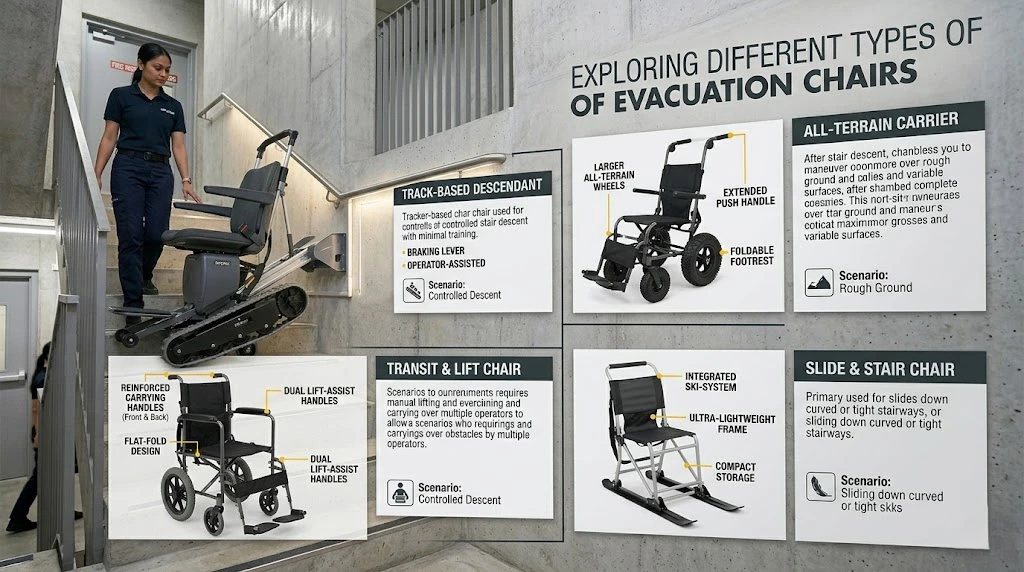
Best for: Offices, schools, hospitals, small to mid-size buildings Weight capacity: 110 kg – 160 kg Price range in India: ₹35,000 – ₹90,000
2. Heavy-Duty Evacuation Chair
Same track mechanism but built for higher weight capacities and more frequent use. Reinforced frame, wider seat.
Best for: Hospitals, industrial facilities, bariatric care centers Weight capacity: Up to 182 kg – 250 kg Price range in India: ₹80,000 – ₹1,50,000
3. Powered / Electric Evacuation Chair
Uses battery-assisted motor to control descent. Requires even less physical effort from the operator. Ideal for buildings with long staircases or frequent use.
Best for: Large hospitals, high-rise offices, airports Weight capacity: Up to 130 kg – 160 kg Price range in India: ₹1,20,000 – ₹2,50,000
4. Lightweight / Compact Evacuation Chair
Designed for smaller buildings, easy storage, and quick deployment. Weighs as little as 9–11 kg.
Best for: Small offices, schools, retail shops, budget-conscious buyers Weight capacity: 100 kg – 120 kg Price range in India: ₹25,000 – ₹55,000
5. Multi-Purpose Evacuation and Transport Chair
Can be used both as a stair evacuation chair and as a regular transport/porter chair for daily mobility. Dual-purpose design.
Best for: Hospitals, nursing homes, care facilities Price range in India: ₹45,000 – ₹1,00,000
Top Evacuation Chair Brands Available in India – 2026
1. Vin Grace – Most Popular in India
The Vin Grace is authorised dear and brand is globally recognized and widely used in Indian hospitals, corporate offices, and institutions.
Model: Vin Grace 300H5 (most popular model in India) Weight capacity: Up to 160 kg (25 stone) Track material: Rubber track belt Operator: Single trained operator Folds to: Compact size, wall bracket available Certifications: BS 8485, CE marked Price in India: ₹55,000 – ₹85,000 Available through: Official Website, Medical equipment dealers, fire safety suppliers, IndiaMart
2. Ferno (USA/UK) – Hospital Grade
Ferno is a leading brand in emergency medical equipment. Their evacuation chairs are designed for hospital and healthcare environments.
Model: Ferno 101-STR Stair Chair Weight capacity: Up to 159 kg Key features: Compact fold, padded seat, foot rest, durable frame Best for: Hospitals, emergency services, care homes Price in India: ₹60,000 – ₹1,00,000 Available through: Medical equipment importers in Mumbai, Delhi, Bangalore
3. Spencer (Italy) – Premium Quality
Spencer is a well-known Italian emergency equipment brand. Their evacuation and stair chairs are used in European hospitals and are now available in India through importers.
Weight capacity: Up to 150 kg Key features: Lightweight aluminum frame, smooth track system, ergonomic handles Price in India: ₹70,000 – ₹1,20,000
4. Vermeiren (Belgium) – Mid-Range Option
Vermeiren offers evacuation chairs that balance quality and cost. Good option for mid-size companies and educational institutions.
Price in India: ₹40,000 – ₹75,000 Available through: Orthopedic equipment dealers
5. Indian / Local Brands and OEM Options
Several Indian manufacturers and OEM suppliers produce evacuation chairs at lower price points. These are popular for government tenders, public sector buildings, and budget-constrained buyers.
Price range: ₹20,000 – ₹45,000 Caution: Always verify quality, weight testing, and compliance certifications before purchase. Do not compromise on safety for price. Available through: Vin Grace, IndiaMart, TradeIndia, GeM Portal (for government procurement)
Evacuation Chair Price in India – 2026 Summary
| Type | Price Range |
|---|---|
| Basic / Lightweight Evacuation Chair | ₹20,000 – ₹45,000 |
| Standard Track-Based (mid-range) | ₹45,000 – ₹90,000 |
| Heavy-Duty / Bariatric | ₹80,000 – ₹1,50,000 |
| Powered / Electric | ₹1,20,000 – ₹2,50,000 |
| Wall Mounting Bracket (usually sold separately) | ₹3,000 – ₹8,000 |
| Carry Bag / Storage Cover | ₹2,000 – ₹5,000 |
Note: Prices include GST at 12% (HSN code for medical/mobility equipment). Import duties apply to foreign brands. Always get a written quotation with warranty terms.
How Many Evacuation Chairs Does Your Building Need?
This is a common question. There is no single universal rule in Indian law yet, but here are the best-practice guidelines followed by safety consultants and large organizations in India:
General Rule of Thumb:
- One evacuation chair per staircase, per floor (for high-risk floors)
- Minimum one evacuation chair per building for small establishments
For Hospitals:
- One evacuation chair per ward or nursing station
- Additional chairs near ICU, OT, and wards with non-ambulatory patients
For Corporate Offices:
- One per floor for buildings up to 5 floors
- Two per floor (one per staircase) for buildings above 5 floors
For Schools and Colleges:
- One per floor, placed near the main staircase
For Malls and Multiplexes:
- One per floor near each emergency exit staircase
For Hotels:
- One per floor, placed at the staircase landing
Place chairs at staircase landings in clearly marked, easily accessible storage brackets. The chair should be visible, reachable in under 10 seconds, and never blocked by other objects.
Training – Who Should Be Trained to Use an Evacuation Chair?
Having an evacuation chair is only half the job. Training is equally important.
Who should be trained:
- Designated fire wardens on each floor
- Security staff and reception staff
- Nurses and ward attendants (in hospitals)
- Facility management staff
- Any employee nominated as a PwD evacuation buddy
What training should cover:
- How to unfold and set up the chair in under 30 seconds
- How to safely seat and secure a person
- How to control descent speed on stairs
- How to handle landings and turns on the staircase
- How to communicate with the person being evacuated to reduce panic
- How to hand over the person at the muster point
How often should training happen:
- Initial training when the chair is installed
- Refresher training every 6 months
- Practical drill (with the actual chair) at least once a year
Most evacuation chair suppliers in India offer free training with purchase. Always ask for this when buying.
Fire Drill Best Practices for Indian Buildings
An evacuation chair is most useful when your team has practiced using it. Here is how to run an effective fire drill in India:
Before the drill:
- Inform all occupants (avoid panic, but ensure seriousness)
- Identify volunteers who will play the role of non-ambulatory persons
- Assign trained fire wardens to each floor
- Ensure all evacuation chairs are in place and accessible
During the drill:
- Sound the fire alarm
- Fire wardens guide occupants to staircases
- One warden deploys the evacuation chair for the volunteer
- Descent is practiced at normal speed
- Timing is noted – aim for under 3 minutes per floor evacuation
After the drill:
- Debrief all wardens and staff
- Note any problems – blocked exits, untrained staff, missing equipment
- Fix issues before the next drill
- Maintain a drill register (required for fire NOC in many states)
Where to Buy Evacuation Chairs in India
Online Platforms
- Vin Grace – An authorised Dealer in stairlifts, home lifts, and evacuation chairs in India.
- IndiaMart – Largest B2B platform. Multiple suppliers, compare quotes
- TradeIndia – Another B2B option with supplier ratings
- Amazon Business India – Some models available with GST invoices
- GeM Portal (Government e-Marketplace) – For government and PSU procurement
Offline Suppliers and Dealers
- Fire safety equipment dealers – Available in all major cities. Search “fire safety equipment supplier” on Justdial in your city
- Medical equipment dealers – Many stock evacuation chairs alongside hospital equipment
- Orthopedic and rehabilitation equipment shops – Especially in cities like Delhi, Mumbai, Bangalore, Chennai, Hyderabad
City-Wise Dealer Presence
- Delhi / NCR: Karol Bagh, Nehru Place, Okhla Industrial Area
- Mumbai: Andheri, Bhandup, Dadar – industrial and medical equipment hubs
- Bangalore: Peenya Industrial Area, Jayanagar
- Chennai: Ambattur Industrial Estate, Anna Nagar
- Hyderabad: Balanagar, IDA Nacharam
- Pune: Hadapsar, Bhosari Industrial Area
- Kolkata: Park Street area, Tangra industrial zone
Always ask for a physical demo before buying. A good supplier will bring the chair to your premises and demonstrate it on your staircase.
Common Mistakes to Avoid When Buying an Evacuation Chair
Mistake 1: Buying based on price alone The cheapest option may not be safe. Always verify weight capacity testing, track quality, and braking mechanism. A failure during an emergency is unacceptable.
Mistake 2: Not checking staircase compatibility Some chairs work better on wider stairs. Some have difficulty with very steep or narrow staircases. Ask your supplier to assess your staircase before purchase.
Mistake 3: Buying without a storage bracket The chair must be stored properly on a wall bracket near the staircase. Do not just leave it in a cupboard. Accessibility in under 10 seconds is critical.
Mistake 4: Skipping operator training A chair without trained operators is useless in an emergency. Insist on training as part of the purchase package.
Mistake 5: Buying one chair for a large building One chair is not enough for a multi-floor building with many occupants. Calculate the number you need based on floors and occupancy.
Mistake 6: Not maintaining the chair Evacuation chairs need periodic checks – track condition, brake function, seatbelt condition, frame integrity. Do a quick inspection every 3 months.
Maintenance Checklist for Evacuation Chairs
Use this simple checklist every quarter:
- Track belt – check for wear, cracks, or looseness
- Braking mechanism – test for smooth and responsive control
- Seatbelt and buckle – check for damage or fraying
- Armrests and footrests – check for firm attachment
- Frame – check for bends, cracks, or corrosion
- Wheels – check for smooth rotation
- Storage bracket – check for firm wall fixing
- Instruction label – must be visible and legible on the chair
- Quick-use guide – must be posted near the storage bracket
If any part fails inspection – replace immediately. Do not wait for the next service cycle.
Evacuation Chair vs Regular Wheelchair – Key Differences
Many people ask – why can’t we just use a regular wheelchair to evacuate someone?
Here is why that does not work:
| Feature | Evacuation Chair | Regular Wheelchair |
|---|---|---|
| Designed for stairs | Yes | No |
| Track system for stair descent | Yes | No |
| Controlled braking on stairs | Yes | No |
| Weight suitable for stair use | 9–14 kg (light) | 15–25 kg (heavier) |
| One-person operation on stairs | Yes | No – dangerous |
| Folds for staircase width | Yes | Not always |
| Safe for emergency speed | Yes | No |
Using a regular wheelchair on stairs is dangerous – for the occupant and the operator. It can tip, slide, or fall. Never attempt stair evacuation with a regular wheelchair.
Conclusion – Make Your Building Ready in 2026
A fire, an earthquake, a power failure – emergencies do not give warnings.
In that critical moment, the difference between life and death for a person with limited mobility is whether your building has an evacuation chair – and whether your staff knows how to use it.
In 2026, Indian buildings are under increasing scrutiny for fire safety and disability compliance. The NBC 2016, RPWD Act, and local fire department requirements are pushing building owners and facility managers to act.
Do not wait for an audit. Do not wait for an emergency.
Here is your action checklist:
- Assess how many evacuation chairs your building needs
- Choose the right type and weight capacity for your occupants
- Buy from a reputable supplier with proper certifications
- Install wall-mounted storage brackets at all relevant staircase landings
- Train all designated fire wardens and staff
- Conduct a practical fire drill with the evacuation chair
- Schedule quarterly maintenance checks
- Display quick-use instructions next to every chair
An evacuation chair is not just equipment. It is a commitment to the safety and dignity of every person in your building – regardless of their mobility.
Make that commitment today.
Frequently Asked Questions (FAQs)
Q1. Is an evacuation chair mandatory in India?
While there is no single law that specifically names “evacuation chairs” as mandatory, the NBC 2016 and RPWD Act 2016 together make it a legal obligation to provide for the safe evacuation of all building occupants including persons with disabilities. Evacuation chairs are the most practical way to comply. Many fire departments now informally expect them in larger buildings.
Q2. Can one person operate an evacuation chair alone?
Yes. All standard track-based evacuation chairs are designed for single-operator use. The rubber track and braking system allow one trained person to safely descend a staircase with an occupant.
Q3. How much does an evacuation chair cost in India?
Prices range from ₹20,000 for basic models to ₹2,50,000 for powered models. The most popular mid-range models used in Indian offices and hospitals cost between ₹55,000 – ₹90,000.
Q4. What is the weight limit of an evacuation chair?
Standard models support 110–160 kg. Heavy-duty or bariatric models support up to 182–250 kg. Always check the rated weight capacity before purchase.
Q5. Does an evacuation chair work on curved staircases?
Most standard track-based evacuation chairs work well on straight staircases. For curved or spiral staircases, check with your supplier about compatibility. Some models handle gentle curves.
Q6. Where should evacuation chairs be stored in a building?
On a wall-mounted bracket at the staircase landing of each relevant floor. The chair must be visible, clearly signed, and accessible in seconds.
Q7. Do evacuation chairs need to be registered or certified?
In India, there is no mandatory national registration for evacuation chairs yet. However, look for products certified to BS 8485 (British Standard) or CE marked. For government tenders, BIS compliance may be specified.
Q8. Can an evacuation chair be used to go upstairs?
No. Standard evacuation chairs are designed only for downward staircase movement. They are not meant for upward movement or for use as a regular wheelchair.
Q9. Is GST applicable on evacuation chairs in India?
Yes. Most mobility and safety equipment attracts 12% GST. Confirm the applicable HSN code with your supplier. Always take a proper GST invoice for ITC claims.
Q10. Can I rent an evacuation chair in India?
Rental options are limited but emerging. For events, temporary facilities, or construction sites – some fire safety equipment suppliers in metro cities offer short-term rentals. Check with local suppliers in your city.