When a fire alarm goes off, everyone is told the same thing: do not use the lift. Take the stairs.
But what about the person in a wheelchair on the fourth floor? Or the employee who is recovering from surgery? Or the elderly visitor who cannot manage even one flight without help?
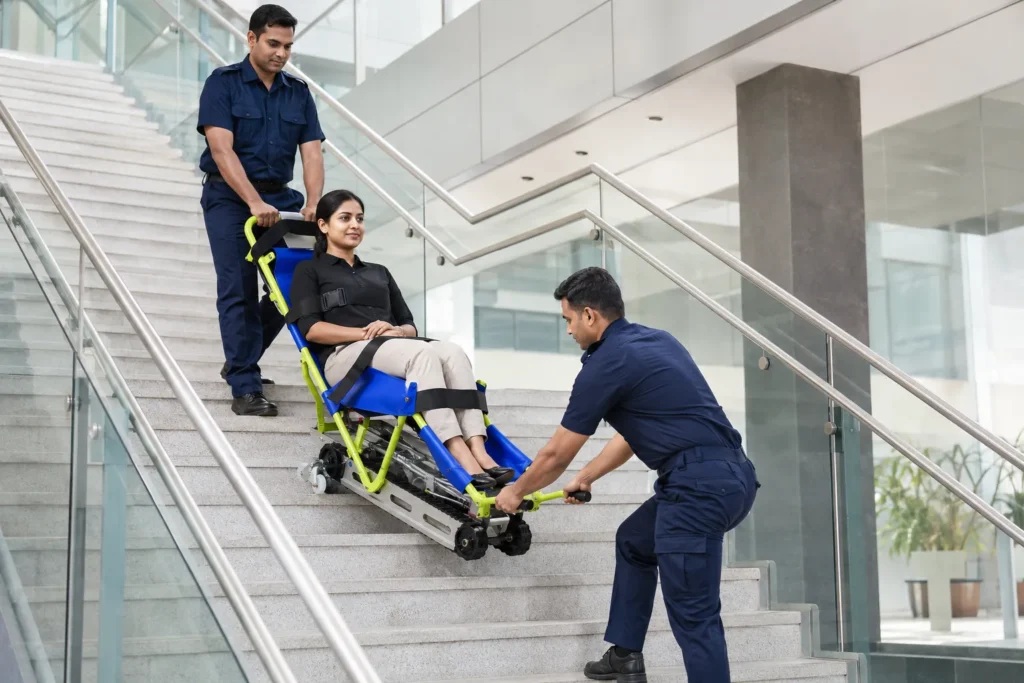
This is the gap an evacuation chair fills. It is a simple device that lets one or two people move someone safely down the stairs during an emergency, without carrying them.
If you manage a building – an office, hospital, school, hotel or apartment complex – you have probably been told you need one. This guide explains how to choose the right one, in plain language, without any technical jargon.
What Is an Evacuation Chair?
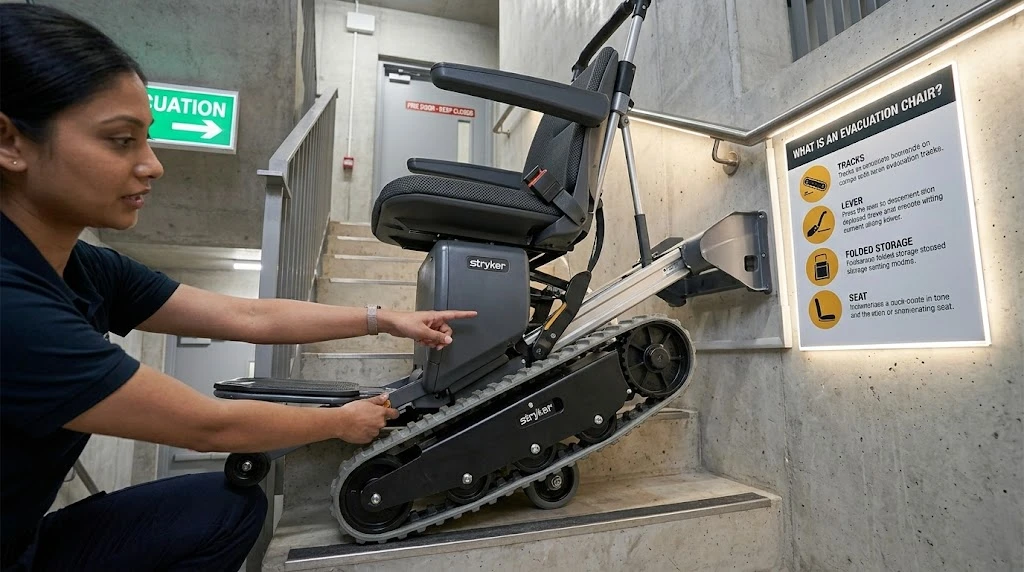
An evacuation chair is a lightweight, foldable chair with tracks or skids underneath. It is stored near a staircase and used only during emergencies.
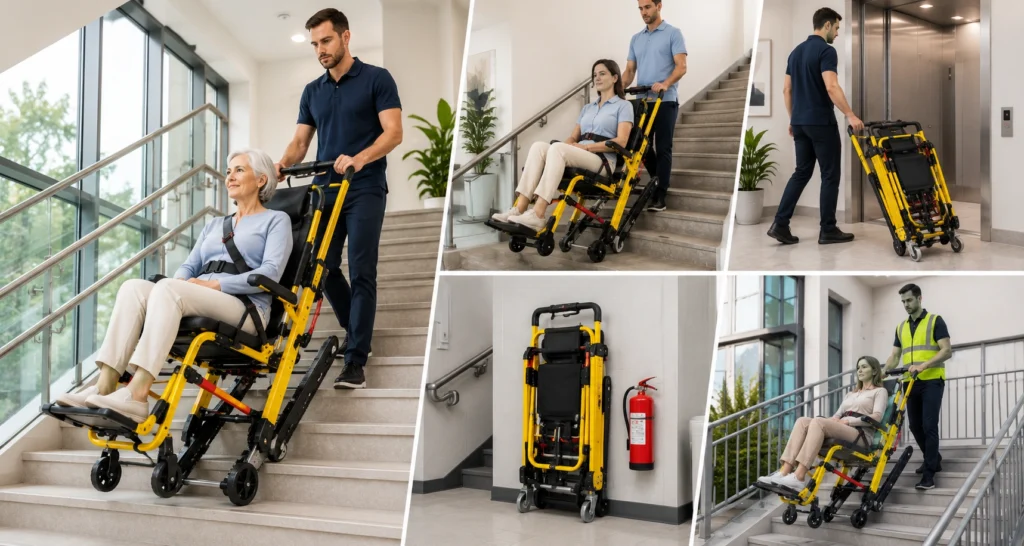
The person sits in the chair and is secured with straps. The operator then tilts the chair back and guides it down the stairs. The tracks grip each step, and a braking system controls the speed, so the chair moves down in a slow, steady line instead of dropping from step to step.
Most models need no electricity and no batteries. That matters, because power often fails during the exact emergencies these chairs are made for. The escape chair was first developed in the United States in 1982, and the basic idea has stayed the same ever since: gravity moves the chair, and the operator simply controls it.
An evacuation chair is not a mobility aid for daily use. It is emergency equipment — like a fire extinguisher. If you need something for everyday movement between floors, look at a stair climbing wheelchair or a stairlift instead.
Why Your Building Probably Needs One
Three reasons, and all three matter.
1. It is a legal responsibility. Under India’s Rights of Persons with Disabilities Act, public buildings must be accessible — and accessibility includes being able to get out safely. The Harmonised Guidelines and Standards for Universal Accessibility in India are a mandatory document for public buildings, and the full guidelines are published online by NIUA.
Fire and life safety rules come from Part 4 of the National Building Code of India, published by the Bureau of Indian Standards and adopted into most state building bye-laws.
2. Lifts cannot be used in a fire. This is the whole problem. Every fire safety plan tells occupants to use the stairs. Without an evacuation chair, a mobility-impaired person on an upper floor has no plan at all — they simply wait for the fire service, which may take time you do not have.
3. Carrying someone is dangerous. Well-meaning staff often try to carry a colleague down the stairs during a drill or a real emergency. This puts both people at serious risk of falling. An evacuation chair removes the lifting entirely.
The Main Types of Evacuation Chairs
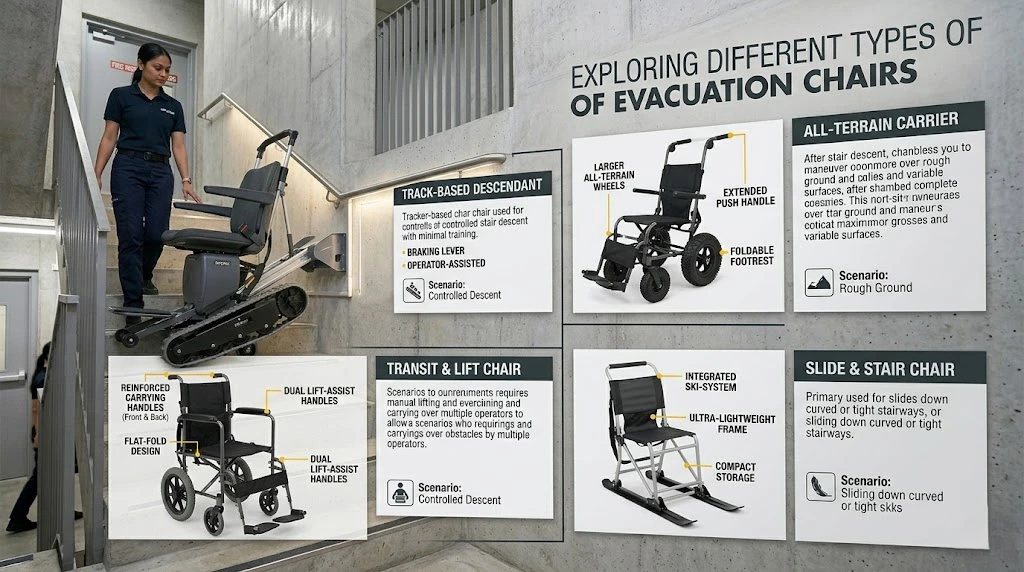
There are four broad categories. Most buildings only need one of them.
Manual descent-only chairs
These are the most common type. The passenger’s own weight moves the chair down the stairs, while a speed governor keeps the descent slow and controlled. One trained person can operate it.
They cannot go up stairs. For most buildings, this is fine, because emergency evacuation is always downward.
Best for: offices, schools, hotels, shopping centres, and any building where the goal is simply getting people down and out.
Powered climbing chairs
These use a motor and battery, so they can move both up and down the stairs. A smaller operator can move a heavier passenger by pressing a button.
Best for: hospitals, care homes, and buildings with basements or below-ground levels where people may need to be brought upward to reach the exit.
The Garaventa Power Evacu-Trac is a good example of this type — it carries up to 136 kg and lets a small attendant move a heavier passenger in either direction.
Two-operator carry chairs
Simple frames with lifting handles, operated by two people. They are the cheapest option but require more physical effort and more training.
Best for: low-rise buildings, or as a backup unit alongside a main chair.
Combined wheelchair-and-evacuation units
These work as a regular wheelchair on flat ground and switch to stair mode when needed.
Best for: care facilities where the same device is used daily and in emergencies.
For most commercial and institutional buildings in India, a manual descent chair such as the Evacu-Trac is the practical choice. It is simple, needs no power, and one person can use it.
Seven Things to Check Before You Buy
This is the part that decides whether your chair actually works on the day it is needed.
1. Weight capacity
Check the maximum load and leave room above your heaviest likely user. Common ratings are around 136 kg (300 lbs), and some models go higher.
Do not buy at the edge of the limit. If your heaviest regular occupant weighs 120 kg, a 136 kg chair is cutting it close once clothing, bags, and movement are added.
2. Your staircase
Measure before you shop. You need:
- Step depth and height — narrow steps change how the tracks sit
- Staircase width — including handrails on both sides
- Landings and turns — half-landings need a chair that pivots easily
- Surface — marble, tile, concrete and metal all behave differently under tracks
Also check whether your fire staircase is narrower than your main staircase. Many buildings have a wide showcase staircase and a much tighter emergency one. The chair must fit the emergency stairs, not the nice ones.
3. Who will operate it
Be honest about this. In most offices, the fire warden is whoever volunteered — not necessarily the strongest person in the building.
If your likely operators are small-built, or if there is only ever one person on duty at night, choose a single-operator model with good braking rather than a two-person carry chair. Also ask a practical question: at 11 PM on a Sunday, who exactly is available to operate it?
4. Setup speed
In an emergency, seconds count. A good chair should be ready to use in under 30 seconds — unfold, position, seat the passenger, secure the straps.
Ask for a live demonstration and time it yourself. If it takes three minutes and a manual to set up, it is the wrong chair.
5. Storage and location
The chair must be stored near the top of the staircase it serves, in a wall cabinet, clearly signposted, and never locked away in a store room.
A common and serious mistake: buying one chair for a six-floor building and keeping it in the ground floor security office. If the emergency is on the fifth floor, that chair is useless. In multi-storey buildings, plan one chair per stairwell per few floors, based on where mobility-impaired occupants actually work or live.
6. Safety features
Look for:
- A failsafe brake that stops the chair automatically if the operator lets go
- A speed governor that controls descent speed
- Fire-retardant seat fabric
- Adjustable straps for the chest and legs, including for a passenger with no upper-body control
- Non-slip tracks that grip without damaging the stairs
- Auxiliary wheels for moving across flat landings
7. Training and maintenance
A chair nobody knows how to use is not safety equipment — it is furniture.
Confirm that your supplier provides hands-on training at handover, and plan refresher sessions when staff changes. Include the chair in your regular fire drills. Also ask about servicing: who inspects it, how often, and are spare parts available in India?
How Many Chairs Do You Need?
There is no single formula, but a practical way to work it out:
- Count the staircases used for emergency exit.
- Identify the floors where mobility-impaired people work, live, study or visit.
- Plan at least one chair per stairwell serving those floors.
- Add one more for buildings above six floors or with large visitor numbers.
Remember to count visitors, not just staff. A hospital, mall or school has mobility-impaired people in the building every single day, even if no employee needs assistance.
Evacuation Chair vs Other Mobility Equipment
People often confuse these products. Here is the simple difference.
| Equipment | Used for | When |
|---|---|---|
| Evacuation chair | Emergency descent only | Fire, earthquake, power failure |
| Stair climbing wheelchair | Daily movement up and down stairs | Every day |
| Stairlift | Fixed rail on one staircase | Every day, one location |
| Platform lift | Wheelchair user with the chair | Every day |
| Home lift | Full vertical travel between floors | Every day |
The key point: an evacuation chair is not a substitute for daily accessibility equipment, and daily equipment is not a substitute for an evacuation chair. A building with a lovely platform lift still needs an evacuation chair, because the lift will be switched off during a fire.
If you are choosing equipment for a home rather than a commercial building, our guide to mobility solutions for the elderly in India covers the daily-use options in more detail.
Common Mistakes Building Managers Make
Buying the cheapest model and never training anyone. The chair works. The people do not know how to use it. This is the single most common failure.
Storing it in a locked room. If the key holder is not in the building, the chair does not exist.
Forgetting visitors. Your staff may all be able-bodied today. Your visitors are not.
Skipping the site assessment. Buying online without checking your staircase means discovering on day one that the chair does not fit the turn on the third-floor landing.
Never testing it. Include the chair in fire drills. A drill that skips the evacuation chair is not testing your actual evacuation plan.
Treating it as a purchase, not a system. The chair is one part. The complete system is: the right chair, in the right place, with trained people, tested regularly, and serviced on schedule.
A Note on Responsibility
Building owners and employers carry a duty of care for everyone inside the building. In the UK, this principle is enforced through corporate manslaughter legislation, and India’s own framework of building codes and accessibility rules places similar obligations on occupiers of public buildings.
Practically speaking, the right approach is to build a Personal Emergency Evacuation Plan for anyone in your building who cannot use stairs unaided. Name the person, name the equipment, name the trained operators, and rehearse it. For broader disaster preparedness guidance, the National Disaster Management Authority publishes public resources, and international fire safety standards are maintained by the National Fire Protection Association.
Getting It Right the First Time
Choosing an evacuation chair comes down to five questions:
- Does it fit my emergency staircase?
- Does it carry my heaviest likely user, with margin?
- Can one available person operate it under pressure?
- Is it stored where the emergency will actually happen?
- Do my staff know how to use it, and have they practised?
If you can answer yes to all five, you have made the right choice.
At Vin Grace, we have supplied mobility and evacuation equipment across India since 2007, to hospitals, schools, offices and public buildings. We offer a free site assessment — we look at your staircases, your occupancy, and your evacuation plan, and recommend the right model and the right number of units.
Book a free site assessment or browse our range of evacuation chairs for stairs to see current models and specifications.
Frequently Asked Questions
Q. Can one person operate an evacuation chair alone?
Yes. Most manual descent models are designed for single-person operation. The passenger’s weight moves the chair, and a speed governor controls how fast it descends. Two-operator carry chairs are the exception.
Q. Do evacuation chairs need electricity?
Manual models need no power at all, which is their biggest advantage during a fire or power failure. Powered climbing models use a battery and must be kept charged and checked regularly.
Q. Can an evacuation chair go up stairs?
Standard manual chairs are descent-only. If you need upward movement – for basements or below-ground exits – you need a powered climbing model.
Q. Where should the chair be stored?
In a clearly marked wall cabinet near the top landing of the staircase it serves. Never locked in a storeroom, and never in a location that requires taking stairs to reach it.
Q. How often should staff be trained?
Train at handover, refresh at least once a year, and retrain whenever fire wardens change. Include the chair in scheduled fire drills.
Q. Is an evacuation chair mandatory in India?
Indian rules require public buildings to be accessible and to have safe means of egress for all occupants, rather than naming a specific product. In practice, for a multi-storey building with mobility-impaired occupants, an evacuation chair is the standard way to meet that obligation. Check your state fire rules, as some are stricter than the national code.
Q. Will it damage my staircase?
Quality models use non-marking rubber tracks. On polished marble or delicate tiles, ask for a test run on your own stairs during the demonstration.