Pushing a wheelchair through a typical home can be tough. You might struggle with narrow bathroom doors, tight corridor bends, or steep staircases. If you’ve faced these challenges, you understand the problem. Most homes were simply not built with wheelchair accessibility in mind.
And now you’re searching for a lift solution. But here’s the catch: not every wheelchair lift or platform lift will actually fit your home. The wrong choice can mean a product that arrives, can’t be installed properly, blocks your corridor, or worse — isn’t safe to use.
This guide is for homes with narrow doorways, tight corridors, and older multi-story designs. It helps you make the right choice the first time.
Why Narrow Spaces Are Such a Big Problem in Homes
Before we get into the types of lifts, let’s talk about why this is even an issue.
Most older homes—independent houses, DDA flats, builder floors, and bungalows—tend to have compact layouts inside. Doorways are often just 24 to 28 inches (60–70 cm) wide.
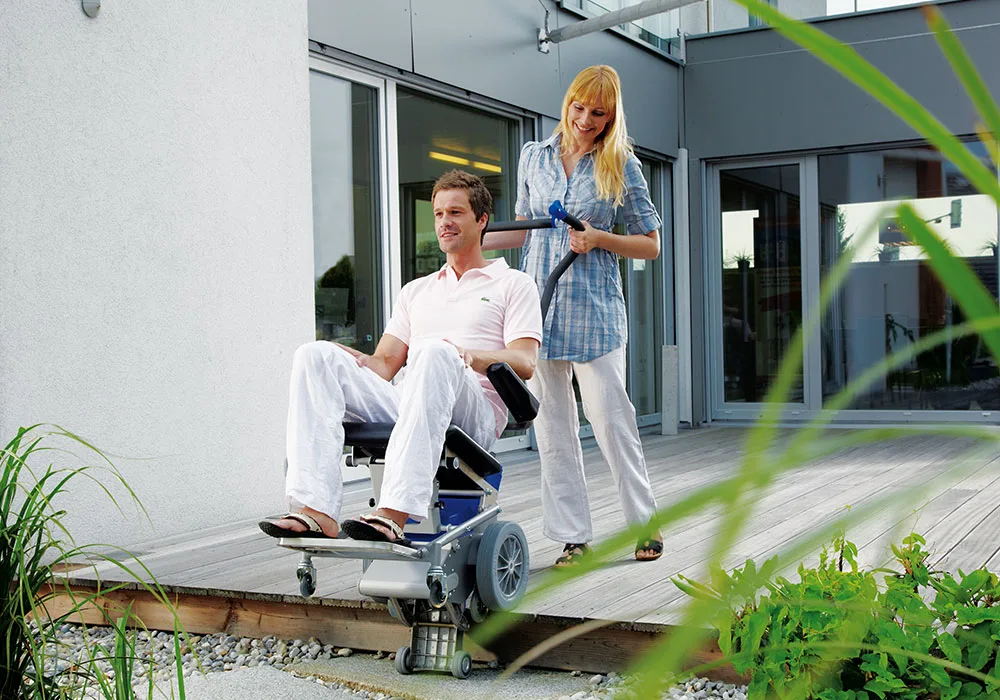
Corridors can be even tighter, sometimes barely enough for two people to cross comfortably. Staircases are frequently steep, narrow, and sometimes spiral or curved.
Now compare that with what a standard wheelchair actually needs:
Most wheelchairs measure 24 to 27 inches wide from wheel to wheel. For a wheelchair to be operated and move freely through a door, the doorway should be a minimum of 32 inches in breadth. If the doorway is in a hallway that requires turning, the door should measure at least 36 inches wide.
That gap — between what homes typically offer and what wheelchairs actually need — is the core of the problem. And choosing the right lift is only part of the solution. Consider how to approach the lift. Think about the turning space around it and if your corridors let the wheelchair reach the lift.
Let’s walk through all of this practically.
Step 1: Measure Before You Shop — The Numbers That Matter Most
This is the most important step that most families skip. Before you call any lift company or look at any product, take these measurements at home:
Doorway clear width: Measure the opening with the door fully open — from the face of the door to the opposite frame. This is your “clear width,” and it’s what actually matters, not the door size itself.
Corridor width: Measure the narrowest point in the corridor that leads to the staircase or the area where you plan to install the lift.
Staircase width: Measure the clear width between the two walls (or the wall and the banister). This determines whether a platform lift or inclined lift can physically go on your staircase.
Turning space: Is there enough room at the top and bottom of the stairs — or at the lift entry — for the wheelchair to turn? A 60-inch turning radius is required for wheelchairs, or a T-shape turning space. In a narrow corridor, this is often the trickiest constraint.
Height difference: How many floors or steps are you trying to bridge? A lift that covers one floor is very different from one that needs to cover three.
Write all these numbers down. You’ll need them for every conversation with a lift provider.
Step 2: Understand the Types of Wheelchair Lifts Available in India
There are three main categories of wheelchair lifts and platform lifts that work in residential settings in India. Each suits a different home layout and need.
Type 1: Vertical Platform Lift (VPL)
This is a compact, open platform that goes straight up and down — like a mini elevator without walls. The wheelchair user rolls onto the platform, and it rises vertically to the next level.
How much space does it need? At the very least, it requires space for the platform and a small overhead structure. The unit itself is approximately 4 feet by 4.5 feet to 5 feet by 5 feet. A straight-through wheelchair lift needs a space of 3 by 4 feet. A side entry lift needs at least 3 by 5 feet for safe turning.
Best for:
Homes where you need to bridge a small height difference — like the 3–5 steps at the front entrance of a house
Split-level homes where one part of the floor is slightly higher than another
Outdoor entry access — very common in independent houses where the main entrance has a short flight of steps
Situations where a full staircase lift isn’t needed
The space reality for homes: A vertical platform lift has one of the smaller footprints of all lift types. However, it still needs clearance above and enough landing space at both the top and bottom levels for the wheelchair to roll on and off safely. If your ground floor entrance opens directly into a narrow lobby, this could be a challenge.
Cost in India: Roughly ₹2–6 lakhs depending on travel height and load capacity.
Type 2: Inclined Platform Lift (Stair-Mounted Wheelchair Lift)
This is a platform, not a chair. It moves along rails on your staircase. It’s like a stairlift but made for wheelchairs. The wheelchair rolls onto the folding platform, and the platform travels up or down the staircase on the rail.
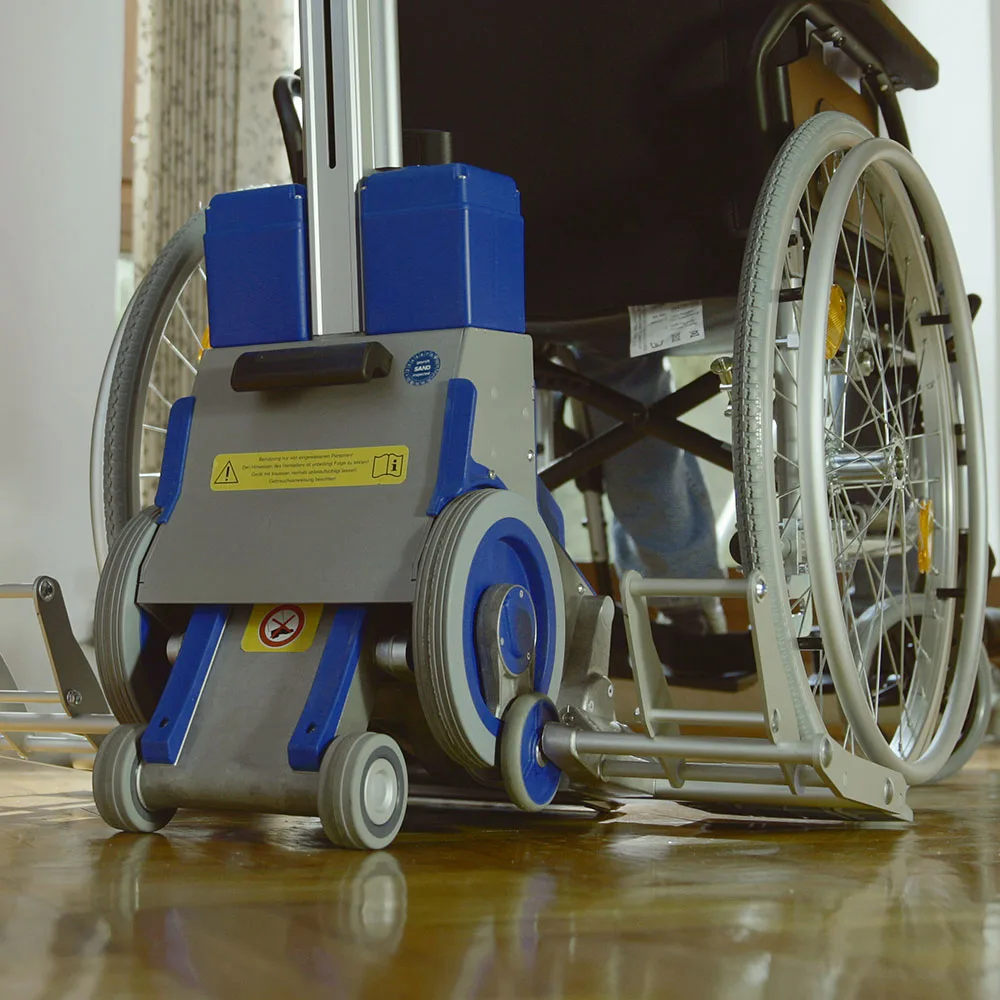
It installs on the wall beside staircase steps. It takes up little space and won’t change how the stairs work. The platform has safety guards on its three outward-facing sides. It will stop automatically if something blocks its movement. When not in use, the platform can be folded to save space.
How much space does it need on the staircase? This is the critical question for narrow staircases. The platform must have a wide enough staircase. It should fit the wheelchair’s width and the rail system. Most inclined platform lifts require a clear staircase width of about 800–900 mm (32–36 inches) for safe operation. Some compact models fit on narrower staircases. Always check with the installer after measuring on-site.
Best for:
Homes where the user needs to go between two or more full floors
Straight staircases (most common in builder floors and DDA flats)
Situations where you want to keep the staircase usable for the rest of the family (the platform folds away)
Users who may not be able to transfer from a wheelchair to a seat
The space in older homes: Many have staircases that are nearly wide enough for this. Careful measurement is essential. The main concern is the landing at the top and bottom. Is there enough room for the wheelchair to roll off the platform and turn into the corridor?
Cost in India: Roughly ₹2–4 lakhs for a straight staircase model.
Type 3: Compact Home Elevator / Residential Lift
Modern compact home elevators, like air-driven or pneumatic models, differ from traditional “platform lifts.” Still, their small size makes them a good option to think about alongside platform lifts. The minimum lift size for a wheelchair is about 880 × 1465 mm. This size provides enough space for easy entry, exit, and movement.
Some new pitless home elevator models need only 1m × 1m of floor space. They don’t require a pit or machine room. This makes them fit well in small home layouts.
Best for:
Families who want a permanent, enclosed, and safe solution
Homes with 3 or more floors
Situations where multiple family members will use the lift — not just the wheelchair user
Cost in India: Starting from ₹5–8 lakhs going up to ₹20+ lakhs for premium glass-cabin models.
Step 3: Match the Lift to your specific doorway and Corridor Situation
Here’s where homes get very specific. Let’s go through the most common scenarios.
Scenario A: The Front Entrance Has Steps (Very Common in Homes)
Many independent houses in cities have 3–10 steps leading up from the gate or driveway to the main door. For a wheelchair user, this is an immediate barrier before even entering the home.
Best solution: A short-rise vertical platform lift at the entrance. These are compact, weather-resistant models designed specifically for outdoor use. They can handle a rise of 1–3 feet, which covers most home entrances. If the rise is small, like 2–3 steps, a good access ramp with a non-slip surface can be easier and cheaper. But for more than 4–5 steps, a vertical platform lift is the safer option.
Doorway consideration: After the lift gets you to the entrance level, the front door still needs to be wide enough for the wheelchair. The minimum width for a wheelchair-accessible doorway is 32 inches (81 cm).
This size lets most standard wheelchairs pass through easily. Accessibility experts recommend 34–36 inches whenever possible to provide additional manoeuvrability space. If your front door is just 24–28 inches wide, common in older homes, you’ll need to widen it. Alternatively, you could pick a narrower wheelchair model.
Scenario B: Narrow Interior Corridor Leading to the Staircase
This is perhaps the toughest situation in homes. You may have a staircase lift ready. However, the corridor linking the bedroom or living room to the staircase is just 2.5–3 feet wide.
The honest answer: No lift can fix a corridor that’s too narrow for the wheelchair to move through in the first place. Before installing any lift, you need to ensure the path to the lift is accessible. Some practical options:
Use a narrower wheelchair. Narrow transport wheelchairs and slim-profile power wheelchairs can be just 21–22 inches wide. This size lets them fit through doorways of 26–28 inches. This is often the simplest fix — choose the right wheelchair first, then match the lift to it.
Widen key doorways. Widening an interior doorway by 3–4 inches is relatively minor civil work. Offset hinges, or swing-clear hinges, can give you about 2 inches more clearance on a door. There’s no need for construction, so it’s a good option to try first.
Remove doors where possible. If a bathroom or bedroom door is a problem, consider removing it. You could also replace it with a sliding or pocket door. This change can create a lot more space.
Plan the lift landing carefully. When installing the platform lift, ensure both landing areas have enough space. This lets the wheelchair approach and exit easily without turning through a narrow gap.
Scenario C: Narrow Staircase in an Older Home or DDA Flat
Many DDA flats, older builder floors, and traditional homes in cities like Delhi, Lucknow, and Kolkata have staircases that are 30–34 inches wide. This width is tight even by normal standards, making it hard for a platform lift.
Options for very narrow staircases:
An inclined platform lift requires a staircase that is wide enough. It should fit the platform width and the rail system. If the staircase is narrower than about 800 mm (32 inches), an inclined platform lift may simply not fit safely. In such cases, your options are:
Switch to a stairlift with a transfer: If the wheelchair user can move from their wheelchair to the stairlift chair at the bottom, they can ride up and switch back at the top. This may involve moving to a second wheelchair upstairs. A regular stairlift is more compact in this case. It can fit on staircases as narrow as 610 mm. This isn’t ideal for full-time wheelchair users, but it works well for those with partial mobility.
Vertical platform lift between floors: If your home has a ground-floor room that can become a bedroom, consider a vertical platform lift. Installing it in a corner may be more practical than dealing with a narrow staircase.
Compact home elevator: If the budget allows, a pitless compact home elevator in a corner of the home often takes less floor space than people expect and avoids the staircase width problem entirely.
Scenario D: Curved or Spiral Staircase
This is a common situation in older bungalows and independent houses across India. Curved staircases are beautiful — but they’re a real headache for lift installation.
Inclined platform lifts are great for straight or curved staircases. They provide a practical solution for wheelchair users. A curved inclined platform lift needs a custom rail to match your staircase’s curve. This raises both cost and complexity. Not all providers can do this. A vertical platform lift, or compact home elevator, is often a better choice for homes with curved or spiral staircases. It’s practical and cost-effective.
Step 4: Key Safety Features to Look For
Regardless of which type of lift you choose, these safety features are non-negotiable — especially in the context:
Battery backup: Power cuts are still a reality in many cities and towns. Your lift needs a battery backup. This should let it make at least one trip during a power failure. It must safely bring the user back to an accessible floor. Look for products with emergency stop buttons and battery backup as standard safety features, not optional extras. Vin Grace
Obstruction sensors: The lift should automatically stop if something — a foot, a bag, a pet — is in its path. This is critical for inclined platform lifts on staircases where family members are passing.
Anti-slip platform surface: The main platform needs an anti-slip pattern and coating. This should provide a slip resistance coefficient of at least 0.85. Check for this specification, especially in homes in coastal or humid regions.
Safety guardrails: The platform edges need automatic folding guardrails or safety barriers. These will stop the wheelchair from rolling off during transit.
Overload protection: The lift should have a sensor that prevents operation if the weight limit is exceeded.
Weather resistance for outdoor lifts: If the lift is at the entrance or in an open courtyard, it must be rated for India’s climate — humidity, monsoon rain, and summer heat. Look for stainless steel or powder-coated finishes and weatherproof electrical components.
Step 5: Indian Standards and Certifications to Check
This is something many families overlook entirely, and then regret later.
All wheelchair elevator lift systems need to follow safety guidelines laid down by the BIS (Bureau of Indian Standards) and the NBC (National Building Code). The BIS codes — IS 14665 governs electric lifts, IS 14671 covers lifts specifically for the disabled, and IS 17386 deals with modernisation projects.
For home elevators, you’ll also need a state lift licence as discussed in our earlier guide. For platform lifts and stairlifts in residential settings, the licensing requirement is generally less strict — but always ask your installer what certifications and compliance documents they will provide upon installation.
Check if the product has European EN 81-41 certification, especially for platform lifts. Many trusted brands in India use or import these certified products.
Step 6: Practical Tips Specific to Homes
Get an on-site assessment — always. Never buy a lift based purely on a phone call or brochure. Reputable companies will offer a free home visit and site survey. Insist on this. The on-site assessment is where the installer will measure your staircase, check your ceiling heights, assess your corridor width, and identify any practical problems before they become expensive problems.
Think about the path, not just the lift. A lift is only one part of the accessibility chain. Think from bedroom to bathroom to living area to staircase and back. Identify every bottleneck — every door, every narrow turn — and address them as a complete plan, not just at the staircase.
Ask about foldaway design. If the lift is on the staircase, other family members still need to use those stairs. Ensure the platform and guardrails fold flat when not in use. This keeps the staircase fully functional for the rest of the household.
Plan for the monsoon. For any outdoor or semi-outdoor installation, monsoon waterproofing is essential. Ask specifically how the electrical components are protected from water ingress.
Consider the caregiver. Many wheelchair users in India have a family member or caregiver assisting them. Make sure there’s enough space on or alongside the lift for the caregiver to accompany or assist if needed.
Check EMI and rental options. Many reputable providers now offer EMI plans, and some offer rental options for short-term needs. EMI options for Vin Grace stair platform lifts start at about ₹8,000 per month. This makes them easier for middle-income families to afford.
Quick Reference – Which Lift Works Best for Your Space?
| Situation | Best Lift Type | Key Requirement |
| 3–10 steps at home entrance | Vertical Platform Lift (outdoor) | Weatherproofing, landing space |
| Narrow straight staircase (32″+ wide) | Inclined Platform Lift | Staircase width min. 800mm |
| Staircase too narrow for platform | Stairlift + transfer | User can sit independently |
| Curved/spiral staircase | Compact Home Elevator | Corner footprint |
| Multiple floors, long-term use | Compact Residential Elevator | ~1m×1m floor space |
| Split-level floors indoors | Vertical Platform Lift (indoor) | Low rise, small footprint |
| 3-floor home, wheelchair user | Home Elevator with wheelchair cabin | Full shaft or pitless model |
How Much Should You Budget? (Estimates)
| Lift Type | Approximate Cost (Installed) |
| Vertical Platform Lift (short rise, outdoor) | ₹2–4 lakhs |
| Inclined Platform Lift (straight staircase) | ₹2–4 lakhs |
| Inclined Platform Lift (curved staircase) | ₹4–8 lakhs |
| Compact Home Elevator (wheelchair capable) | ₹6–15 lakhs |
| Premium Glass-Cabin Home Elevator | ₹15–25 lakhs+ |
Add 18% GST to most product prices unless the supplier includes it in the quote. Annual maintenance typically runs ₹5,000–₹20,000 per year depending on the lift type and brand.
Note: Some mobility aids for disabled persons may qualify for tax deductions under Section 80DD of the Income Tax Act. Consult a tax advisor with the relevant medical certificates.
Conclusion
Choosing the right wheelchair or platform lift for a narrow home isn’t just about picking a product. First, it’s about planning your space, and then you select the right lift.
The golden rule is this: measure everything before you decide anything. Your doorway width, corridor width, staircase width, turning radius, and landing space will tell you more than any brochure can.
For homes with a few steps at the entrance, a compact vertical platform lift is usually the cleanest solution. An inclined platform lift offers wheelchair users true independence. It provides full-floor access on wide, straight staircases. For curved staircases or homes needing long-term access, a compact home elevator is often the best choice. Pitless models are especially practical and offer great value over time.
Choose an installer who will visit your home. They should take accurate measurements, explain the necessary work, provide certified products, and offer a maintenance plan. The right lift in the right home offers your loved one something special: the freedom to move around their home however they choose.
Frequently Asked Questions (FAQs)
Q1. What is the minimum staircase width needed for a wheelchair platform lift in India?
Most inclined platform lifts need a clear staircase width of at least 800–900 mm (about 32–36 inches). This space ensures the platform and rail system fit safely. Some compact models fit in tighter spaces. However, always have the installer take an on-site measurement before confirming.
Q2. My home has a 24-inch doorway. Can a wheelchair pass through it?
A standard wheelchair (24–27 inches wide) will not comfortably pass through a 24-inch doorway. You have two options: widen the doorway (minor civil work, or try offset/swing-clear hinges first for 1–2 inches of extra clearance), or switch to a narrow transport/slim wheelchair that is 21–22 inches wide. Address the doorway problem first — no lift will help if the wheelchair can’t reach it.
Q3. Can a vertical platform lift be installed outdoors in India to handle monsoon conditions?
Yes, but make sure the model you choose is specifically rated for outdoor use with weatherproofing. Choose stainless steel or powder-coated materials. Check for IP-rated electrical parts and an anti-corrosion finish. Ask your installer about the monsoon rating explicitly.
Q4. Is there a platform lift that doesn’t block the staircase for other family members?
Yes — inclined platform lifts are designed with foldaway platforms. When not in use, the platform, guardrails, and ramps fold flat against the staircase wall, leaving the stairs fully accessible for the rest of the family. This is a standard feature; confirm it when purchasing.
Q5. Can a platform lift work during a power cut in India?
It should — and this is a must-have feature. Always choose a lift with battery backup that can complete at least one trip even during a power failure. Some models support 10–20 trips on battery alone. This is especially important in cities and towns where power outages are still common.
Q6. What Indian standards apply to wheelchair lifts and platform lifts?
Platform lifts for disabled persons in India follow BIS standards IS 14671 (for disabled persons) and IS 14665 (for electric lifts). European EN 81-41 certification is also widely accepted and recognised as a quality benchmark. Ask your supplier for compliance documentation at the time of purchase.
Q7. Is there any tax benefit for buying a wheelchair lift in India?
Potentially, yes. You can claim deductions under Section 80DD of the Income Tax Act. This applies to expenses for medical treatment, rehabilitation, and mobility aids for a disabled family member. If the disability is below 80%, you can deduct up to ₹75,000. For severe disabilities above 80%, the deduction is ₹1,25,000. A valid medical certificate is required. Always consult a tax advisor for your specific situation.