India’s cities are going vertical fast.
Mumbai, Bengaluru, Hyderabad, Pune, Delhi NCR — high-rise residential towers are everywhere now. Families are living on the 8th, 15th, even 25th floor.
But here’s a question most apartment residents have never thought about:
If there’s a fire tonight and the elevator doesn’t work, how can your elderly parent or family member in a wheelchair get out?
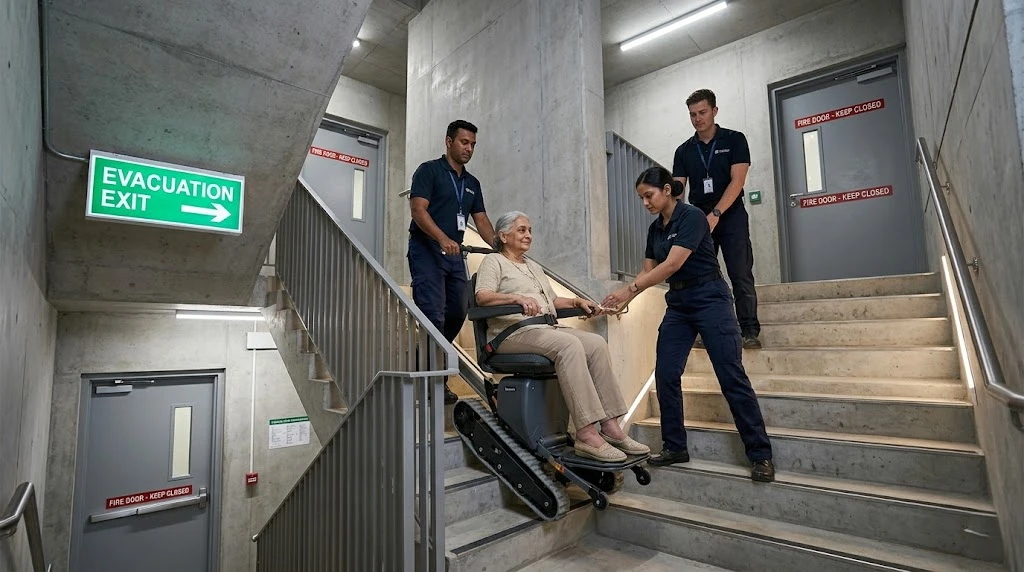
This is not a hypothetical. It is a real, daily risk in Indian high-rise apartments — and most buildings are not prepared for it.
Evacuation chairs are vital safety tools for multi-story buildings. Yet, they are often overlooked.
This guide covers it all: what they are, how they work, who needs them, and what Indian apartments must do for emergency evacuation.
The Problem With High-Rise Evacuations in India
Why the Elevator Is Not an Option During a Fire
This is the most dangerous misconception that kills people in high-rise fires.
In an emergency, like a fire, earthquake, or power outage, avoid using elevators in tall buildings. This creates a serious barrier for people with disabilities or mobility issues. They can’t easily use the stairs to evacuate.
Elevators shut down during fires for safety. They can fill with smoke, their shafts can act like chimneys, and losing power while riding is dangerous.
This means everyone—elderly residents, wheelchair users, pregnant women, and those with mobility issues—must use the stairs to evacuate.
For many, that is simply not possible without help.
Who Is at Risk in a High-Rise Fire?
The answer is more people than most buildings plan for.
Emergencies expose every vulnerability. Stair evacuations aren’t only challenging for the permanently disabled. Seniors, pregnant women, people with mobility challenges, and those healing from surgery or injury face serious risks during stair evacuations. Also, individuals with respiratory or heart conditions are at risk.
In a typical Indian high-rise RWA, nearly every building has:
Several elderly residents who cannot walk down 10+ floors independently
At least one or two wheelchair or walker users
Residents with heart conditions, asthma, or post-surgery restrictions
Young children who may panic or cannot move fast enough
None of them can safely self-evacuate during a fire using stairs alone.
Without a plan — and the right equipment — they are left behind.
The Indian High-Rise Reality
Fire incidents in India, according to the National Crime Records Bureau, lead to thousands of deaths and injuries each year. Each floor of a high-rise building should have two staircase exits for faster evacuation, with staircases at least two metres wide.
Fire safety in Indian residential societies is uneven, even with clear rules in the National Building Code (NBC).
Many residential buildings have residents who don’t know fire-fighting steps. Also, the equipment often doesn’t work due to poor maintenance.
The gap between what the rules require and what actually exists on the ground is where lives are lost.
What Is an Evacuation Chair?
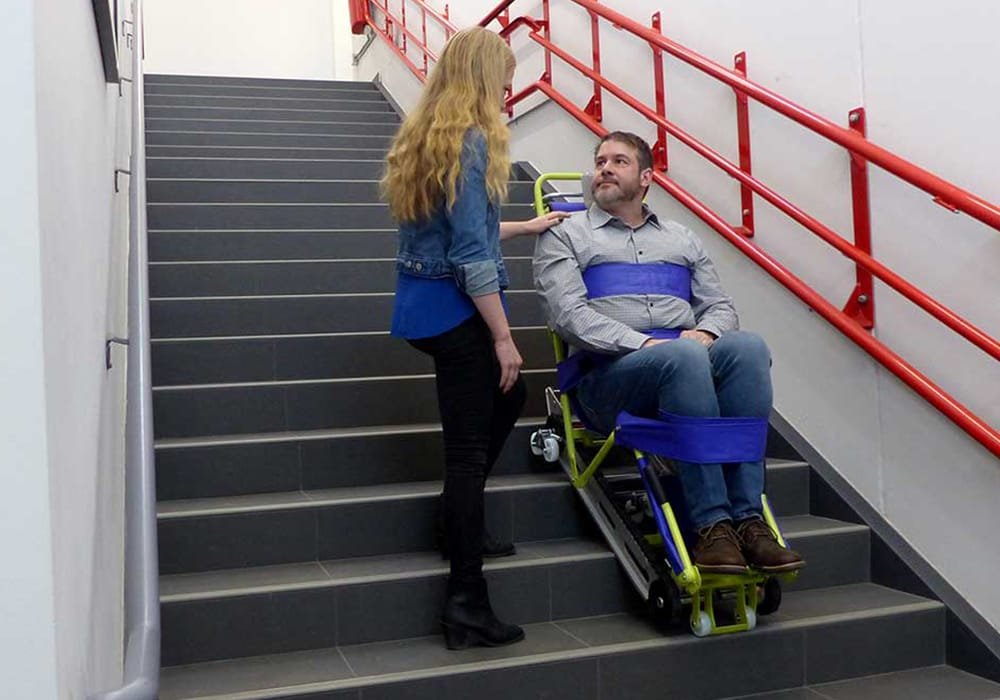
An evacuation chair, or evac chair, is a lightweight chair. It helps carry people with mobility issues safely down stairs in emergencies.
Evacuation chairs help people with disabilities, wheelchair users, the elderly, and those with injuries to exit safely during emergencies.
In emergencies like fires, earthquakes, or power cuts, evacuation chairs help people leave buildings safely and quickly when elevators or ramps can’t be used.
It is not a regular wheelchair. It is not a stairlift.
It is a purpose-built emergency device — designed for speed, safety, and staircase use under pressure.
How Does an Evacuation Chair Work?
Understanding the mechanism helps you choose the right model and train staff properly.
Evacuation chairs are built for one-person use. This lets a responder safely assist anyone up to 180 kg. They feature advanced brakes, secure harnesses, and durable rubber tracks. These elements ensure a smooth and stable descent.
Here’s the step-by-step of how it works:
Step 1 — Retrieve and unfold: The chair is stored flat against a wall bracket near the stairwell. One person unfolds and opens it in seconds — no tools, no installation required.
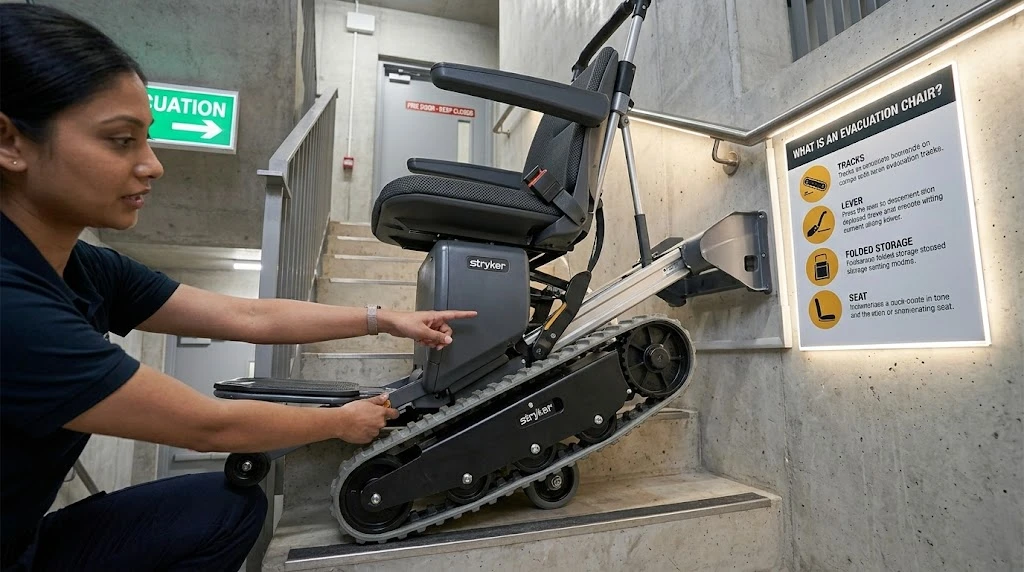
Step 2 — Seat the user: The person who cannot walk sits in the chair. Secure them with a safety belt or harness across their torso and lap. This keeps them stable during descent.
Step 3 — Descend the staircase: Evacuation chairs can handle nearly all staircases. The rubber track system makes it easier to carry loads. It also lowers the chance of injury while going down stairs. The operator holds handles at the rear of the chair, tips it back slightly onto its rubber tracks, and guides it smoothly downward. The tracks — not the operator’s muscles — bear most of the weight.
Step 4 — Navigate Landings: At each landing between flights, wheel the chair on its rear wheels. Then, turn and reposition it for the next flight.
Step 5 — Transfer at ground floor: Help the user out at the safe exit point. Hand them over to emergency services or move them to the assembly point.
The entire descent can happen in minutes per floor with a trained operator.
Key Features to Look for in an Evacuation Chair
Not all evacuation chairs are the same quality. Here’s what matters:
Rubber track system: This is the most important feature. Durable rubber tracks ensure a smooth, stable descent. They also greatly lessen the physical strain on the operator. Chairs without tracks depend on the operator’s strength. This can be tiring and hard to control across different floors.
Controlled braking: A built-in speed control or braking mechanism prevents the chair from sliding too fast on steep stairs. This is critical in Indian staircases, which are often steep.
Secure harness: A good chest and lap belt keeps the user in place. This stops them from sliding forward during descent.
Weight capacity: Standard models handle up to 160–180 kg. Verify the capacity matches the likely users in your building.
Lightweight frame: The chair should be light enough for one person to carry when folded. It typically weighs under 15 kg. Evacuation chairs are light enough to carry upstairs quickly while folded and easy to deploy.
No electricity or batteries needed: Evac chairs work manually, so they function even during a power outage. This is essential — an evacuation chair that requires charging is unreliable in a real emergency.
Works on most staircases: Check if the chair fits your building’s stairs — concrete, marble, or tile. Most quality models work on all these surfaces.
**Wall-Mount Storage Bracket:** This bracket lets you store the chair flat against the stairwell wall. It keeps it out of the way but makes it easy to access. This is the correct placement — not inside a storage room or security cabin.
Types of Evacuation Chairs Available in India
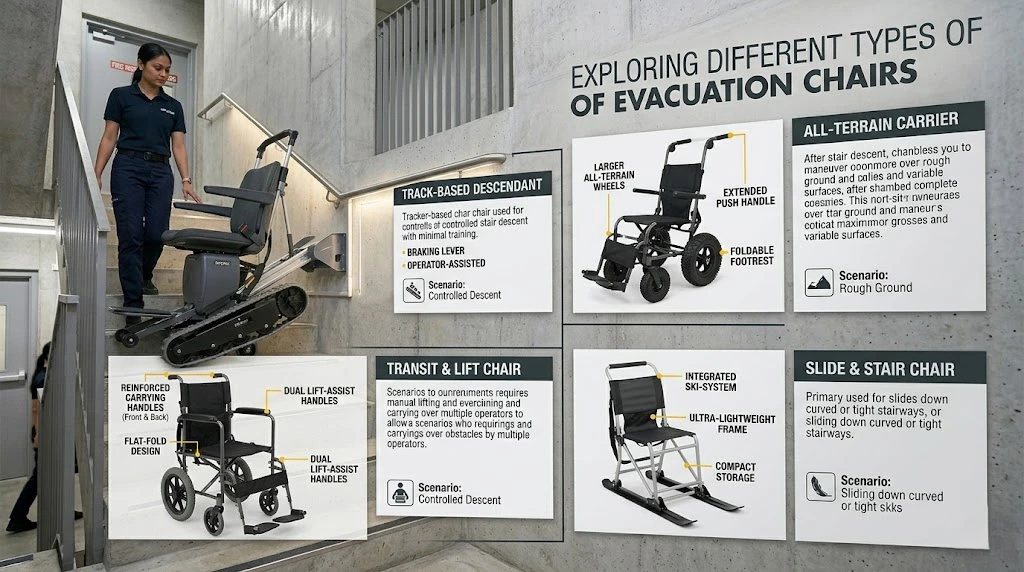
1. Standard Manual Evacuation Chair
The most common type. Lightweight, track-based, manually operated by one or two people.
Works on all standard staircases. No electricity needed. Folds flat for wall mounting.
Best for: Most Indian residential high-rises as a standard emergency equipment item.
Price in India: Around ₹15,000 to ₹50,000. This varies by brand, quality, and weight capacity.
2. Heavy-Duty / Bariatric Evacuation Chair
Same mechanism but with a reinforced frame and higher weight capacity — typically up to 200–225 kg.
Best for: Buildings where residents include heavier individuals, or hospitals and care facilities.
Price in India: ₹40,000 – ₹80,000 approximately.
3. Electric / Battery-Powered Stair Climber
A motorised device that mechanically assists the descent (or ascent) of a wheelchair user on stairs.
More comfortable and requires less physical effort from the operator. However, it relies on battery charge.
Wheelchair stair climbers help safely evacuate injured, elderly, or disabled people from high-rise buildings during emergencies.
Important: In a fire emergency, battery-powered devices carry the risk of battery failure. A manual evacuation chair should be the main emergency device. Motorized climbers can serve as a backup for daily use.
Price in India: ₹80,000 – ₹2.5 lakhs depending on model.
Where Should Evacuation Chairs Be Placed in a Building?
Placement is as important as having the chair in the first place.
If the chair is locked in the security cabin, stored in the basement, or kept in a management office — it is useless in an emergency.
Correct placement:
One chair is mounted in a wall bracket by the stairwell door on each accessible floor. This is for residents with mobility impairments.
At minimum, one chair per stairwell at the top floor and at every 3–5 floors in taller buildings.
Evacuation chairs should have clear signs. They need to be easy to spot, even in smoky hallways.
Unlocked and immediately accessible — never behind a locked cabinet or stored away.
Evacuation chairs should be strategically located near stairwells and high-traffic areas where individuals with mobility challenges may need assistance.
Indian Fire Safety Regulations — What the Law Says
National Building Code (NBC) 2016 — Key Requirements
The National Building Code 2016 mandates that high-rise buildings hold fire drills at least once every three months for the first two years. After that, drills should be done twice a year.
Buildings with a floor area over 150 sq metres or more than 20 occupants must have two staircases. Each exit needs to be at least two metres wide.
NBC 2025 Draft — Stricter Rules Coming
In March 2025, the Bureau of Indian Standards released a new draft, NBC 2025. This draft aims to create stricter fire safety measures.
All residential buildings over 15 metres must have addressable fire detection systems. They also need smart alarms and evacuation systems. These systems pinpoint fire locations and guide safe, efficient evacuations.
Fire Evacuation Lifts in Very Tall Buildings
In India, high-rise buildings above 30 metres must have a dedicated fire evacuation lift. This lift must be fire-resistant for at least 2 hours.
It should have a minimum floor area of 1.4 sq metres. The loading capacity needs to be at least 545 kg, which is about 8 persons. It must have fire-rated landing doors, vision panels, battery backup, and communication systems.
This fire lift is for firefighters and official evacuations. It is not a substitute for a well-planned resident evacuation with the right equipment.
The Gap That Matters Most
Indian regulations set minimum requirements for staircases, fire lifts, and drills.
Evacuation chair rules in residential buildings vary by state and aren’t always enforced.
This means the RWA (Residents’ Welfare Association) and building management often have to take charge. They need to proactively equip the building.
Waiting for a regulatory mandate before acting is not a safety strategy.
What Every RWA and Building Committee Should Do
1. Conduct a Vulnerability Assessment
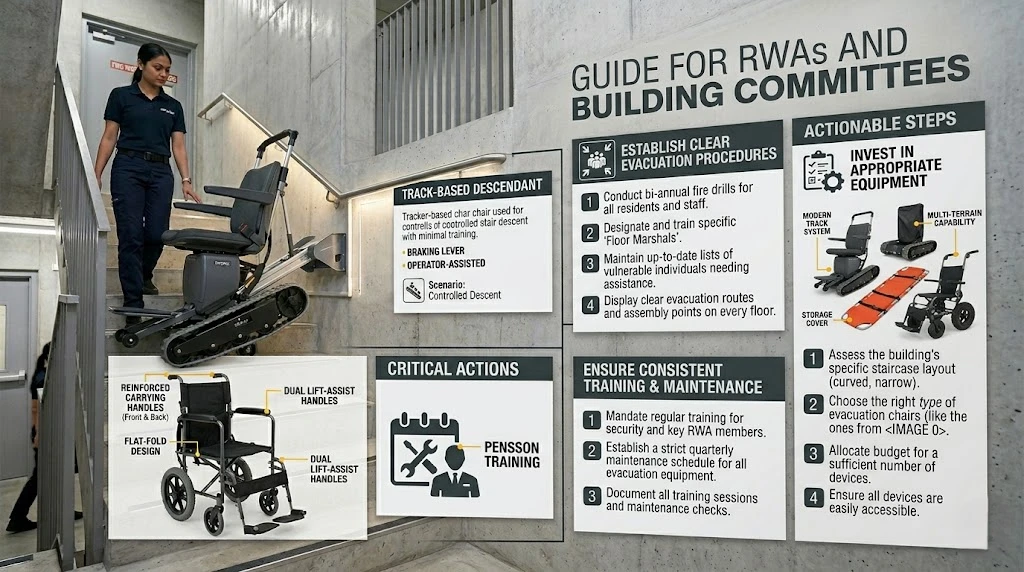
Walk every floor of your building and identify:
Which residents cannot self-evacuate (elderly, wheelchair users, health conditions)?
Which floors do they live on?
How many people per floor may need assistance?
This tells you exactly how many evacuation chairs you need and where to place them.
2. Buy and Install the Right Number of Chairs
A comprehensive building fire evacuation plan must include provisions for vulnerable residents.
A building with 20 floors should not have just one evacuation chair in the lobby.
A general rule: place one chair at each stairwell entry for every 4–5 floors. Add more chairs on floors with mobility-impaired residents. For a 20-floor building with two stairwells, budget for at least 8–10 chairs.
3. Assign and Train Evacuation Wardens
Equipment alone is not enough. Someone needs to know how to use it — fast, under pressure, in a smoky stairwell.
Any staff, safety team members, or building occupants who help during an evacuation should know how to use chairs properly. No specialised certifications are required, but basic staff training is strongly recommended.
Each floor needs an evacuation warden. This should be a strong resident or staff member. They must know where the chair is and how to use it. They should also know how to seat and secure a user, plus navigate the descent safely.
Training takes under an hour. It can save a life.
4. Conduct Regular Fire Drills That Include Mobility-Impaired Residents
Most building fire drills in India involve able-bodied residents walking down the stairs.
Drills almost never include a simulation of evacuating someone in an evacuation chair.
Regular drills turn evacuation plans into real survival skills. They help us practice routes and procedures. High-rise buildings should practice every three months during the first two years, then every six months after that.
Include a full evacuation chair drill — with a volunteer “passenger” — at least once a year.
5. Maintain the Equipment
An evacuation chair stored for years without inspection is not reliable.
Check for:
Frame integrity — no cracks, bends, or rust
Harness and belt condition — no fraying, working buckles
Track condition — rubber not worn or cracked
Easy unfolding — the mechanism opens smoothly without sticking
Bracket is secure — chair is properly mounted and won’t fall
Annual inspection is a minimum standard. Keep a log.
What Individual Residents Should Do
Even if your RWA hasn’t acted yet, you can take steps to protect your family.
- Know your building’s evacuation plan. Ask your RWA if one exists. If it doesn’t, raise it at the next general meeting.
- Know where your nearest stairwell is. And the one on the other side of the floor — both of them.
- Talk to your building’s security and staff. Ask whether they know what to do if a resident cannot use the stairs. If the answer is uncertain, escalate to the RWA.
- Consider a personal evacuation chair for your flat. If you have an elderly parent or a family member with mobility issues on a high floor, consider a foldable evacuation chair. You can store it in your apartment and use it at the stairwell door when needed. This is a responsible personal safety investment.
- Create a personal emergency plan. Know which neighbour or family member will assist your elderly parent or disabled family member. Have that conversation now — not during a fire.
Evacuation Chair Cost in India — What to Budget
For RWAs and building committees planning a purchase:
Type & Approximate Price
- Standard manual evacuation chair – ₹15,000 – ₹50,000
- Heavy-duty / bariatric model – ₹40,000 – ₹80,000
- Wall-mount storage bracket – ₹1,500 – ₹5,000
- Electric stair climber (supplementary) – ₹80,000 – ₹2.5 lakhs
- Staff training (per session) – ₹3,000 – ₹10,000 (provider-dependent)
For a building with 15 to 20 floors and two stairwells, budget around ₹3 to 8 lakhs for safety coverage. This is a smart investment. It costs less than the monthly maintenance fees of most RWAs in Mumbai or Bengaluru.
Conclusion
A fire in a high-rise apartment is one of the most terrifying emergencies possible.
For most residents, the path to safety is simple — walk down the stairs and out.
But for your elderly neighbor on the 14th floor with a hip replacement, and the resident in flat 12B who uses a wheelchair, safety isn’t certain. Someone must plan and equip the building properly for that to happen.
Evacuation chairs are not luxury safety equipment. They are essential, affordable, and save lives.
Every Indian high-rise needs trained evacuation wardens. There should be a clear emergency plan, too. Plus, the right number of evacuation chairs must be ready at each stairwell.
The time to think about this is today — during a quiet Tuesday — not at 2 AM when a fire alarm is going off.
Talk to your RWA. Ask the hard questions. Insist on proper equipment.
Your building is only as safe as its weakest evacuation plan.
Frequently Asked Questions (FAQs)
Q1. Can a single person operate an evacuation chair during a fire emergency? Yes — most standard evacuation chair models are designed for single-person operation. The rubber track system and braking mechanism handle the main load. One trained operator can safely help a person down the stairs. They do this without lifting or carrying them. For heavier users or steep stairs, it’s best to have a second person up front as a spotter for extra safety.
Q2. Is an evacuation chair the same as a regular wheelchair? Can we use a wheelchair instead? No — they are very different. A regular wheelchair is not designed for staircase descent. It has no tracks, no controlled braking, and no mechanism for navigating steps safely. Using a standard wheelchair on stairs in an emergency is risky for the user and the helper. An evacuation chair is purpose-built for exactly this situation and should not be substituted.
Q3. Does Indian law require high-rise apartments to have evacuation chairs?
The National Building Code 2016 requires buildings over 30 metres to have:
Fire drills
Two staircase exits
Fire evacuation lifts
Evacuation chair rules vary by state in India and aren’t always enforced. However, buildings have a duty of care to all occupants. Any RWA or building management that fails to plan for evacuating mobility-impaired people faces legal and moral risks. Don’t wait for legislation — act proactively.
Q4. How many evacuation chairs does our building need? First, check how many stairwells your building has. Then, find out which floors have residents who can’t evacuate on their own. A practical minimum is one chair for every stairwell every 4 to 5 floors. Also, there should be at least one chair on each floor with a known mobility-impaired resident. For a 15–20 floor building with two stairwells, this typically means 8–12 chairs across the building.
Q5. How do we train building staff to use an evacuation chair properly? Most evacuation chair suppliers in India offer basic training as part of the purchase.
A standard training session includes:
How to unfold and mount the chair.
How to seat and harness a user correctly.
The right technique for going down stairs.
How to navigate landings.
What to do if you face obstacles.
Training lasts less than an hour. It should happen when new staff join and before each fire drill, which is twice a year. No special certification is needed. Any adult who is physically fit can be trained to operate one safely.