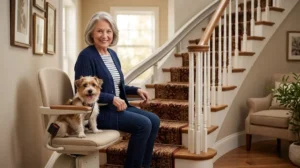
Living in a multi-story home in India—whether it’s a duplex in Bengaluru, a kothi in Delhi, or a bungalow in Mumbai—often means dealing with stairs. While straight staircases are simple to navigate, many Indian homes feature staircases with landings, sharp 90-degree turns, or “fan” steps that wind around a corner.
For elderly family members, these turns can be the most dangerous part of the climb. A straight stairlift simply won’t work here because it cannot bend around the corner.
If you want to travel from the ground floor to the first floor in one smooth, safe journey, you need a specialized solution: a curved stairlift.
This guide explores the best options for a stairlift for 90-degree stairs, highlighting the models best suited for the unique architecture of Indian homes. We will look at features, installation processes, and why choosing the right curved model is crucial for your family’s safety.
Understanding the Challenge: The 90-Degree Turn
In architectural terms, a 90-degree turn usually involves a flat landing where the staircase changes direction (L-shaped), or a set of winding steps that turn the corner without a landing.
Standard stairlifts only move in a straight line. If you install two straight stairlifts (one for the first flight, one for the second), the user has to get off at the landing, walk across the turn, and get on the second lift. This “transfer” is risky for someone with limited mobility.
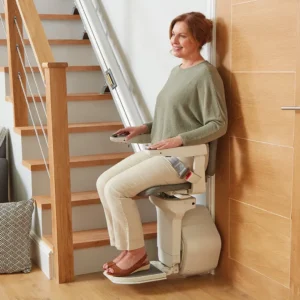
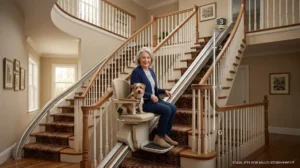
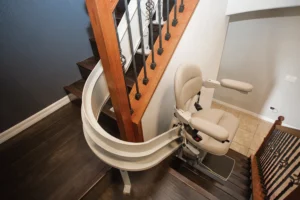
Curved stairlifts for Indian homes solve this problem. They run on a custom-made rail that bends precisely to match the angle of your staircase. The chair glides smoothly around the 90-degree corner, across the landing, and up the next flight without the user ever needing to stand up.
Why Indian Homes Need Specific Stairlift for 90-Degree Turn Stairs
Indian staircases differ from those in the West. They are often constructed of concrete with granite or marble finishing, and widths can vary significantly.
- Narrow Widths: Older homes may have narrower staircases, requiring a lift with a slim profile.
- Concrete Treads: The rail must be anchored securely into stone or concrete, not wood.
- Power Reliability: Given the frequency of power cuts in many Indian cities, battery backup is a non-negotiable feature.
Top Stairlift Models for 90-Degree Turns in India
Here are the best-performing models currently available in the Indian market that excel at handling 90-degree turns.
1. Vingrace Curved Stairlift
Designed specifically to adapt to the varied architecture of Indian households, the Vingrace curved model is a top contender for mobility solutions for Indian homes.
- The 90-Degree Edge: It features a highly customizable rail system that hugs the inner bend of the staircase tightly. This “inside curve” installation saves valuable walking space for other family members.
- Why it works for India: It comes with robust battery backup systems designed to handle extended power outages. The seat is ergonomically designed for comfort, and the rail can be color-matched to your home’s interior.

2. Platinum Curve (Heavy Duty)
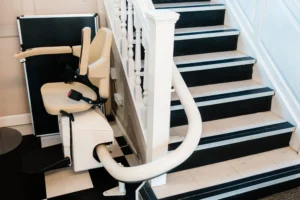
The Platinum Curve is renowned for its durability and smooth ride. It is particularly good for staircases that have tight bends or narrow landings.
- The 90-Degree Edge: This model uses a twin-rail system, which provides extra stability as the chair turns the corner. It effectively reduces the vibration often felt on single-rail systems during a turn.
- Why it works for India: It has a higher weight capacity compared to many standard models, making it a robust choice for heavier users. The seat can be adjusted to fit the user’s leg length, ensuring a custom fit.
3. Handicare Freecurve
The Handicare Freecurve is famous for its single-tube rail design. It is sleek, modern, and less intrusive than double-rail systems.
- The 90-Degree Edge: The Freecurve uses a unique “Turn and Go” feature. If your staircase is extremely narrow at the 90-degree turn, the seat can swivel automatically while moving to prevent the user’s knees from hitting the wall or railing.
- Why it works for India: Its modular rail design allows for faster installation compared to fully custom-welded rails. This is ideal if you need an urgent solution for an elderly parent returning from the hospital.
4. Otolift Air (Modul-Air)
Otolift Air (Modul-Air) is widely considered one of the world’s thinnest single-rail stairlifts.
- The 90-Degree Edge: The rail is incredibly slim (often just 6cm diameter), making it perfect for tight 90-degree turns where every inch of space counts. It is usually installed on the inner curve of the stairs.
- Why it works for India: The sleek design fits well in modern Indian apartments where aesthetics are a priority. It is unobtrusive and quiet.

Key Features to Look For in a Curved Stairlift
When shopping for best stairlifts for curved stairs, don’t just look at the price tag. Focus on these essential features:
1. Custom vs. Modular Rails
- Custom Rails: These are measured and manufactured specifically for your staircase in a factory. They offer the smoothest ride but take weeks to arrive.
- Modular Rails: These are pre-made curved sections that are assembled on-site. They are faster to install but might not be as smooth as a custom rail. For a complex 90-degree turn, a custom rail is often the better long-term investment.
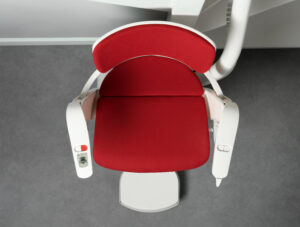
2. Automatic Swivel Seat
Getting off a stairlift at the top of a 90-degree turn can be scary if the chair doesn’t turn fully onto the landing. An automatic powered swivel seat turns the chair to face the landing, blocking the stairs behind the user. This acts as a safety barrier, preventing falls.
3. Retractable Rail Hinge
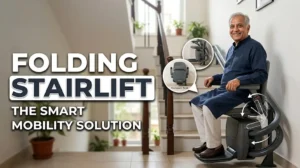
In many Indian homes, the bottom of the staircase starts right near a doorway or a hallway. A fixed rail might become a tripping hazard. Look for a model with a hinged rail that automatically folds up when the lift is not in use, clearing the walkway.
4. Safety Sensors
Indian homes often have high foot traffic. Your stairlift should have sensitive pressure sensors on the footrest and carriage. If a grandchild leaves a toy on the stairs, or if a pet is sleeping on a step, the lift should stop gently and automatically upon contact.
Cost Considerations
It is important to be realistic about costs. A curved stairlift for 90-degree stairs will be significantly more expensive than a straight one.
- Engineering: The rail requires custom bending and engineering.
- Motor: The motor needs to be more powerful and sophisticated to handle changes in angle and speed.
- Installation: It requires specialized technicians.
While the upfront cost is higher, the safety benefits of a continuous journey without transfers are priceless for elderly family members.
The Installation Process for Curved Stairs
Installing a stairlift for 90-degree stairs is more complex than a straight lift.
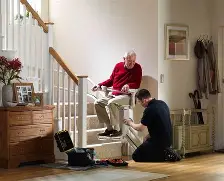
- Photogrammetry Survey: A technician visits your home and places markers on your stairs. They take photos to create a 3D digital map of your staircase. This ensures the 90-degree bend is measured with millimeter precision.
- Fabrication: The rail is bent to match your specific turn. This ensures the ride is level and the speed is controlled during the turn.
- Installation: The rail is bolted to the stairs (not the wall). Because it is custom-made, the actual installation usually takes only one day.

Conclusion: Which Model Should You Choose?
If you have a standard Indian home with a concrete staircase and a 90-degree landing, you have excellent options.
- For narrow stairs where space is tight, look at the Otolift Air or Handicare Freecurve.
- For heavy usage and stability, the Platinum Curve or Vingrace models offer robust performance.
- For safety on tight corners, ensure your choice has a “Turn and Go” or powered swivel feature.
Investing in a curved stairlift transforms your multi-story house back into a single accessible home. It removes the barrier of the stairs, allowing your parents to move freely from the living room to the bedroom without fear or pain.
Frequently Asked Questions (FAQs)
Q. Can a curved stairlift be installed on very steep spiral stairs?
Yes. High-quality curved stairlifts are designed to handle tight spirals and steep angles. Custom rails are essential here to ensure the chair remains level throughout the tight turns.
Q. How long does it take to get a custom curved rail in India?
Because the rail is custom-made (often imported or fabricated centrally), the wait time is typically 3 to 6 weeks from the date of measurement to installation. Modular rails can be installed faster.
Q. Does a curved stairlift use more battery power than a straight one?
Yes, slightly more. The motor works harder to navigate bends and maintain speed control. However, reliable mobility solutions for Indian homes come with high-capacity batteries that still provide 10-15 trips during a power cut.
Q. Will the rail obstruct the staircase for other people?
Modern curved rails are designed to park tightly against the wall or banister. When the seat and footrest are folded up, the staircase usually remains wide enough for other family members to walk comfortably.
Q. Can I rent a curved stairlift in India?
Rentals are rare for curved stairlifts. Since the rail is custom-bent to fit your specific 90-degree turn, it cannot be easily removed and reused in another house. Buying is usually the only practical option for curved stairs.