Living in Delhi comes with its perks—rich history, vibrant culture, and amazing food. But it also comes with a frustrating reality: power cuts. While the situation has improved over the years, summer outages and load shedding are still common in many neighborhoods, from South Extension to Dwarka.
For most people, a power cut is just an inconvenience. But if you rely on a motorized device to move between floors, a power cut can be a genuine fear.
Imagine being halfway up the stairs when the lights go out. Will you get stuck? Will you be stranded on the ground floor? These are valid concerns for anyone considering mobility solutions for the elderly. The good news is that modern stairlift technology has evolved specifically to handle these situations.
This guide explains everything you need to know about battery backup stairlifts in India, how they function during Delhi’s notorious power fluctuations, and exactly how many trips you can expect when the grid goes down.

The Fear of Getting Stuck: Myth vs. Reality
One of the biggest misconceptions about stairlifts is that they run directly off your home’s main electricity supply, like a vacuum cleaner or a toaster. People often assume that if the power dies, the stairlift dies instantly.
This is a myth.
Almost all modern stairlifts sold in India today are DC (Direct Current) powered. This means they run on rechargeable batteries located inside the stairlift carriage itself. The main electricity supply is only used to charge these batteries.
So, when the power goes out in your Delhi home:
- The stairlift does not stop. It continues to run smoothly because it is drawing power from its own battery, not the wall socket.
- You are never stranded. Even if the outage happens while you are mid-journey, the lift will carry you to your destination safely.
This battery-operated design is a standard safety feature in reliable stairlifts for Indian homes, ensuring that mobility is never compromised by the local electricity board.
How Battery Backup Stairlift in India
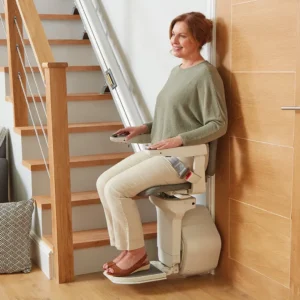
To understand how reliable these machines are, it helps to understand the mechanism. A typical stairlift system consists of:
- The Rail: This is fitted to your stairs.
- The Carriage: This is the chair unit that moves.
- Charging Points: These are usually located at the very top and very bottom of the rail. Some advanced models, like those with “continuous charging,” charge the battery wherever the lift stops on the rail.
When the stairlift is parked at a charging point, it sips electricity from your home to keep its internal batteries fully juiced. When you use the lift, it runs off that stored battery power.
This system acts like a built-in UPS (Uninterruptible Power Supply). You don’t need to buy a separate inverter or generator to keep the stairlift running; it takes care of itself.

The Big Question: How Many Trips Can You Make?
So, the power is out, and the inverter is beeping. How long will your stairlift keep working?
The number of trips a stairlift battery backup in India can provide depends on several factors:
- The age of the batteries: New batteries hold more charge.
- The weight of the user: Heavier loads consume more power.
- The length and angle of the staircase: Longer, steeper stairs require more energy.
- The type of stairlift: Curved stairlifts use slightly more power than straight ones due to the complexity of the movement.
The Average Number
On average, a fully charged stairlift battery can provide 10 to 20 trips up and down the stairs during a power outage.
For a curved stairlift, which has to work harder to navigate bends and turns, you might expect roughly 10 to 15 trips. For a straight stairlift on a standard staircase, you could easily get 15 to 20 trips.
What Does This Mean for Daily Life?
Think about how often the user goes up and down the stairs. Even on a busy day, a senior citizen might go up and down 4 or 5 times.
- Morning: Down for breakfast.
- Afternoon: Up for a nap.
- Evening: Down for tea or a walk.
- Night: Up for sleep.
That is roughly 4 trips. With a capacity of 15-20 trips, your stairlift can easily function for 3 to 4 days without any electricity at all. Given that most Delhi power cuts and stairlifts issues are resolved within a few hours, this provides a massive safety buffer.

Why Battery Backup is Essential for Delhi Homes
Delhi’s power supply can be erratic. While scheduled cuts are announced, faults in transformers or local distribution lines can happen unexpectedly. Here is why robust battery backup is non-negotiable for Indian households.
1. Safety During Emergencies
Power cuts often happen during storms or emergencies. If an elderly parent needs to evacuate the upper floor quickly, or if a medical need arises when the power is out, the stairlift must work. The battery backup ensures that evacuation is always possible.
2. Independence from Generators
Many Delhi households have large inverters or diesel generators. However, these systems sometimes take a minute to kick in, or they might not be connected to every socket in the house. Because the stairlift has its own battery, it is completely independent. It doesn’t matter if your main generator fails; the stairlift will still work.
3. Voltage Fluctuation Protection
Delhi is also known for voltage fluctuations that can damage sensitive electronics. Since the stairlift runs on batteries and the charger usually has built-in surge protection, the motor is isolated from these dangerous spikes. This extends the lifespan of the machine.
4. Peace of Mind for Caregivers
If you are at work and your elderly parents are home alone, the last thing you want to worry about is them getting stuck on the stairs during an outage. Knowing the power outage solutions for stairlifts are built-in allows you to focus on your day without anxiety.
Maintenance Tips for Stairlift Batteries
To ensure you always get those 15-20 trips when you need them most, you must look after the batteries.
- Keep it Charging: Always park the stairlift at the designated charging point (usually at the top or bottom of the stairs) when not in use. If you leave it in the middle of the track (unless it has a continuous charging strip), the batteries will drain. Most modern lifts will beep at you if you leave them off the charger.
- Regular Use is Good: Batteries degrade if they sit unused for months. Using the lift regularly keeps the battery chemistry active and healthy.
- Replace Every 3-5 Years: Even the best rechargeable batteries lose their capacity over time. In the Indian climate, heat can sometimes degrade batteries faster. Plan to replace them every 3 to 5 years as part of your annual service contract.
- Switch Off During Long Vacations: If you are going away for a month, turn the stairlift off at the isolator switch to prevent the batteries from draining completely.
Latest Trends in Battery Technology
As of 2026, stairlift technology continues to improve.
- Lithium-Ion Batteries: Some premium models are shifting from traditional lead-acid batteries to Lithium-Ion. These charge faster, last longer, and hold their charge better during extended outages.
- Smart Monitoring: High-end stairlifts now come with smartphone apps that alert you if the battery is low or if the power supply to the charger has been cut (for example, if a plug was accidentally pulled out). This is a game-changer for home accessibility in Delhi.


Conclusion: Don’t Let Power Cuts Stop You
Living in a multi-story home in Delhi shouldn’t mean living in fear of the stairs. The modern stairlift is designed with the Indian reality in mind. With robust battery backup systems capable of providing up to 20 trips during an outage, these devices offer reliable, uninterrupted mobility.
When shopping for a stairlift, always ask the supplier about battery capacity. Look for reliable stairlifts for Indian homes that specify DC power and inquire about the cost of battery replacements.
By choosing a model with a strong battery system, you ensure that your loved ones retain their independence, regardless of what the electricity grid is doing.
Frequently Asked Questions (FAQs)
Q. Will my stairlift stop immediately if the power goes out while I am using it?
No. Modern stairlifts run on internal batteries. If the power cuts while you are moving, the lift will continue to your destination smoothly without stopping or jerking.
Q. How long do stairlift batteries last before they need replacing?
Generally, stairlift batteries last between 3 to 5 years. This depends on usage frequency and how well they are maintained. In hotter climates like Delhi, it is wise to check them during your annual service.
Q. Does the stairlift consume a lot of electricity to charge?
No. A stairlift uses about as much electricity as a standard light bulb to keep its batteries charged. It is very energy efficient and will not significantly impact your electricity bill.
Q. Can I connect my stairlift to my home inverter?
Yes, you can plug the stairlift’s charging unit into a socket connected to your home inverter. However, since the stairlift has its own battery, this is just a backup for the backup! It ensures the lift’s internal batteries stay charged even during very long outages.
Q. How do I know if the stairlift battery is low?
Most stairlifts have a digital display or a light indicator on the armrest. It will typically show a specific code or flash a light if the battery is low. The lift may also move slower than usual or beep if it’s not parking correctly to charge.