Does your home have a staircase that feels a bit tight? In many Indian homes, staircases are often designed to be functional but compact. While this saves space, it can become a big problem when you need to install a mobility aid. A common worry we hear at Vingrace is: “My stairs are too narrow for a lift. Will it block the way for everyone else?”
If you have been told your stairs are too small, don’t lose hope. Technology has come a long way. Today, you don’t need a grand, wide staircase to enjoy the safety of a stairlift. Modern engineering focuses on slim, unobtrusive designs specifically built for tight spaces.
In this guide, we will explore the best solutions of stairlift for narrow stairs. We will focus on ultra-slim rails—some taking up less than 8 inches of space—and features that fold away to keep your home accessible for the whole family.
Here is what you will learn:
- Why Indian staircases often require specialized slim lifts.
- Top features to look for in space-saving models.
- How slim rail technology works.
- Installation tips for tight spaces.
Let’s find the perfect fit for your home.
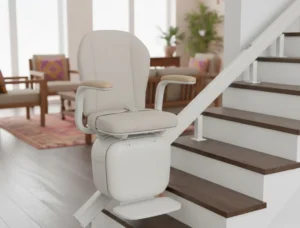
The Challenge of Narrow Stairs in Indian Homes
Indian architecture is unique. In many independent floors, duplexes, and older bungalows, the staircase width can sometimes be as little as 28 to 30 inches. Standard stairlifts might eat up too much of this valuable walking space, making it difficult for other family members to use the stairs safely.
When looking for the best stairlift for Indian homes, the width of the rail and the folded seat is the most critical factor. A bulky unit can become an obstruction, creating a tripping hazard. This is why standard models often don’t work here. You need a solution designed with “compact living” in mind.
What Counts as “Narrow”?
Generally, if your staircase is less than 29 inches wide, it is considered narrow for a standard lift. However, with the right slim stairlift for narrow stairs, we can often install units on staircases as narrow as 24 to 26 inches, depending on the user’s seated width.
Slim Rail Options: The Game Changer
The rail (or track) is the metal part attached to your stairs that the chair travels along. In the past, these were bulky and sat far out from the wall.
Ultra-Slim Single Rails
The latest innovation in the industry is the single-rail system. Unlike older double-rail systems that look like train tracks, a single tube rail is much less intrusive.
- Low Profile: Top models feature rails that sit very close to the wall or banister, often protruding less than 6 to 8 inches.
- Better Aesthetics: They look cleaner and less industrial, blending better with your home decor.
- Maximize Walking Space: By hugging the edge of the stairs, these rails leave the maximum amount of space open for others to walk up and down.
When you choose a compact stairlift for tight spaces, the rail design is just as important as the chair itself.
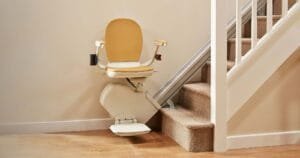
Essential Features for Small Staircases
Finding a rail under 8 inches is a great start, but the chair needs to be compact too. Here are the must-have features Vingrace recommends for narrow settings.
1. Fold-Flat Technology
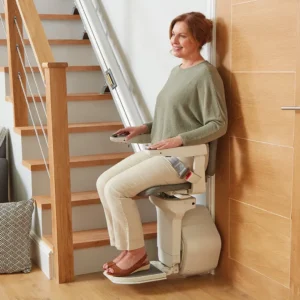
This is non-negotiable. The seat, armrests, and footrest must fold up tightly against the wall when the lift is not in use.
- Slim Folded Depth: Look for a model where the folded depth is around 11 to 13 inches. This ensures that when the lift is parked, the stairs are clear.
- Linked Footrests: Bending down to fold a footrest can be hard. Many space-saving stairlift models have a linked mechanism where folding the armrest automatically folds the footrest too.
2. The Turn and Go (Swivel) Feature
For extremely narrow stairs (under 26 inches), your knees might hit the opposite wall as you travel. The solution? A specialized seat that swivels slightly.
- How it works: Instead of sitting with your back to the wall, the seat turns so you travel at a 45-degree angle (or sometimes even sideways).
- The Benefit: This position tucks your knees in, preventing them from knocking against the wall or banister, allowing the lift to glide through very tight gaps.
3. Parking Bends and Start Rails
Where you park the lift matters.
- Top and Bottom Parking: If your staircase is narrow from top to bottom, you don’t want the chair parked on the stairs at all. We can install a “park point” that allows the chair to travel around the corner onto the landing, leaving the entire staircase 100% obstruction-free.
- Hinged Rails: If you have a doorway right at the bottom of the stairs, a hinged rail can fold up automatically after you use it, removing the tripping hazard.
Why Customization Matters in Stairlift for Narrow Stairs
You cannot buy a “one-size-fits-all” product for a narrow staircase. Precision is key.
At Vingrace, we use advanced photogrammetry (photo surveys) to measure every inch of your staircase. For a stairlift for small staircases, every millimeter counts.
A custom curved rail can be designed to hug the inside turns of your stairs tightly, whereas a modular rail might require wider turns that use up too much space.
While custom options might cost slightly more, they are often the only way to safely fit a lift into a tight Indian staircase without requiring structural changes to your home.
Installation Process for Tight Spaces
Installing a lift in a narrow area requires expertise.
- Survey: Our technician checks for obstructions like window sills, radiators, or protruding skirting boards that could interfere with the lift.
- Design: We create a 3D model to show you exactly how much space remains for walking. You will see the rail position before we manufacture it.
- Fitting: The rail is attached to the stair treads, not the wall. This is great for Indian homes with decorative wall finishes, as it causes minimal disruption.

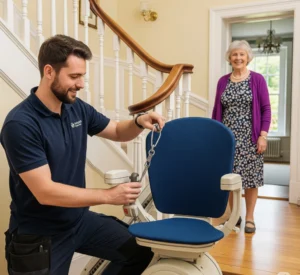
Conclusion
Living in a home with narrow stairs doesn’t mean you have to sacrifice your independence or safety. With advancements in engineering, the best stairlift for Indian homes is now sleek, slim, and incredibly smart. By choosing a model with a single rail under 8 inches and utilizing features like “Turn and Go” seating, you can navigate your home comfortably.
At Vingrace, we specialize in solving complex mobility problems. We believe that if you can walk up it, we can usually fit a lift on it. Don’t let a narrow staircase limit your lifestyle.
Frequently Asked Questions (FAQs)
Q1: What is the minimum width required for a slim stairlift for narrow stairs?
A: Generally, a staircase should be at least 29 inches wide. However, with a specialized slim stairlift for narrow stairs that features a “Turn and Go” or standing perch option, we can often install lifts on stairs as narrow as 24 to 26 inches.
Q2: Are there specific space-saving stairlift models for curved narrow stairs?
A: Yes. Space-saving stairlift models are available for curved stairs. These use custom-made single rails that hug the inner curve (bends) of the staircase very tightly, maximizing the usable width for other people walking on the stairs.
Q3: How much space does a compact stairlift for tight spaces take up when folded?
A: A high-quality compact stairlift for tight spaces is designed to be unobtrusive. When the seat, arms, and footrest are folded up, the unit typically protrudes only about 11 to 13 inches from the wall.
Q4: Can I install a stairlift for small staircases if I have a door at the bottom?
A: Absolutely. For a stairlift for small staircases where a doorway causes an obstruction at the bottom, we use a hinged rail. This section of the rail folds up automatically or manually when the lift is not in use, clearing the doorway.
Q5: Which is the best stairlift for Indian homes with steep and narrow steps?
A: The best stairlift for Indian homes with steep, narrow steps is usually a custom-built model with a slim single rail and a powered swivel seat. This ensures the rail takes up minimal space (often under 8 inches) and the user can get on and off safely without twisting.